Portuguese
  Spanish


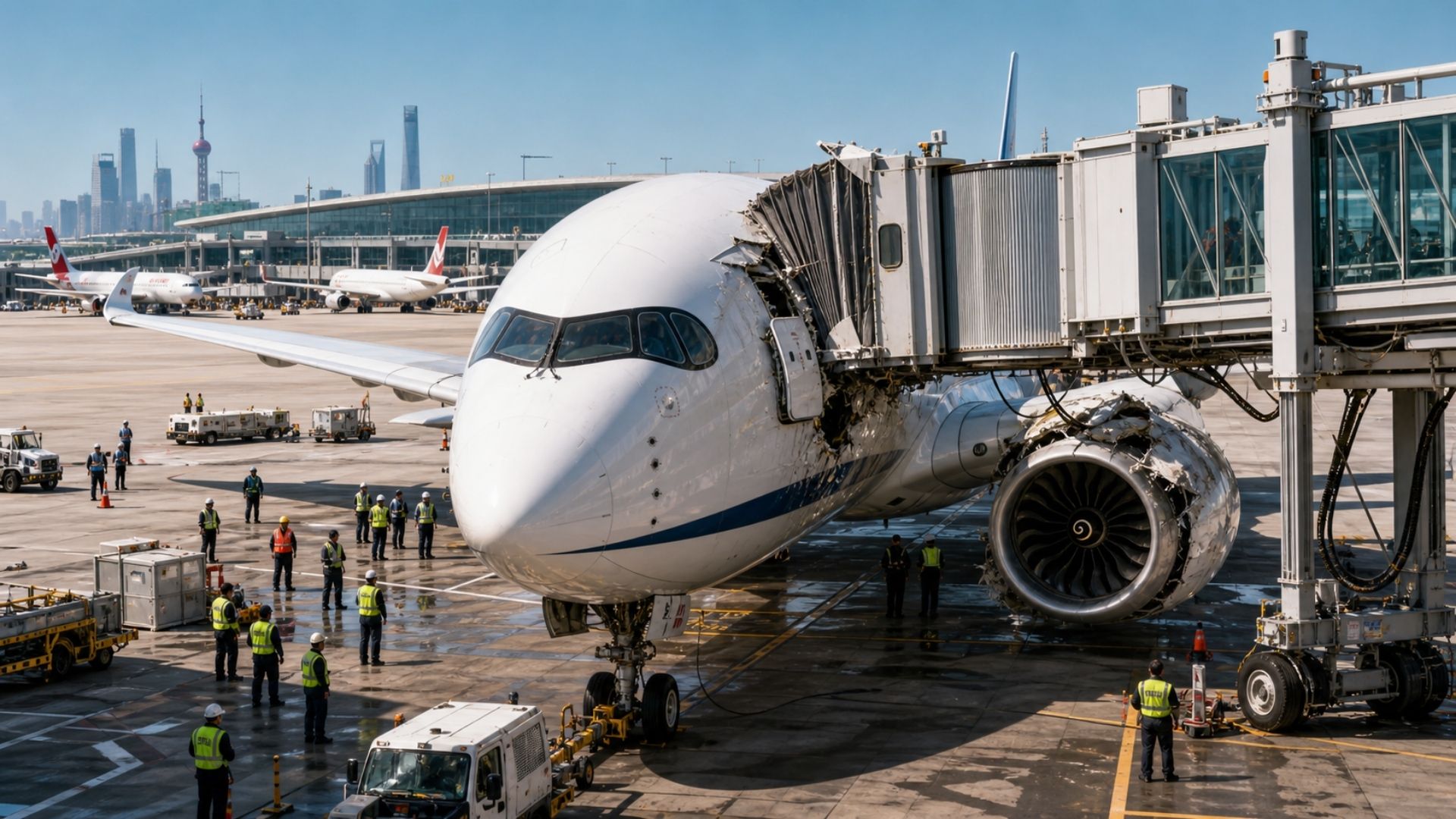

China Eastern Airbus A350 involved in incident with no injuries at Shanghai airport, hitting two boarding bridges during gate arrival, damaging a high-value Rolls-Royce engine and raising questions about the finger approach procedure
A China Eastern Airbus A350-900 hit two boarding bridges at Shanghai airport while arriving at the gate, in an incident that resulted in no injuries but significant damage to the aircraft. The impact affected the left wing area and directly hit one of the Rolls-Royce Trent XWB-84 engines, valued between US$25 million and US$35 million, a figure that could reach around R$150 million.
The case drew attention due to the aircraft’s size, the engine’s price, and the sequence of the impact recorded on video. According to the provided information, after the first collision, the Airbus reversed a few meters and then moved forward again, hitting the obstacles once more. The incident was recorded in Shanghai and has already led to the opening of an investigation to ascertain what happened during the arrival at the finger.
What happened to the Airbus in Shanghai

The Airbus involved in the incident was a China Eastern A350-900, one of the most modern and expensive aircraft in commercial operation. Images published on social media show the aircraft’s left wing touching the boarding bridges, also known as fingers in aviation.
-
Brazil Welcomes Spanish Wamos Air and Nigerian Air Peace, Potentially Transforming International Routes and Increasing Competition

-
Offshore air transport soars in Brazil, surpasses 2.5 million passengers, and reveals how oil has transformed Rio’s airports into key pieces of national logistics.

-
Latin America becomes the “global champion” of aviation taxes, tickets may become more expensive in Brazil, and IATA’s warning exposes risk for flights, tourism, and passengers.
-
Brazil has lost 85 air routes since 2019 and is still flying less than before the pandemic, leaving passengers with fewer destinations, fewer frequencies, and a more limited air network.


The impact occurred when the aircraft was already in the gate arrival procedure. In one of the recordings, the Airbus appears to touch the structure a first time, reverse, and then move forward again, causing a second collision. This detail increased attention on the incident’s dynamics and the possibility that the collision was not immediately perceived.
Why the affected engine draws so much attention
The affected engine was a Rolls-Royce Trent XWB-84, one of the most valuable components of the entire aircraft assembly. According to the provided information, this engine costs between US$25 million and US$35 million, a level that brings the potential loss to around up to R$150 million.
This data helps to gauge the financial weight of the incident. Even without injuries, a collision of this type goes beyond the idea of a simple ground touch or maneuvering error and comes to involve high-cost equipment, installed in a long-haul aircraft that is among the most sophisticated models in current commercial aviation.
The numbers that explain the size of the Airbus A350
The Airbus A350 is described in the information as a widebody, meaning a wide-body aircraft designed for intercontinental operations. It is an aircraft with a length of 74 meters and a wingspan of 64 meters, dimensions that help explain the complexity of ground maneuvers.
This size also shows why the final approach to the finger requires precision. In models of this size, small alignment differences can generate significant risks, especially in tight apron areas or when the stopping and guidance system is not suitable for the exact type of aircraft arriving.
How finger arrival works and where the problem can arise
The information explains that widebody aircraft like the Airbus A350 do not allow the pilot to visually, directly identify the distance between the wing and the finger. This reference needs to be provided by external support, either by an airport employee positioned in front of the aircraft, known as a marshaller, or by an electronic panel installed in the terminal.
It is precisely at this stage that critical failures can appear. Since fingers receive aircraft of different models and dimensions, a device adjusted for another type of aircraft can cause a problem. In an operation of this magnitude, any error in calibration, guidance, or reading can compromise the final approach and lead to collisions like the one recorded in Shanghai.
What the videos show about the impact sequence
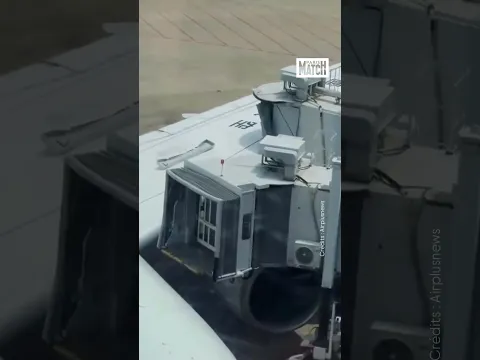

China Eastern Airbus hits finger in Shanghai and strikes Rolls-Royce during maneuver that opens investigation.
Recordings made from inside the aircraft and from other angles show the Airbus’s left wing coming into contact with the boarding bridge structure. The most important detail of the sequence is that, after the first hit, the aircraft reverses a few meters and then moves forward again, hitting the obstacles a second time.
This behavior became one of the central points of the case because it indicates that the first collision may not have been fully perceived at the time of the maneuver. As the source text highlights this possibility, the open investigation tends to look closely at the procedure adopted during gate arrival.
What the investigation will now ascertain
An investigation has been opened to identify the causes of the incident. The inquiry will seek to determine if there was human error, a ground guidance problem, an error in the calibration of the electronic stopping system, or another factor related to the aircraft’s docking procedure at the finger.
The central point will be to understand why an Airbus A350 reached the point of hitting the boarding structure twice during the same maneuver. As it involves a large aircraft and an impact involving a very valuable engine, the case is likely to receive detailed technical attention.
Why this case draws attention even without casualties
Ground accidents and incidents do not always gain widespread prominence, but this case brings together elements that greatly increase its repercussion. The first is the model involved, an Airbus A350, which is among the most advanced aircraft in commercial aviation. The second is the component hit, a Rolls-Royce engine valued at tens of millions of dollars.
Furthermore, the scene recorded on video amplifies the public impact of the episode. Seeing an aircraft of this size touch the finger twice during gate arrival transforms a technical event into a highly publicized case, especially as it involves an operation that, in theory, is highly controlled.
What this means in practice for airport operations
The incident reinforces how final ground maneuvers demand absolute precision, especially when involving wide-body jets. In aircraft like the Airbus A350, the margin for visual error is small, and reliance on external support is decisive in ensuring a safe arrival at the finger.
In practice, the case also focuses on guidance systems, the marshaller’s role, and the compatibility between ground equipment and aircraft type. When one point in this chain fails, the risk ceases to be merely operational and begins to involve high costs, network impact, and strong public exposure.
Do you believe that cases like this should lead airports to reinforce guidance systems for large aircraft upon arrival at the finger?