Portuguese
  Spanish


The New Intercontinental Missile DF-5C Was Presented in a Military Parade in Beijing, Promising to Change the Global Nuclear Balance with Its Unprecedented Range.
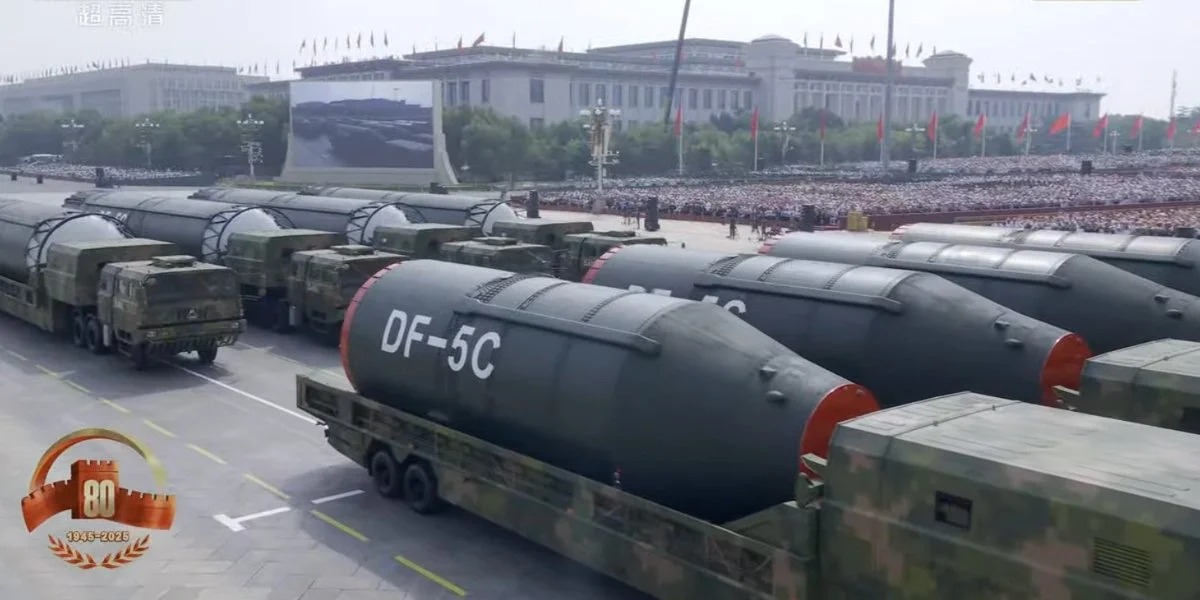
The recent military parade in China in Beijing revealed to the world the new intercontinental ballistic missile DF-5C, presented as “always on alert and capable of reaching anywhere on the planet.”
Displayed on three heavy transport vehicles, the weapon represents the latest evolution of the Dongfeng-5 series, which had its first test in 1980.
Unprecedented Power and Unprecedented Range
It is believed that the DF-5C can carry up to 10 independently targetable reentry vehicles (MIRVs) and reach more than 20,000 kilometers.
-
Lenovo Unveils Legion Y700 Tablet with RGB Backlighting, 5G, and SIM Card Support

-
World’s First Nuclear Hydrogen Unit Begins Operation: Copper-Chlorine Technology with Initial Capacity of 150 Liters per Hour, Aiming for 3,000 Liters per Hour
-
Mechanics Retrofit Old Fiat Uno with BYD Electric Motor for Silent, Low-Voltage Operation Reaching Nearly 60 km/h in Home Test
-
Free Internet Begins Testing in São Paulo Metro Stations, Network-Wide Rollout Expected by 2026


This range comfortably exceeds that of the United States’ Minuteman III, developed during the Cold War, which reaches about 13,000 kilometers.
The Challenge of Liquid Fuels
Liquid-fueled missiles, such as the DF-5C, can carry heavier payloads and reach greater distances.
However, they are notoriously difficult to keep ready for continuous use, as they depend on toxic and corrosive substances such as nitrogen tetroxide and asymmetric dimethylhydrazine.
Moreover, versions that use liquid hydrogen and oxygen require storage at extremely low temperatures, facing risks of leakage, metal fragility, and explosive vaporization.
Historically, this has forced armies to stockpile these missiles without fuel, undergoing a slow and dangerous refueling process before launch.
Innovation in Continuous Readiness
According to the South China Morning Post (SCMP), the DF-5C seems to circumvent these obstacles.
Close-up images from the parade showed a gray-silver and flexible material around the engine nozzles, possibly silicone or composite rubber.
Analysts suggest that this detail may indicate advancements in fuel storage or rapid refueling methods, allowing the missile to remain loaded and ready for long periods.
This represents a drastic change in the readiness doctrine of China, reducing response time and making satellite detection more difficult.
Strategic Value of the DF-5C
Despite the risks, liquid-fueled missiles continue to be valued for their ability to carry heavier warheads or multiple independent warheads.
When installed in reinforced silos, they become a vital part of the so-called second-strike capability, ensuring retaliation even after an initial nuclear attack.
Since its first nuclear test in 1964, China has maintained a “no first use” policy, promising to employ its weapons only in response to an attack.
Together with India, it is one of the two nuclear powers that still formally uphold this commitment.
Sign of Change in Nuclear Doctrine
The alleged capability of the DF-5C to remain ready at all times suggests a shift to a real-time deterrence model.
This would mean that China could respond immediately to any attack, anywhere on the planet.
Furthermore, the DF-5C represents a technological leap over the DF-5B, launched about ten years ago.
A defense expert in Beijing told the SCMP that detailed images of the new missile were released to “dispel doubts about China’s nuclear readiness.”
Repercussions on the Global Scenario
The DF-5C joins other modern heavy ICBMs, such as Russia’s Sarmat, capable of carrying multiple warheads, including hypersonic gliders.
Although solid-fuel missiles, such as China’s DF-61 and the U.S. Minuteman III, are preferred for their mobility and quick launch capability, the DF-5C offers much greater range and gigantic payload.
According to the SCMP, the new missile shows that Beijing has overcome historical limitations of liquid fuel, strengthening its position in the global nuclear balance.