Portuguese
  Spanish


A giant printer from the brand COBOD BOD2, operated by PERI 3D Construction, completed the ViliaSprint² in Bezannes, France, the largest 3D-printed concrete residential building in Europe. The giant printer erected the structure of 12 apartments distributed over three floors and 800 square meters in 34 working days, with only three operators controlling the system via tablet. The total schedule was three months shorter than conventional construction, and next to the printed building, an almost identical building was erected by the traditional method for direct comparison.
A giant concrete printer has just built the largest 3D-printed apartment building in Europe, and the numbers challenge everything the construction industry considers normal. The ViliaSprint², in Bezannes, France, was erected in 34 working days of printing, with only three operators on the construction site, compared to the initially planned 50 days and the six workers required by conventional construction. The giant printer COBOD BOD2 extruded concrete layer by layer to form the complete structure of 12 apartments over three floors and 800 square meters of living space, including support walls and all internal partitions.
The project was developed by Plurial Novilia, a subsidiary of Action Logement, as social housing. To validate the results, the company built an almost identical building next to it, using the conventional method, allowing direct performance comparison. The result confirmed that the giant printer reduced the total schedule by three months and material waste from 10% to 5%, in addition to saving approximately 10% in concrete volume thanks to the optimized curved geometry that is only economically viable with 3D printing.
The numbers delivered by the giant printer

Image: Cobod.com
The printing phase began in March 2025 and was completed ahead of schedule. The giant printer printed the entire structure in 34 working days, but if the layer height used had been 5 centimeters instead of the 2 centimeters adopted, the time would have dropped to just 14 days, according to Henrik Lund-Nielsen, founder of COBOD International.
-
More than 6,000 trucks poured nearly 70,000 cubic meters of concrete without interruption for 72 hours to create the largest continuous concrete pour in history and erect a megaproject in Saudi Arabia.

-
28-meter, 156-ton titans traveled 20,000 km from China to the port of Santa Catarina: Portonave received 7 fully electric megacranes, part of a R$ 210 million package, to double container handling.
-
They exchanged the idea of a large house for a 35 m² warehouse, spent US$ 12,000 on the structure, and created a tiny house in Colorado with space to live and work.

-
A newly opened terminal in the middle of the Amazon has begun transporting soy and corn through Amapá, eyeing the queue of ships that is congesting the ports in the South.

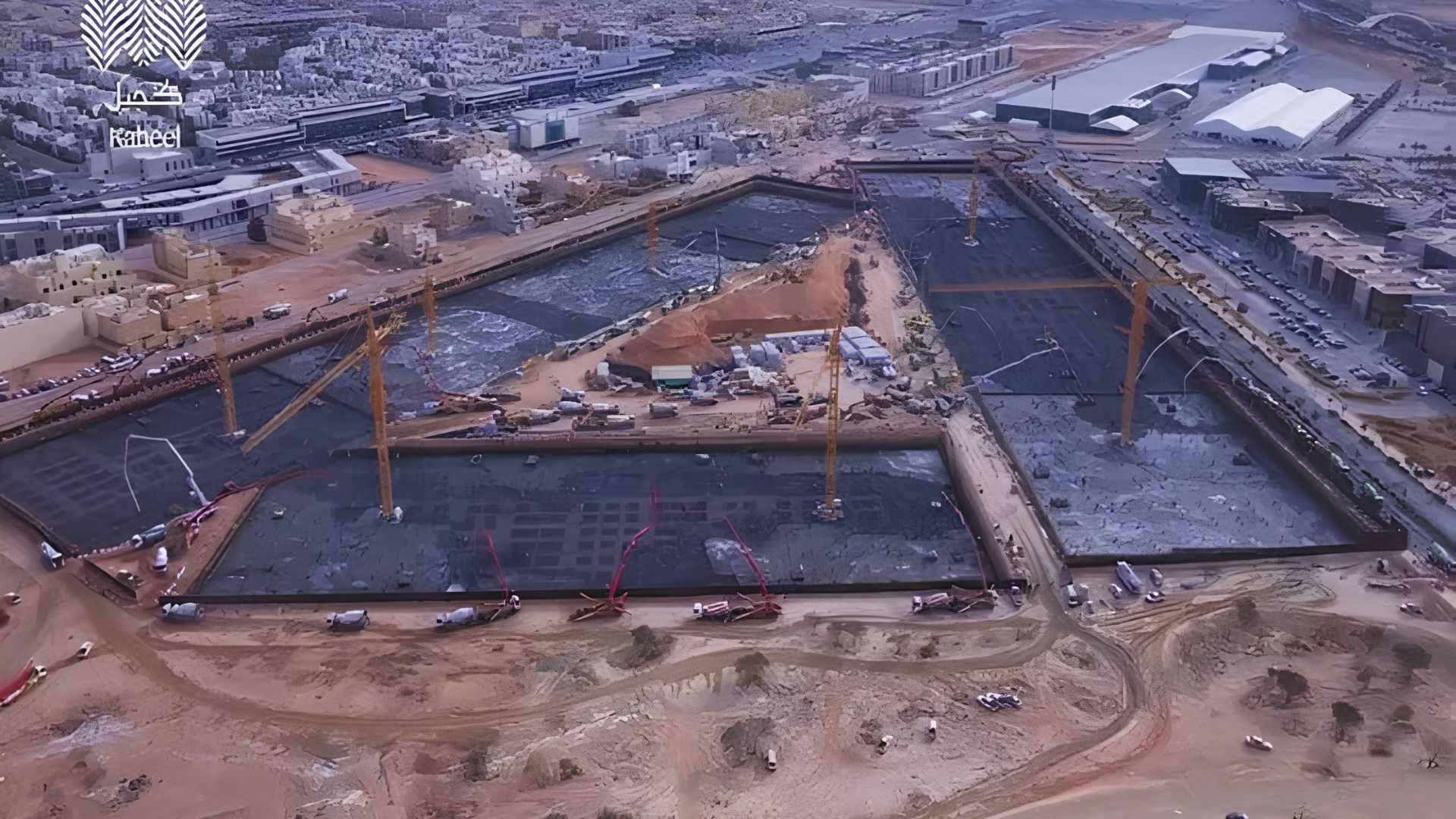


image: Cobod.com
Only three operators were needed on-site during the printing, compared to six for traditional construction of the structure. Workers control the giant printer via a tablet, eliminating manual heavy lifting and reducing the risk of musculoskeletal injuries. Jérôme Florentin, from Plurial Novilia, stated that the result “confirms the enormous potential of this construction method, which reduces construction time and improves working conditions on-site”.
The curved facade that only the giant printer enables
The rounded layout and curved facade of ViliaSprint² are features that would cost a fortune in conventional molds, but in 3D printing, they have no additional cost. The giant printer follows digitally programmed paths, and complex curves require the same operational effort as straight lines, eliminating the need for custom molds that increase the cost of unconventional geometries.
The optimized shape of the building also saved approximately 10% of the total concrete volume compared to an equivalent rectangular design. The printable concrete was supplied by Holcim, based on TectorPrint technology, reinforced with synthetic macrofibers, and formulated within the ECOPact line with CO2 reduction. On-site production eliminated transportation emissions that would be necessary to bring prefabricated panels from a distant factory.
Sustainability beyond the giant printer

image: Cobod.com
The ViliaSprint² integrates 500 square meters of photovoltaic panels, perlite insulation, wooden balconies, and a hybrid gas and heat pump system. The complex achieves about 60% energy self-sufficiency, in compliance with France’s RE2020/2025 goals for low-carbon buildings.
The combination of a giant printer that reduces waste and construction time with efficient energy systems positions the ViliaSprint² as a reference for the future of social housing in Europe. The building is not just a technological demonstration: 12 families will live in apartments built faster, with less environmental impact, and with the same structural safety as a conventional building.
The next step: 40 apartments with two giant printers
Plurial Novilia and its partners are already planning a subsequent project with approximately 40 apartments, using two giant printers simultaneously. The goal is to reduce printing time by four times and, through greater scale, match the costs to conventional construction, eliminating the last barrier to the massive adoption of the technology.
Johnny Huat, general director of Plurial Novilia, stated that “the ViliaSprint² demonstrates the potential of 3D printing for faster and more sustainable housing.” If the next project confirms economic viability on a larger scale, the giant printer that erected 800 square meters of concrete in 34 days may cease to be a novelty and become a standard tool on construction sites where speed, efficiency, and sustainability are priorities.
Would you live in a building erected by a giant printer in 34 days? What impresses you the most: the three operators with a tablet, the three months less of construction, or the curves that only 3D printing makes possible? Tell us in the comments.