Portuguese
  Spanish


China Invests in Megacanal of 134 Km and $58.8 Billion to Create New Maritime Route, Connecting Inland Cities and Boosting Its Dominance in Global Trade.
The Chinese government is advancing on one of the most ambitious projects in its recent history, creating an unprecedented maritime route to connect inland cities to the sea.
With an estimated investment of 58.8 billion reais, the country has been constructing the Pinglu megacanal since 2023, which promises to transform the transportation of goods and reinforce China’s position in international trade.
In total, the project will have a length of 134 kilometers and is expected to be ready to operate by December 2026.
-
YouTuber Discovers Surreal Collection in 400-Year-Old Italian Fortress Near Florence: 419 Anvils, Giant Walruses, Ancient Church, and WWII Tunnels

-
As Brazil Expands Social Welfare, Survey Reveals 40% Blame Poverty on Laziness, While 58% Cite Lack of Opportunities

-
Creative Uses for Toilet Paper Rolls That Will Change Your Perspective
-
Crab Trapped in Plastic Bottle for 62 Days Near Okinawa Highlights Little-Known Impact of Marine Pollution on Small Animals


Unlike what happens in Middle Eastern countries, where the search for skyscrapers dominates the headlines, China directs its efforts towards territorial integration.
The creation of extensive tunnels, colossal bridges, and now the Pinglu canal illustrates the country’s commitment to uniting distant regions and enhancing its logistical routes.
The canal stands out as the first major project of its kind since the founding of the People’s Republic of China, highlighting the strategic relevance of this investment for the Asian giant.
Pinglu Canal: Strategy for Dominance in Global Trade
The Pinglu canal emerges as a key element in the national strategy to dominate global trade.
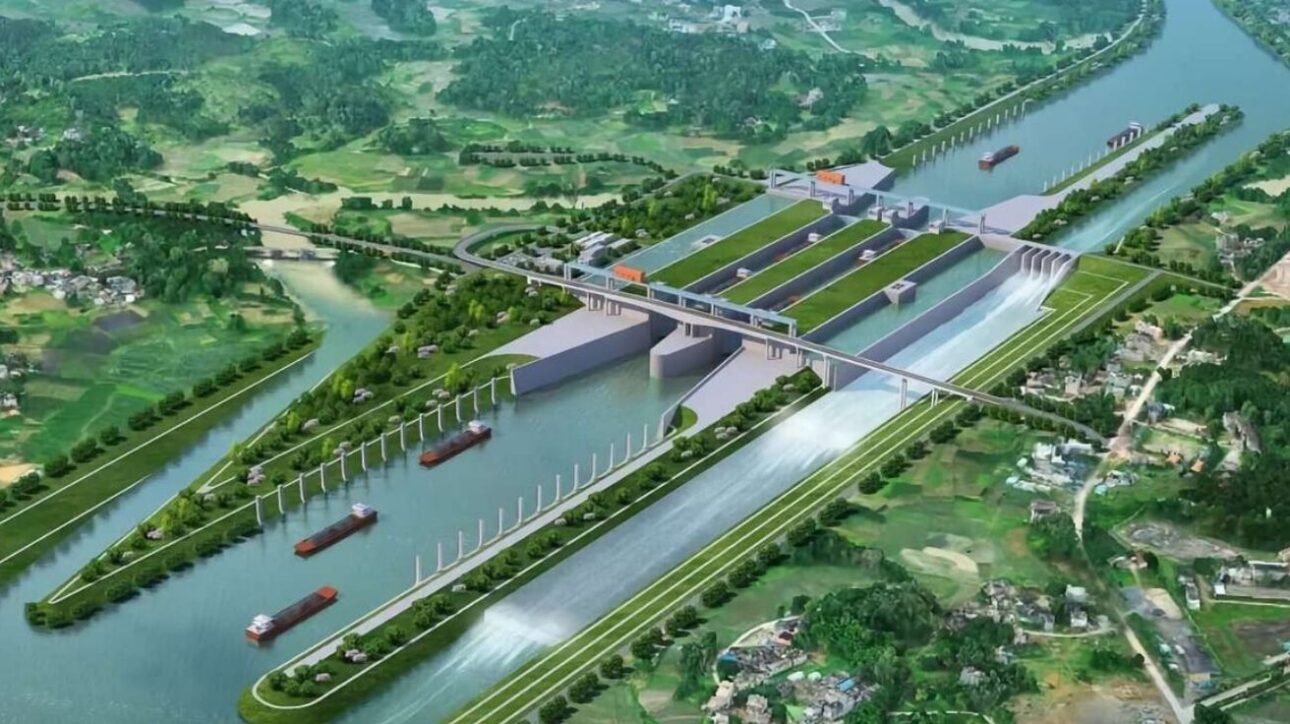
Located in the autonomous region of Guangxi, the project establishes a link between the Yu River and the Gulf of Tonkin, allowing direct access to the strategically important South China Sea.
The project reduces the distance covered by trucks in transporting goods by 560 kilometers, providing significant gains in time and logistical costs.
Constructing the canal required adaptations to over 127 kilometers of existing rivers and the excavation of only 6.5 kilometers of entirely new stretches.
To enable navigation, engineers needed to move more than 50 million cubic meters of material, and the expectation is that the total excavation will exceed 339 million cubic meters, which represents more than three times the volume of the Three Gorges Dam, another major Chinese construction.
In addition to the impressive dimensions, the Pinglu canal was designed to accommodate ships of up to 5,000 tons, with a maximum length of 90 meters, a width of 15.8 meters, and a draft of five meters.
The system will feature two locks, each 300 meters long and 34 meters wide, capable of overcoming height differences of up to 65 meters.
These modern structures are essential to ensure the swift flow of vessels and minimize waiting times during the journey.
Pinglu Megacanal: Technology and Accelerated Pace
From the start of planning to the forecast for operations to begin, the Pinglu megacanal is expected to be completed in just seven years, of which three are dedicated to intensive construction.
The choice of materials reflects concern about the durability of the infrastructure: the concrete used was specially developed to resist seawater erosion for over a century, which reduces the need for frequent maintenance.
Despite technological advancements, the project faces criticism from environmental specialists.
The canal passes near mangrove areas, sensitive ecosystems that may be affected by increased earth movement and changes in water flow.
According to environmental organizations, there is a risk to local biodiversity, especially aquatic species and vegetation typical of these regions.
The discussion about the balance between economic progress and environmental preservation remains at the forefront as construction advances.
Cost Reduction and Commercial Integration
Although the ships capable of navigating the Pinglu canal are smaller than those used in the Panama and Suez canals, the main goal is to connect inland cities to the coast, facilitating the transportation of goods to major Chinese maritime ports.
From these ports, products head towards markets in Asia, Africa, and Europe, in alignment with the New Silk Road, a geopolitical and commercial project led by President Xi Jinping.
It is estimated that the new route will enable an annual savings of $725 million in cargo transportation, a significant amount considering the costs involved in long-distance logistic operations by road and rail.
Moreover, the canal will help alleviate traffic in key industrial hubs of China, enhancing the efficiency and competitiveness of the country on the international stage.
The impact of the Pinglu megacanal goes beyond cargo transportation.
The infrastructure is expected to help improve water resource management, optimizing irrigation of crops and reducing the risk of flooding, recurring problems in some inland regions of China.
Thus, the canal is part of a broader policy of regional development, aiming to boost the economy and provide new opportunities for the local population.
The Pinglu Canal in the Global Scenario
The Pinglu canal is not the only hydro-integration project underway in China.
The country invests in other corridors, such as the Kra canal in Thailand, to bypass bottlenecks like the Strait of Malacca, and in various internal waterways, such as the Zhejiang-Jiangxi-Guangdong, Jinghan, and Xianggui canals.
Such initiatives aim to connect industrial centers to external markets, strengthen sectors like steel, and promote more sustainable transportation practices.
In addition to logistical and economic aspects, the construction of the Pinglu canal reinforces China’s prominence in the race for dominance in global trade.
The bet on large infrastructure projects highlights the country’s search for alternative and diversified trade routes, reducing dependence on traditional paths and increasing its resilience against potential trade barriers or geopolitical conflicts.
Given the magnitude of this undertaking, experts and international observers are closely monitoring the impacts of the Pinglu canal on global trade dynamics and the reorganization of production chains.
Will this new maritime route created by the Asian giant truly consolidate Chinese dominance over global trade in the coming years?