






 Portuguese
  Spanish


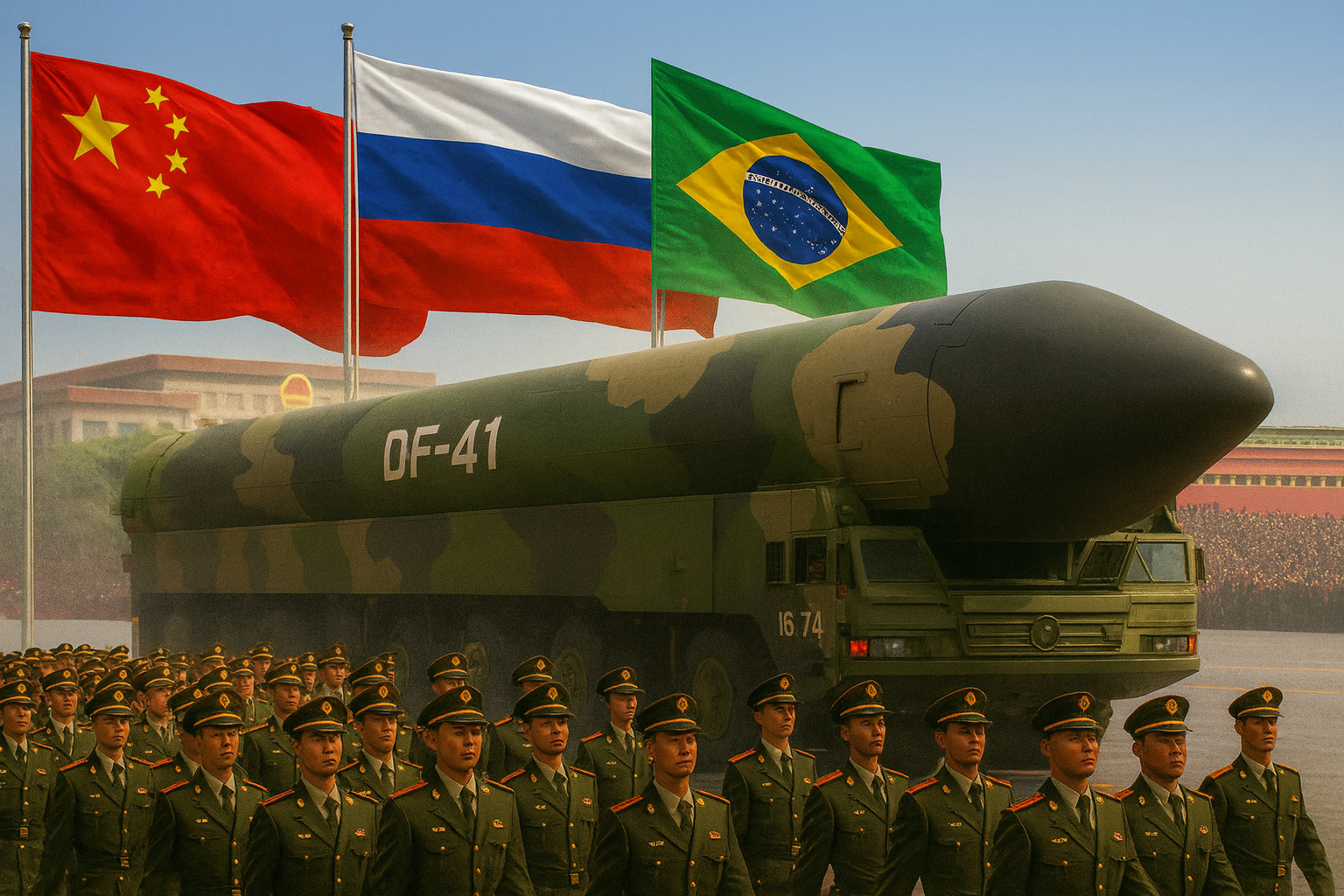


With Vladimir Putin and Kim Jong-un Next to Xi Jinping, the Event Was More Than a Celebration: It Signaled a Multipolar Order in Formation and Raised Alerts That Could Impact the Global Energy Market and Brazil’s Position
On September 3, 2025, China held the largest military parade in its history in Beijing. There were over 10,000 soldiers, 100 aircraft, and hundreds of vehicles showcasing advancements of the People’s Liberation Army.
The parade, held “in memory of the 80th anniversary of victory over Japan in World War II,” was accompanied by 80 cannon shots at the start and 80,000 white doves at the end, a calculated sequence to show that peace can only be sustained through strength.
The presence of Vladimir Putin and Kim Jong-un beside Xi Jinping Elevated the Geopolitical Tone. As described in the original account, Kim expressed support for Russia in the war against Ukraine, and Putin thanked him. The visual message: a multipolar order where the West is no longer the center.
-
Brazil’s 2026 Tax Refund: Record 9.58 Million Filers in Largest Payout Ever, But a Key Detail on Priority Recipients Draws Nationwide Attention

-
Itaú Alters Hybrid Work Model, Increasing Office Days from 2028, Prompting Employees to Adjust to New Routine
-
Facing Labor Shortage, Japan Plans to Invest $34 Million to Attract Foreign Workers in Construction, Healthcare, Industry, and Commerce

-
Brazilian City Makes Remarkable Leap, Becomes 4th Wealthiest in the Country with GDP of R$ 134.1 Billion




Xi’s Speech: Multipolarity, Global Governance, and the Promise to Reform the Rules
On stage, Xi Jinping contrasted, without naming names, the Western model and advocated for multipolarity and dialogue as pillars. The highlight was the Global Governance Initiative (GGI), which proposes equality among states, respect for UN norms, and updating international rules for AI, cyberspace, and space exploration. The proposal does not break with existing institutions but attempts to reshape them from within, giving prominence to the Global South.
The image of Putin and Kim alongside Xi, however, relativized the speech. For those following energy and geopolitics, this contrast matters: strategic alliances influence shipping routes, supply chains, and the security of oil and gas transport.
Arsenal and Technology: What Was Shown and Why It Matters in the Market
The parade showcased new ICBMs (DF-61) with hypersonic warheads, missiles exceeding Mach 5, underwater drones, autonomous fighters, laser weapons on trucks and ships to take down drones, as well as electronic warfare systems against satellites. The American press highlighted the range reaching US territory and noted that part of the arsenal remains classified.
For the oil sector, this is no minor detail: the greater the perception of geopolitical risk, the higher the freight insurance premium and the more volatile the barrel price. Anti-satellite systems and electronic warfare, if tested in a real crisis, could affect maritime logistics and cargo monitoring, critical for the global energy trade.
Where Brazil Fits In: Between the Farm of the World and the Negotiating Table
The text recalls that a large part of what Russians, Chinese, and Americans consume in food comes from Brazil, and our stock market stood out this year, aided by the depreciation of the dollar. In energy, the logic is similar: China is the largest destination for Brazilian commodities, the United States is a strategic ally in technology, and Europe remains a regulator and buyer.
This multipolar order is not an invitation to neutrality: it is an opportunity for negotiation. On one hand, there is the advantage of stable demand for commodities and the opportunity to demand technology transfer in refining, fertilizers, and logistics. On the other hand, there is a risk of pressure to “choose sides” in future crises, which could affect investments in gas, offshore oil, and equipment supply chains.
Here lies the turning point: Brazil cannot limit itself to being the world’s farm and gas station. It must use its relevance to demand industrial and technological counteroffers, as has already happened in other countries during moments of strategic repositioning.
In the end, the inevitable question for the Brazilian reader is: Should we accept the condition of exporters of basic inputs or is it time to demand technology, added value, and a real seat at the global decision-making tables?
Leave your opinion in the comments.








Até 1996 a CSN fabricava sim trilhos ferroviários e parou devido só desestímulo pelas ferrovias no Brasil e a importação predatória da china, ha relatos q muitos trilhos vindos da china implantados na ferrovia norte sul deram problemas de durabilidade! Não seria o caso de o nosso governo exigir a volta da fabricação???
Um país que não produz um metro sequer de trilhos ferroviários, sendo um dos maiores exportadores de minério de ferro do mundo só pode ser biruta.
Quem foi que disse que a China venceu o Japão na segunda guerra mundial? O Japão se rendeu após o ataque dos EUA e livrou a China do Japão.