






 Portuguese
  Spanish


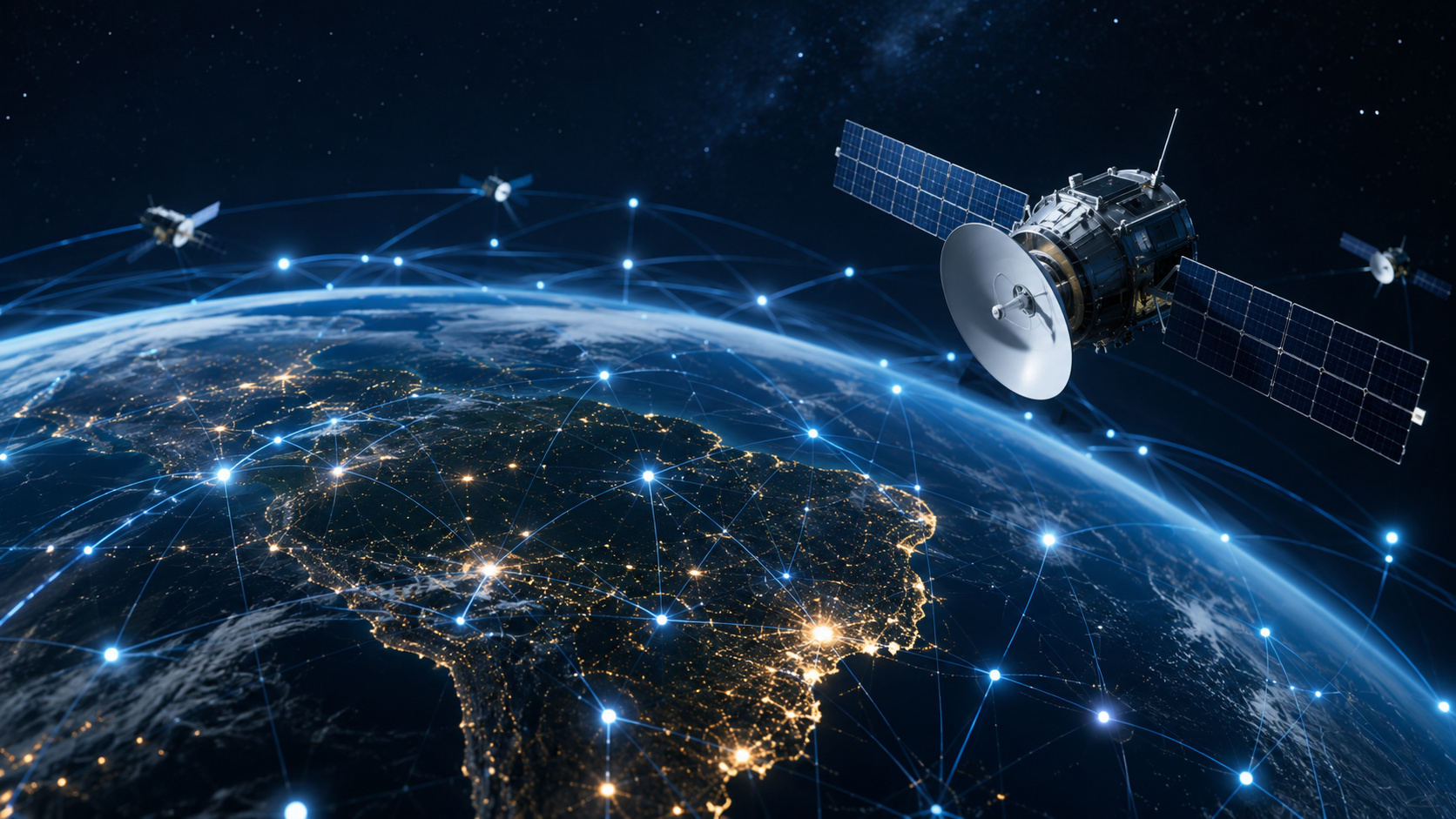

Study projects that LEO technology and satellite broadband can boost GDP, expand digital inclusion, and connect isolated regions.
The expansion of connectivity in Brazil may be entering a new phase. A report by Oxford Economics, commissioned by Amazon, indicates that low Earth orbit satellite-based internet could generate up to R$ 89 billion for the Brazilian GDP by 2035. The expected impact goes beyond connection: it involves productivity, jobs, infrastructure, and digital access.
According to a report published by Forbes on May 13, 2026, despite recent advances, significant gaps still exist. In 2024, only 76% of the rural population used the internet. Furthermore, many locations situated more than 25 kilometers from traditional fixed internet networks still face access limitations.
Satellite network gains space in Brazilian digital strategy
Connectivity has taken a central position in debates about economic growth and infrastructure. In this scenario, the expansion of the satellite network emerges as an alternative to expand coverage in regions where terrestrial infrastructure encounters obstacles.
-
Brazilian Researchers Develop Low-Cost Sensors to Detect Avian Flu in Minutes, Enhancing Global Health Security

-
545 Intact Amphorae Found 370 Meters Deep in Turkey Reveal Ancient Byzantine Trade Routes Connecting the Aegean and Black Sea

-
NASA to Send Astronauts Over 400 km Above Earth for 6.5-Hour Spacewalk to Repair Canadarm2 on the ISS

-
Microsoft Raises Xbox Prices Again Due to Rising Component Costs


Amazon’s proposal draws attention because it seeks to reduce historical inequalities and connect communities that remain outside the major technological corridors.
The Oxford Economics study shows that the impacts could reach different sectors of the Brazilian economy over the next decade.


LEO operates closer to Earth and changes the connection experience
The LEO technology operates differently from traditional models. Satellites orbit between 20 and 60 times closer to Earth compared to geostationary systems.
This difference reduces latency and makes browsing faster. In many cases, the experience can approach the conventional internet used in urban areas.
Another important differential is the resilience of the structure. Since the connection occurs in space, it may suffer fewer impacts from physical failures in terrestrial networks.
The expansion of LEO also expands possibilities for locations where building traditional infrastructure would be financially complex.

Satellite broadband can transform small businesses
The expansion of Broadband tends to create important opportunities for businesses, especially small and medium-sized ones.
According to the study, SMEs appear among the segments with the greatest growth potential. Continuous internet access allows for expanded operations and reduced geographical barriers.
Some benefits pointed out include:
- Expansion into e-commerce and new markets;
- Reduction of operational costs;
- Expanded access to financial services;
- Development of digital skills;
- Adoption of technologies such as artificial intelligence and the internet of things.
The presence of Broadband can also accelerate processes in productive areas important to the economy.

Agriculture, logistics, and energy can register significant gains
Technological advancement should not be restricted to large cities.
Strategic sectors can take advantage of connected tools to enhance operational efficiency. Remote monitoring, automation, and data analysis are already part of this transformation.
Among the segments mentioned by the study are:
- Precision agriculture;
- Connected logistics;
- Intelligent energy systems;
- Real-time monitoring.
The evolution of the satellite network can also support operations in regions far from major urban centers.
Brazilian GDP could receive a billion-dollar boost by 2035
The report presented by Oxford Economics works with three growth scenarios for technology adoption.
In the incremental scenario, approximately 5.9 million users would use satellite-enabled internet in about 2.2 million households. In this model, the GDP could receive approximately R$ 12 billion in economic gains, in addition to supporting 87 thousand jobs.
In the intermediate scenario, the numbers advance to 8.9 million users in 3.3 million households. In this case, the GDP could reach up to R$ 51 billion and support almost 370 thousand jobs.
The transformative scenario gathers the most significant numbers. Approximately 14 million users distributed in 5.1 million households could boost up to R$ 89 billion in economic activity.
Furthermore, the GDP could reflect indirect gains related to increased productivity.
Digital inclusion can reduce historical barriers
The expansion of digital inclusion involves not only internet access. It also creates opportunities in essential areas of daily life.
Schools can expand access to educational platforms, digital content, and remote learning tools. In the health area, telemedicine services can bring specialists closer to more isolated communities.
The advancement of digital inclusion also strengthens access to public services, professional qualification, and economic opportunities. Sector studies indicate that reducing digital distances can change local realities over the coming years.
The future of Brazilian infrastructure has already begun
The data presented by Oxford Economics and Amazon indicate that space infrastructure can gain a strategic role in Brazil. The expansion of LEO, Broadband, and the satellite network shows that the topic has ceased to be just a technological discussion.
If the projected scenarios materialize, millions of Brazilians will be able to access digital services, strengthen local businesses, and expand opportunities through digital inclusion.
More than a technological change, the transformation represents a new stage for economic development, productivity, and sustainable growth.
With information from Forbes


