






 Portuguese
  Spanish


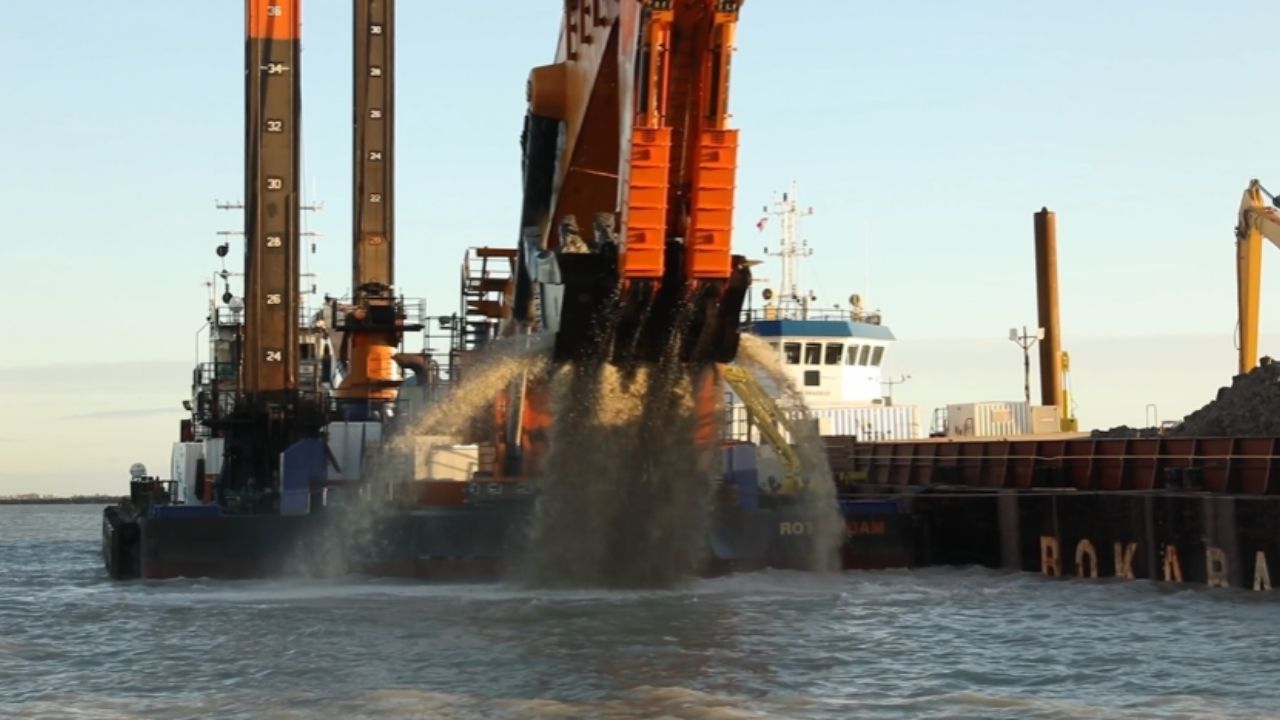


The Fehmarnbelt tunnel entered a new era with the immersion of the first of 89 gigantic concrete elements into the seabed, in an unprecedented engineering operation that will create the world’s longest immersed tunnel and drastically shorten travel time between Denmark and Germany
The Fehmarnbelt tunnel reached its first major milestone physically completed after the successful installation of the first concrete element on the seabed, in an operation that began late on Monday, May 4, 2026, off the Danish coast. The block left the tunnel factory in Rødbyhavn, on the Danish island of Lolland, and was transported by five tugboats and the special immersion vessel IVY to the lowering point in the Fehmarn Strait.
According to Femern, what makes this tunnel so impressive is not just its scale, but the way it is being built. The first of the 89 concrete elements, each 217 meters long and weighing over 73,500 tons, was precisely positioned in a trench on the seabed, in front of the Danish portal. When the work is completed, the crossing can be done in just 10 minutes by car and 7 minutes by train, transforming mobility between Denmark and Germany and creating a new backbone for European transport.
The tunnel’s first immersion marked an unprecedented moment
The operation was neither quick nor simple. After several days of work, the immersion phase began around noon on Wednesday. Approximately 14 hours later, the first element reached its exact position on the seabed and was connected to the Danish portal by hydraulic arms.
-
Humanoid Robots Begin Replacing Factory Workers in China, Working 64-Hour Shifts and Driving Industrial Automation Forward

-
Miniature Nuclear Reactor to Be Installed in South Wales, Powering 20,000 Homes and Reviving UK’s Nuclear Industry After Nearly 50 Years

-
San Andreas Fault Reaches “Highest Tension in 1,000 Years,” Raising Fears of the “Big One,” but New Study Identifies Key Zone Near Los Angeles Influencing Earthquake Impact

-
French Scientists Set Sail on Ice-Trapped Ship for 18-Month Arctic Climate Study


Subsequently, the position was confirmed by laser measurements inside the submerged element itself. It was a historic moment because, for the first time, mass-produced tunnel elements of this size are being used in such a construction. This is not just another construction phase, but a real test of a solution that had never been applied on this scale before.
The tunnel blocks are concrete giants designed for highway and railway

Each standard element of the tunnel is a massive hollow concrete structure. The foundation states that these blocks are 217 meters long and weigh over 73,500 tons, numbers that help explain why the operation required so many days, specialized equipment, and absolute precision.
These elements are divided into five tubes, with two for the future highway, two for the railway, and one for technical installations. In practice, each block is born as a functional part of the tunnel, ready to fit into a submerged network that will be assembled piece by piece over the coming years.
How the tunnel was fixed to the seabed
After the element was placed in the correct position, the operation did not end. The plan foresees another special vessel depositing large quantities of gravel along the sides of the structure, ensuring it remains firmly in place.
This detail shows why the tunnel depends on such rigorous technical choreography. It’s not enough to lower the block and fit it. It’s necessary to stabilize it, confirm alignment, and prepare the ground for connection with the next elements. Each immersion requires naval engineering, hydraulic precision, and geotechnical control to function as a single machine.
What still needs to be done for the tunnel to be ready

The first element was just the beginning. The foundation states that, in the coming years, the remaining 88 elements will be immersed one by one and connected in a trench excavated in the seabed, up to 40 meters below the sea surface.
When all are installed, the Fehmarnbelt tunnel will be 18 kilometers long, becoming, by a wide margin, the longest immersed tunnel in the world. It is precisely this combination of length, construction method, and serial production that makes the work seem almost unbelievable even by European infrastructure standards.
The tunnel’s impact goes beyond crossing between two countries
Although the direct connection between Denmark and Germany is already a huge achievement, the project was conceived as something greater than a simple binational connection. The foundation highlights that the Fehmarnbelt tunnel is part of Europe’s future transport network, aiming to strengthen trade, mobility, and security on the continent.
The European Commission treated the work as a priority project and allocated approximately 1.3 billion euros for its construction. This shows that the tunnel is not merely seen as local infrastructure, but as a strategic piece of a more integrated and faster European network.
What changes in the European transport map

When the tunnel is completed, crossing the Fehmarn Strait will drop to 10 minutes by car and 7 minutes by train. Furthermore, rail connections between Copenhagen and Hamburg can be made in 2 and a half hours, compared to the current 5 hours.
This time reduction helps explain why the project attracts so much attention. It is not just a monumental engineering feat, but an intervention capable of redesigning economic and logistical distances between important cities in Northern Europe. What today requires more time, planning, and slower crossings will operate with much greater fluidity.
Denmark, Germany, and Europe treat the tunnel as a historic landmark

The symbolic weight of the operation was clearly evident in official statements. Mikkel Hemmingsen, CEO of Sund & Bælt, stated that the technology, equipment, and contractors demonstrated the capacity to achieve something unprecedented, classifying the moment as very important for the project, for Denmark, for Germany, and for Europe.
Apostolos Tzitzikostas, European Commissioner for Sustainable Transport and Tourism, also described the immersion of the first tunnel element as a historic achievement and stated that the world is witnessing the best of European engineering and construction. This reaction shows that the work has already transcended the technical field and also entered the realm of a continental symbol.
The tunnel began to take shape with one block, but already carries the ambition to change an entire region
Works of this magnitude are usually imagined as maps, projections, and schedules. What happened now was different. The tunnel began to take shape on the seabed, with concrete, tugboats, hydraulic arms, laser, and tons of precision.
The first successfully submerged element concludes nothing on its own, but changes everything in the project’s perception. From this point on, the tunnel ceases to be merely an engineering promise and becomes a real structure, already installed on the seabed, paving the way for one of the most impressive submerged connections in global infrastructure.
If the first block has already been successfully installed and the next 88 are yet to come, will the Fehmarnbelt tunnel merely be remembered as an engineering feat or can it truly change how Europe connects for centuries to come?








About 80% of Denmark is already connected to Germany by being part of the same landmass. Copenhagen is on an island connected to the rest of Denmark and Sweden by bridges. Apart from prestige don’t really see the point