Portuguese
  Spanish


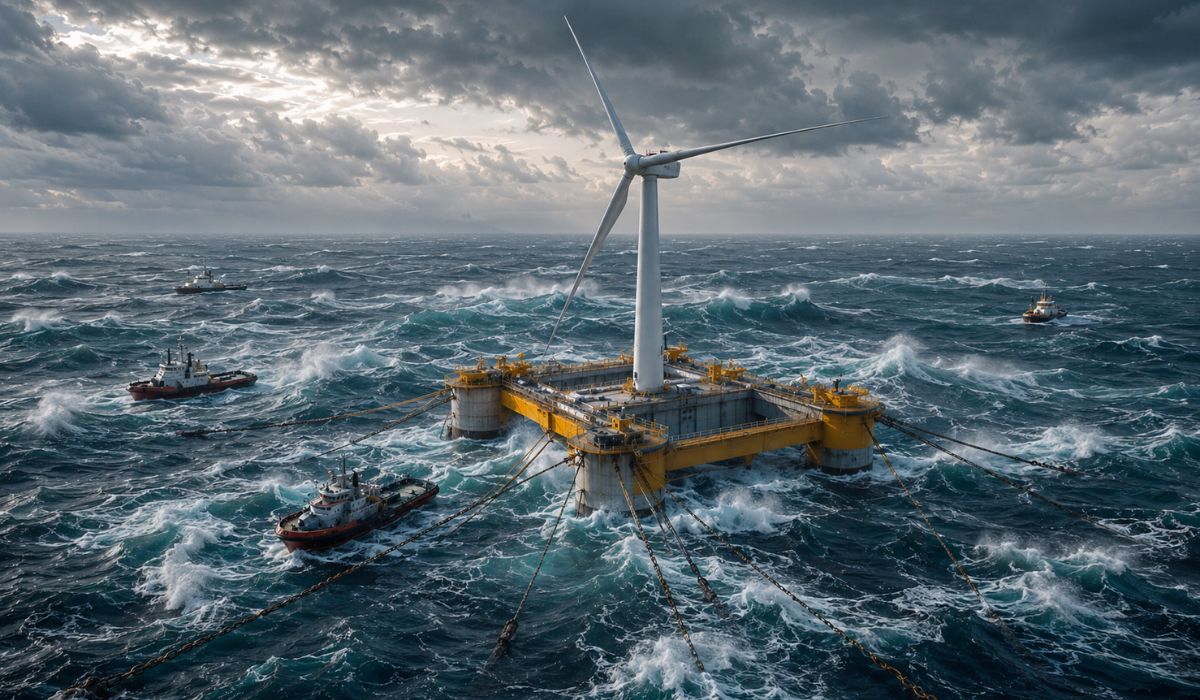


Floating wind platform installed in China brings together unusual figures, offshore technology, and engineering solutions aimed at deep-water power generation, in a project that stands out for its size and offshore operation.
China has installed a **24,100-ton** floating wind platform offshore, anchored to the seabed by **nine suction anchors**, in an operation linked to the advancement of deep-water power generation.
The structure, named Sanxia Linghang, or Three Gorges Pilot, was installed on **May 2, 2026**, in the Yangjiang region, Guangdong province, according to information from **China Three Gorges Corporation cited by the specialized portal Offshore Wind**.
The unit is located more than **70 kilometers offshore**, in an area with a depth exceeding **50 meters**.
-
EcoFlow’s Portable Fridge Offers 43 Hours Off-Grid, Reaches -25°C, App-Controlled, Solar-Powered for Camping and RV Adventures

-
Vietnamese Inventor Overcomes Debt and Develops Agricultural Robot Sold in 15 Countries
-
3,000 Sheep Maintain 900 MW Solar Farm Transforming Texas Fields into Energy for Data Centers

-
Distant Galaxy Shaped Like a Giant Jellyfish Sheds Gas, Forming New Stars as It Moves Through Hot Cosmic Gas


Unlike offshore turbines fixed directly to the seabed, the equipment was mounted on a semi-submersible base, which floats and remains anchored to the bottom by a mooring system designed to operate in a marine environment.
16 MW Floating Wind Platform
According to China Three Gorges, the platform has **16 megawatts of power** and was presented by the company as the largest single-unit floating wind platform ever installed.
The formulation refers to the single-unit model, as other Chinese projects have greater total power or different configurations, such as OceanX from Mingyang Smart Energy, with two turbines, and the Qihang prototype from CRRC.
The Sanxia Linghang combines a large-scale turbine, a semi-submersible floating foundation, a mooring system with polyester ropes, and a dynamic **66 kV** submarine cable.

According to the developer, the assembly was designed to allow operation in areas further from the coast, where the installation of fixed structures tends to be more complex due to depth.
24,100-ton Structure and 252-meter Rotor
The scale of the structure is evident in the technical figures released about the project.
The platform measures **80.82 meters in length** by **91 meters in width**, with a displacement of **24,100 tons**, while the turbine rotor has a **252-meter diameter** and a swept area equivalent to about seven standard football fields, according to descriptions published by Chinese media.
The height also draws attention due to the equipment’s size, but the data is technical, not just visual.
The blade tips can exceed **270 meters**, according to information released by Chinese state media and specialized offshore energy outlets.
This type of configuration allows the turbine to capture wind over a larger area, in line with the operating logic of large-diameter wind turbines.
Nine Anchors Secure the Structure to the Seabed
The anchoring system is one of the central parts of the project.
The platform uses **nine suction anchors** on the seabed, connected to the structure by chains and high-performance polyester ropes.
According to Xinhua, this type of polyester rope was applied for the first time in China’s offshore wind sector.
The choice of material is related to the platform’s behavior at sea.
According to the technical description published by Xinhua, the polyester ropes can deform elastically when the unit is impacted by waves, absorbing part of the energy and reducing the transmission of rigid forces to the structure.
The text also states that each rope can withstand up to **1,300 tons of tension**.


Active ballast and dynamic submarine cable
In addition to moorings, the project uses an active ballast system.
On floating platforms, ballast helps control the position and inclination of the structure by distributing water in internal compartments.
In the case of Sanxia Linghang, the system automatically adjusts the amount of water in three columns to control the platform’s posture during operation, according to China Three Gorges and Chinese state media.
Electricity generation also requires a connection adapted to the structure’s movement.
As the platform is not fixed, the submarine cable needs to accommodate variations caused by waves, currents, and wind.
For this, the project uses a dynamic 66 kV cable, with a wave-shaped design and protection measures against excessive bending, according to information released about the installation.
Towing operation to Yangjiang
Before installation in Yangjiang, the platform was assembled in Beihai, Guangxi region, and towed to the offshore area where it would be anchored.
Industry reports indicate that the unit arrived on site on April 20, 2026, with the completion of mooring hook-up on May 1st and final installation the following day.
The operation mobilized specialized vessels for transport, lifting, and offshore fastening.
Information published by Chinese media cites the use of national equipment and installation technology aimed at deep-water wind power projects, including methods for driving and monitoring suction anchors.
Project succeeds another floating platform from China Three Gorges
The project succeeds the Sanxia Yinling, or Three Gorges Leader, the previous floating unit from the same developer.
According to China Three Gorges, the new platform has nearly three times the capacity of its predecessor, in addition to a reduction of over 50% in cost per kilowatt and the use of locally manufactured key equipment.
As this data is disclosed by the company itself, the information depends on operational monitoring and independent records for commercial-scale comparison.
When it enters operation, the developer’s forecast is that the turbine will generate approximately 44.65 GWh per year.
This estimate is equivalent to approximately 44.65 million kWh annually, a volume that, according to the company, could supply about 24,000 families of three people for one year.

Deep-water offshore wind energy
The installation occurs in a context of expanding floating wind projects in China.
In 2024, Mingyang Smart Energy installed the OceanX platform, of 16.6 MW, at the Qingzhou IV offshore wind farm, also in Yangjiang.
In the same period, CRRC installed the Qihang prototype, of 20 MW, in Shandong, intended for testing.
In the offshore energy sector, floating platforms are developed for areas where depth makes the use of fixed foundations difficult.
This model allows turbines to be installed in locations further from the coast, but also requires specific solutions for stability, electrical transmission, maintenance, corrosion, and resistance to severe sea conditions.
In the case of Sanxia Linghang, the company reports that the structure was designed to withstand waves over 20 meters and winds of up to 73 meters per second.
These parameters were disclosed by Chinese media based on project information, but continuous operation of the platform will still be necessary to evaluate its performance under real conditions over time.
The image of a 24,100-ton platform towed offshore and held in place by nine anchors summarizes a technical stage of China’s offshore wind expansion.
Without relying on a fixed foundation on the seabed, the unit will now test, on a real scale, solutions for flotation, mooring, ballast, and electrical transmission for large-scale turbines.

The deployment of Sanxia Linghang also shows how offshore wind generation is no longer limited to shallower coastal areas.
As floating platforms advance, projects of this type can expand the dispute for maritime regions with more constant winds, provided that costs, maintenance, and operational safety are proven over long operating cycles.