






 Portuguese
  Spanish
  5 min of reading
  0 comments


The school project attracted attention by combining KT board, carbon fiber reinforcements, and minimal adjustments to the wings and center of gravity to make a giant aircraft inspired by a paper airplane take off with stability.
A group of students from Shenzhen Zhili Middle School, in Shenzhen, China, attracted attention by creating a remote-controlled paper airplane with a wingspan of 6.06 meters and a fuselage of 5.06 meters.
The project, led by student Zhu Junjie, took almost six months, went through prototypes, precision adjustments, and ended with a flight of almost 15 minutes on the school field. According to Oddity Central, the feat entered the Guinness. However, Chinese sources cited in the research, such as Shenzhen News, Sina/Fast Technology, and HK01, treat the case as a formal attempt at global recognition in the process of certification.
Giant paper airplane was born inside a school in Shenzhen
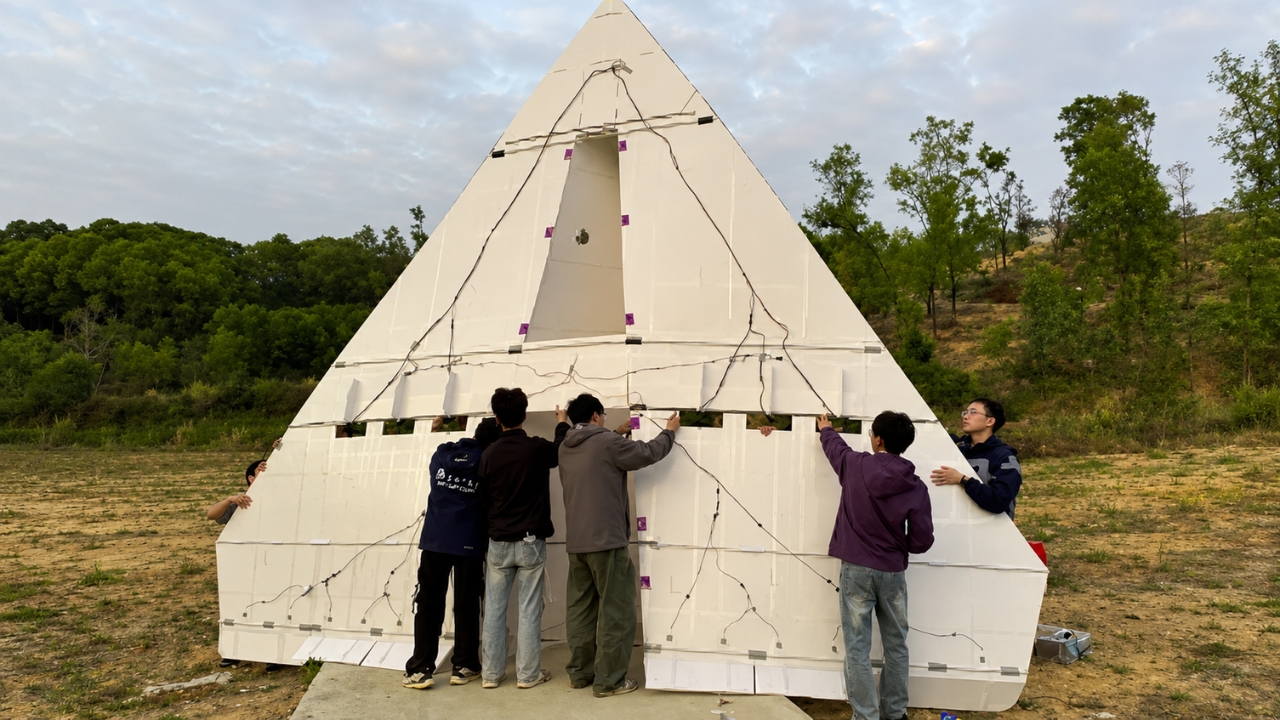
The scene seems simple at first glance. A group of students pushes a huge white airplane, it gradually gains speed, takes off, flies steadily, and lands in front of classmates and teachers.
-
He started with a jigsaw, his father’s screwdriver, and many drawings made during classes; years later, the young man who built a roller coaster in his own backyard went viral on the internet, was hired by Cacau Park, and now coordinates Brazilian and foreign professionals in the installation of an attraction weighing 737 tons, 55 meters high, one kilometer long, featuring moments of zero gravity and a speed of 120 km/h, in a journey that turned curiosity, calculations, and persistence into a professional career.

-
Between Egypt and Sudan, Bir Tawil is no man’s land that neither country wants on paper, but in practice has gold mining, nomadic tribes, and even fake “kings.”

-
Swimming champion Shavarsh Karapetyan dove about 40 times into a frozen lake in Armenia to rescue a sunken bus, saved 20 lives, and lost his career because of it.
-
Júlia Pimentel, an 11-year-old from Minas Gerais, independently invented a new formula to calculate the square root using simple addition and multiplication, and her method was published in one of the most important mathematical scientific journals in Brazil.


But what happened on the Chinese school field was not just an enlarged-scale prank.
According to Shenzhen News, the airplane was created by students from Shenzhen Zhili Middle School, an institution that maintains a strong structure focused on science, technology, and innovation. The school is also linked to high-standard laboratories, simulators, and aeromodelling activities.
The central character of the story is Zhu Junjie, a first-year high school student in China, pointed out as the chief designer and pilot of the project. He is part of the school’s aeromodelling club and already had experience in aeronautical design competitions.
Six months of testing to make 6 meters take off
The most impressive number is not just in the size. It’s in the time required to make an apparently simple idea work.
According to information gathered by Shenzhen News and reproduced by outlets like Sina/Fast Technology and HK01, the group worked for almost six months to transform the concept into a controllable aircraft.
In the beginning, the team thought about enlarging a common 1-meter model to a much larger scale. Practice showed that this was not enough. When the airplane grows, everything changes: weight, rigidity, lift, center of gravity, power, and control response.
The group went through three generations of prototypes and more than ten aerodynamic adjustments to reach the final model, with a 6.06-meter wing and a 5.06-meter fuselage.
One degree on the wing and one centimeter in weight changed the flight
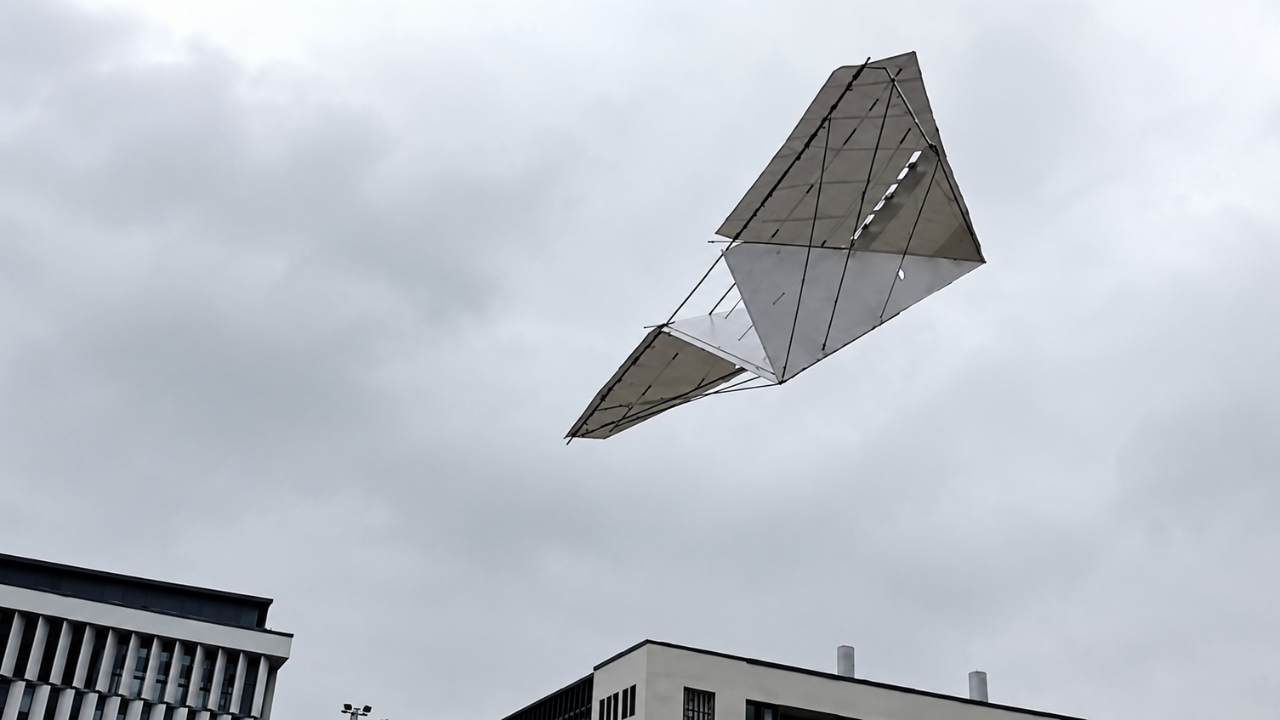
The detail that best summarizes the technical difficulty of the project is in the precision of the adjustments.
According to Shenzhen News, the students realized that a change of just 1 degree in the wing surface could change the airplane’s lift. Similarly, shifting the center of gravity by just 1 centimeter already directly affected stability.
This type of sensitivity shows why the case gained attention outside of China. It was not about making a large airplane look nice in a photo. It was necessary to make the structure take off, maintain stable flight for several minutes, and land in a controlled manner.
The team also had to deal with the relationship between thrust and weight. Chinese sources mention that the thrust needed to exceed a ratio of 0.7 for the aircraft to be able to take off with difficulty.
Light material, carbon reinforcement, and deformation problem
Despite being called a paper airplane, the project was not a common sheet folded into a giant size.
Chinese sources report that the students used KT board, a lightweight material widely used in models and experimental structures. The problem is that, on such a large scale, this type of material can deform easily.
To compensate, the students reinforced important areas with carbon fiber strips, seeking a combination of low weight and strength. This detail helped maintain the shape of the wings and prevent the structure from losing stability during flight.
Professor Zou Guoyun, responsible for the aeromodeling club, appears in Chinese sources explaining that the scale was the biggest challenge. In such a large airplane, small imperfections cease to be details and become decisive in whether it flies or falls.
Oddity Central talks about a record, Chinese sources mention certification
Oddity Central reported that Chinese students set a new Guinness World Record with the largest remote-controlled paper airplane.
However, in the submitted research, the Chinese sources closest to the case take a more cautious approach. Shenzhen News, Sina/Fast Technology, and HK01 talk about an attempt at a record, preparation of flight data, and seeking certification.
Therefore, the safest reading is to present the achievement as a project that, according to Oddity Central, entered the Guinness, while the Chinese sources treat the recognition as a formal step in progress.
This difference does not diminish the strength of the story. On the contrary, it helps to show how a school project moved beyond the internal school environment and began circulating as a possible world record.
What seemed like a joke turned into an engineering laboratory
The case draws attention because it takes an object known to any child, the paper airplane, and transforms it into an experiment in aerodynamics, materials, and remote control.
Around 16 years old on average, the students faced problems similar to those of real aeronautical projects: weight, deformation, thrust, lift, stability, and landing.
After the flight, Zhu Junjie stated, according to Shenzhen News, that the group intends to improve structural resistance, increase wind resistance capacity, and explore new propulsion systems, such as ducted fan and turbojet engines.





Be the first to react!