






 Portuguese
  Spanish
  6 min of reading
  0 comments


In 1976, the Soviet champion Shavarsh Karapetyan was training near a lake when a crowded bus plunged into the water. Without thinking, he entered the icy lake and dived repeatedly to rescue the passengers. He saved about 20 people, but the effort destroyed his lungs and ended his brilliant swimming career.
There are movie heroes and then there is Shavarsh Karapetyan, a real man who did something no screenwriter would dare invent. An absolute champion in a swimming discipline, he traded medals and records for the lives of strangers in a single day, and paid a very high price for it. The story took place in the then Soviet Republic of Armenia and, for decades, almost no one outside of it knew the extent of what he did.
What makes the case so impressive is not just the courage, it’s the final tally. To save about 20 strangers from a sunken bus, the world’s best athlete in his specialty ruined his own health irreversibly. It was the kind of choice that defines a human being, made in seconds, in dark and icy water, without anyone ordering and without anyone watching. This is the story of the rescue that cost an entire career.
The day the bus fell into the lake
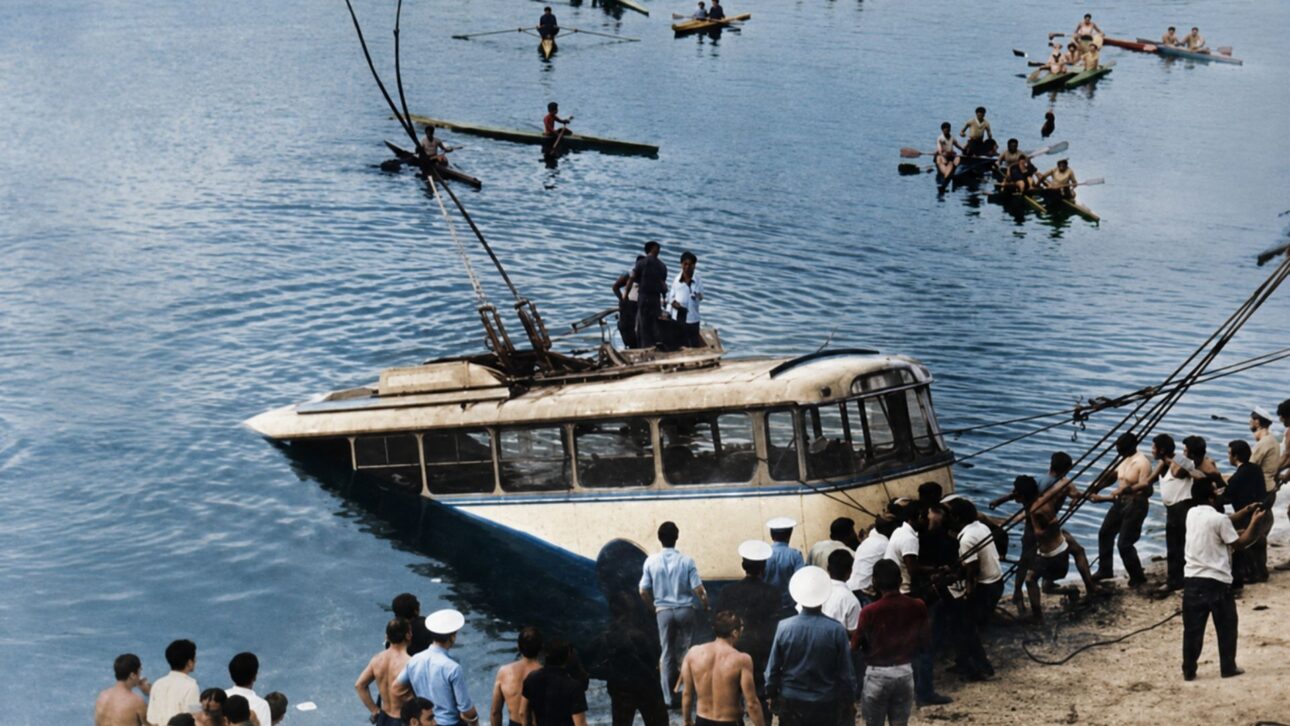
According to the detailed account on Wikipedia, an electric bus, the kind that runs connected to cables, lost control and plunged into the city lake, stopping about 25 meters from the shore and sinking to about 10 meters deep, with dozens of people trapped inside.
-
Júlia Pimentel, an 11-year-old from Minas Gerais, independently invented a new formula to calculate the square root using simple addition and multiplication, and her method was published in one of the most important mathematical scientific journals in Brazil.

-
New portable bathroom is ready in 90 seconds, measures 2.18 meters, fits in the car when closed, and offers privacy for showering and changing clothes.

-
They planted a sea of eucalyptus to produce cellulose, but the monoculture turned into a green desert, dried up springs and rivers, and pushed families out of regions in Minas Gerais and Bahia.
-
Coal mine purchased for $2 million in Wyoming, the Brook Mine holds rare earth elements and critical minerals estimated at up to $37 billion, in an asset that the US is competing for with China.




By one of those coincidences of fate, Shavarsh Karapetyan was nearby. He was finishing a running workout with his brother, Kamo, when he saw the scene. No one was more prepared for what lay ahead: the man passing by at that moment was one of the greatest living names in an underwater swimming discipline. Chance placed the right athlete in the right place, at the worst possible time for the passengers and the only time they still had a chance.
About 40 dives of 25 seconds each
What followed is almost impossible to imagine. Karapetyan dove into the lake and, using his legs, broke the rear window of the bus to get inside. From there, it was an exhausting back-and-forth: descending to 10 meters, finding a person in the dark, pulling them through the hole filled with shards of glass, and bringing them to the surface, where others helped, and diving again. According to the site All That’s Interesting, there were about 40 dives, each lasting about 25 seconds.
The conditions were brutal. The water was cold, muddy from silt, and contaminated with sewage, with virtually no visibility. Each descent meant cutting his own skin on the broken glass and holding his breath to the limit, repeatedly, for about 20 minutes. The report Twenty-Five Seconds Per Life, by Aurora Humanitarian, sums up well the terrible math of that day: each life saved cost about half a minute of immersion in hell, at a pace that only a swimming champion trained for apnea could sustain.
Twenty lives saved, and those that couldn’t be saved
In the end, about 20 people were rescued alive thanks to him. Karapetyan brought more bodies to the surface, but not all could be revived, and this is the detail that haunted him the most afterward. In interviews, he recounted being haunted by the memory of a bench he mistook for a person in the dark, a gesture that, in his mind, may have cost a life that might still have been saved.
This emotional weight accompanies the story and makes it even more human. It wasn’t a clean rescue by an invincible hero; it was a desperate effort, at the physical limit, with losses along the way. Shavarsh Karapetyan himself never sold himself as a superhero, and precisely for this reason, the account is so moving. He did what he could, as far as his body could withstand, and the body, after that, was never the same again.
The price: destroyed lungs and the end of swimming
The bill arrived quickly. Due to the contaminated water he swallowed and the open wounds from the glass, Karapetyan developed pneumonia in both lungs and a generalized infection, sepsis. He was hospitalized for about 45 days, part of that time in serious condition, as detailed in accounts gathered by Mental Floss. When he finally recovered, the news was harsh: his lungs were permanently compromised.
For an athlete whose life depended precisely on lung capacity, it was the end of the line. High-performance swimming, which requires superhuman breath, became impossible. At 24 years old, at his peak, Shavarsh Karapetyan had to abandon the career that had made him a legend in the pools. The rescue in the Armenian lake saved strangers and, at the same time, drowned forever the sporting future of the man who performed it.
Who was the champion before the accident
To understand the magnitude of the sacrifice, it is necessary to know what he threw away. Before that September 16, Shavarsh Karapetyan was a phenomenon in underwater swimming, known as finswimming. Throughout his career, he accumulated 17 world titles, 13 European titles, and various Soviet championships, in addition to breaking 11 world records, achievements gathered by outlets like Grantland in a profile about his life.
In other words, he was not just any athlete passing by the lake. He was one of the greatest on the planet in his specialty, with dozens of gold medals and the title of Honored Master of Sport of the USSR. All of this was weighed in a few minutes against the lives of people he didn’t even know. And he chose to jump. In swimming, Shavarsh Karapetyan’s career ended there, but his story was just beginning.
The recognition that was slow to arrive
Incredibly, the feat remained almost silent at first. In the Soviet Union of the time, this type of news did not circulate easily, and Armenia mourned its victims without the world knowing about the hero of the lake. It was only in 1982, when a major Soviet newspaper published the story, that Shavarsh Karapetyan’s name gained national and later international fame. That same year, he received a congratulatory letter from UNESCO for the gesture.
The following years brought tributes, awards, and even new acts of courage, as in 1985 he helped rescue people from a burning building. Today, the bus rescue in the Armenian lake is studied as an example of altruism, and his name appears on lists of real-world heroes worldwide. Swimming lost a champion, but humanity gained one of the most moving stories about what it means to put another’s life above one’s own.
The journey of Shavarsh Karapetyan is a punch to the chest because it mixes greatness and loss in the same scene. On one side, about 40 dives into an icy lake and 20 lives saved from a sunken bus. On the other, destroyed lungs and the end of a swimming champion career he had built with years of sweat. The rescue defined who he was forever.
And you, do you think you would have the courage to dive into that dark water knowing the risk, or is this kind of heroism for only a few? Share in the comments what this story awakens in you.


Be the first to react!