Portuguese
  Spanish


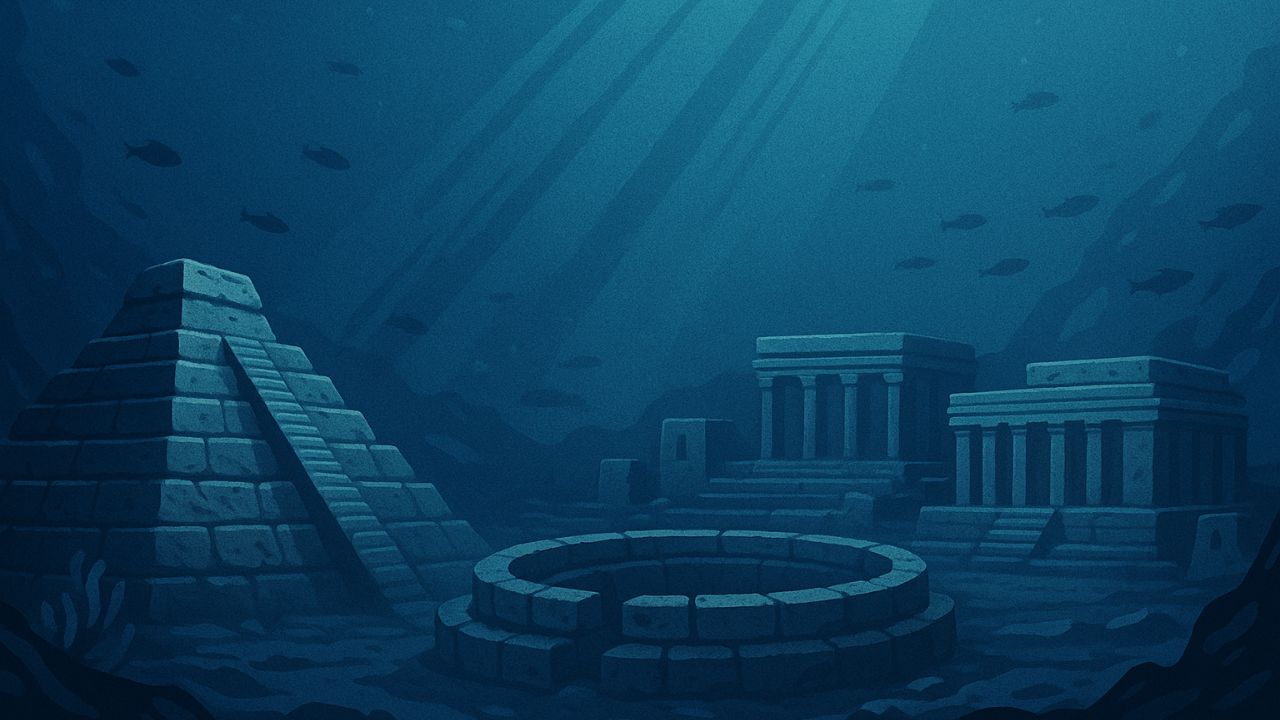


A Submerged City Discovered in Cuba in 2001 Remains Ignored by Science and Authorities. Enigmatic Structures Still Raise Doubts and Fascination.
A discovery made off the coast of Cuba in the early 2000s remains unanswered, even two decades later. In 2001, a team led by marine engineer Paulina Zelitsky located, approximately 800 meters deep, what appeared to be a submerged city, with structures resembling pyramids and ancient buildings.
The revelation, made with the aid of high-precision sonars, raised the hypothesis of a lost civilization predating known ones. However, the topic was quickly ignored by authorities and the scientific community, which opted for caution in light of a lack of conclusive evidence.
Geometric Structures Challenge Explanations
The underwater images obtained by the Canadian company Advanced Digital Communications (ADC), responsible for the mission, impressed with the symmetry and shape of the structures.
-
Brazilian Researcher Develops Protein Supplement from Tilapia Waste, Combining Innovation and Sustainability with Economic Potential

-
Women in São Paulo Unknowingly Tracked by Coin-Sized Tags Hidden in Cars and Belongings, Raising Stalking Concerns
-
Near a $750 million AI data center in Brazil, a resident’s well runs dry, leaving her unable to afford the $25,000 needed for repairs.

-
16-Year-Old from Brazil’s Sertão Wins Young Scientist Award for AI Predicting Rainfall with 94.5% Accuracy to Aid Farmers


According to Zelitsky, the site appeared to have been a planned urban center. “It is a truly wonderful structure that seems to have been a major urban center,” she stated at the time.
The geometric aspect of the formations sparked theories about the existence of a highly advanced civilization, possibly older than those in Egypt.
Some estimates suggested that the architectural remains could be over 6,000 years old, which would completely change the known historical landmarks.
Skepticism and Lack of Resources Halted Research
Despite the initial excitement, the possibility of a submerged city in Cuba was treated with skepticism by the scientific community.
Geologists argued that it would require an interval of at least 50,000 years for a city to sink to that depth, considering the natural processes of tectonic movement.
“It would be totally irresponsible to assert what those structures are without concrete evidence,” Paulina Zelitsky declared in an interview with the BBC.
Cuban geologist Manuel Iturralde-Vinent also expressed doubts, despite the fascination:
“It’s strange, it’s bizarre; we’ve never seen anything like this before and we have no explanation,” he told the Washington Post.
Institutional Abandonment and International Silence
Following the announcement of the discovery, no large-scale expedition returned to the site.
An international mission planned for 2002 was canceled due to lack of funding, as reported by oceanographer Sylvia Earle.
The governmental disinterest also weighed in. Although the initial operation had authorization from Fidel Castro, the Cuban government did not show continued support for the research.
This lack of action led many to believe that the possible submerged city of Cuba was deliberately ignored.
For some, the silence represents an attempt to cover up discoveries that could rewrite human history.
Submerged City of Cuba Fuels Theories About Atlantis
With the lack of new evidence, the topic has been widely debated on social media, where it has gained the status of a modern legend.
Theorists suggest that the region could be the remnants of the mythical Atlantis, while others believe that the scientific negligence is related to political or ideological interests.
The Cuban case is often compared to other intriguing archaeological sites, such as Göbekli Tepe in Turkey and Yonaguni in Japan — both considered examples of structures that challenge the traditional chronology of human civilization.
Even with technological advances in recent decades, the site remains without in-depth studies.
The submerged city, located in the deep waters of Cuba, remains ignored, as if its history were condemned to oblivion.
Until new missions or concrete evidence emerge, the finding will continue to divide opinions between skeptics and enthusiasts, marking yet another chapter of the vast unknown that still lies beneath the oceans.