Portuguese
  Spanish


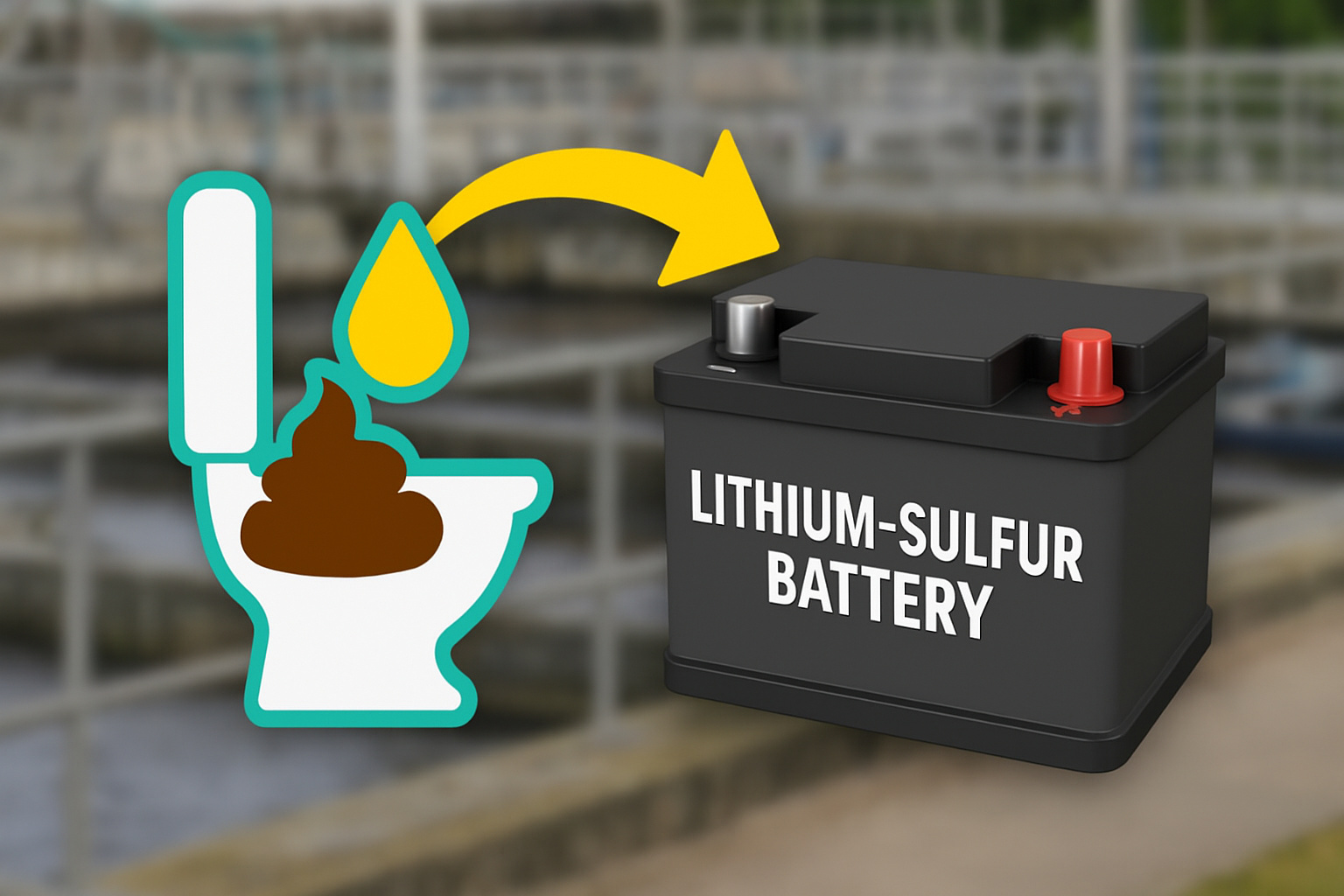


Scientists Turn Feces and Urine into Lighter and Cheaper Batteries, Paving the Way for a Revolution in the Automotive Industry. Understand.
Scientists Transform Human Waste into Batteries That Could Revolutionize the Automotive Industry
Scientists from the University of Córdoba, in Spain, announced a surprising innovation: the use of feces and urine to produce activated charcoal intended for lithium-sulfur batteries.
The discovery came after researchers tested the process directly at the city’s wastewater treatment plant.
The team explored sludge as an alternative source because it can generate the sulfur needed for this type of battery, responding to the demand for more sustainable solutions in the automotive industry. The initiative has been advancing since 2024 and already shows concrete results.
-
Engineers Develop Fridge-Sized Machine to Produce 95-Octane Synthetic Fuel from Air and Water, Aiming to Sustain Combustion Engines Without Oil

-
Two-Armed Robot Uses AI to Reassemble Destroyed Pompeii Frescoes, Solving an “Impossible” Puzzle
-
New Law in Brazil Requires Breaks for Type 1 Diabetes Management at Work, School, and Public Exams

-
Scientists Confirm “Greening” of Antarctica: Ice on the World’s Coldest Continent Turns Green as Mosses Multiply Over Tenfold in Four Decades


This research reinforces how science, technology, and innovation can transform waste considered problematic into strategic materials for the future of electric mobility.
Innovation Born from an Abundant Waste
The Chemical Institute of Energy and Environment (IQUEMA) leads the study.
The researchers discovered that sewage sludge can be transformed into activated charcoal, an essential component for lithium-sulfur batteries.
They highlight the impact of the discovery: “This is a major breakthrough that we achieved using a waste that we considered problematic.”
Thus, the research shows a viable path to reduce costs, recycle waste, and drive new solutions in energy technology.
Why This Battery Is So Interesting to the Automotive Industry
Lithium-sulfur batteries attract attention for being lighter while maintaining high energy capacity.
This improves the range, performance, and efficiency of vehicles.
Additionally, it could accelerate charging by up to 50%.
Another important point is the cost.
This technology could be less than half the price of current lithium-ion batteries.
Recycling is also simpler.
Thus, the innovation has the potential to transform the automotive industry and drive the production of more affordable electric cars.
How Science Transforms Feces and Urine into Battery Material
The process developed by the researchers involves five simple and efficient steps:
- Drying the sludge for initial preparation.
- Addition of potassium to increase porosity.
- Pyrólisis at 800 °C, converting organic matter into carbon.
- Grinding the carbon with sulfur, creating a stable composition.
- Production of the electrodes, the final step in battery manufacturing.
In this way, the technology creates a high-value material from a waste that would typically be discarded.
Benefits and Challenges of the Lithium-Sulfur Battery
Among the advantages are higher storage capacity, lower cost, and the possibility of using abundant materials.
It can store up to three times more energy than a conventional battery.
On the other hand, there are obstacles.
Sulfur has low conductivity and can degrade after many cycles.
Long-term stability is still a concern.
Even so, the activated charcoal produced from the sludge helps address some of these issues, making the innovation more attractive.
Stellantis Is Already Testing the Use of This Technology
The advancement has caught the attention of the global automotive industry.
At the end of 2024, Stellantis partnered with Zeta Energy to develop lithium-sulfur batteries.
The group, owner of brands like Fiat and Jeep, bets on low cost and high performance.
Zeta uses waste, methane, and unrefined sulfur, without the need for cobalt, nickel, or manganese.
This reduces costs and risks in the supply chain.
Thus, the innovation created by science and driven by sustainable research could reach the market much sooner than expected.