






 Portuguese
  Spanish
  3 min of reading
  7 comments


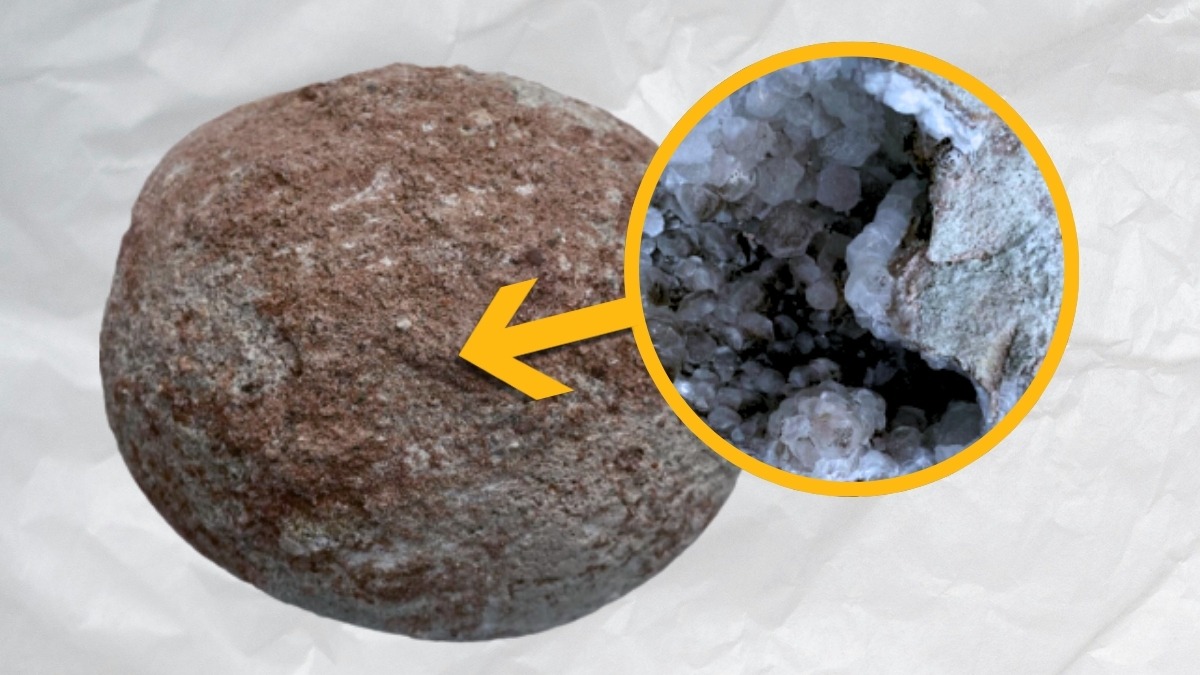


Found in the Chishan Formation, in the Qianshan Basin, the dinosaur egg dated to about 70 million years revealed calcite crystals inside, allowed for the identification of a new oospecies, and expanded the scientific record on microstructure, fossilization, and environmental conditions of the Late Cretaceous in China
A dinosaur egg about 70 million years old, found in the Chishan Formation in China, surprised researchers by containing calcite crystals, allowing for the identification of a new oospecies and generating unprecedented data on microstructure, fossilization, and environmental conditions of the site.
Discovery of the Egg and the Natural Geode
The fossil, approximately the size of a grapefruit, was found in a Chinese fossil site and exhibited an unusual condition. Instead of an embryo or sediment, the interior of the egg was coated with shiny calcite crystals adhered to the inner shell.
This configuration transformed the egg into a natural dinosaur geode, which is something rare in the paleontological record.
-
Roblox changes the rules for children and teenagers in Brazil and promises a safer platform with selfies and parental control.

-
Water can carry pesticides invisible to common treatment, but nanosensors developed by Brazilian researchers promise to speed up the alert before the risk reaches the tap.

-
Gases created to save the ozone layer have become a new global warning: substitutes for CFCs have already released more than 335,000 tons of a “forever chemical” onto the Earth as invisible rain, contaminating everything from tap water to Arctic ice.
-
Researchers present a hydrogen ion battery capable of storing energy in two different forms, an innovative solution that promises to increase the autonomy of renewable systems and simplify energy transportation.




The material attracted researchers’ attention for preserving the shell intact while revealing a little-documented mineralogical process in this type of fossil.
The analysis showed that the crystals are not part of the original structure of the egg but result from processes occurring after burial. This unusual preservation offers new possibilities for studying events that took place after the deposition of the material in the soil.
Identification of the New Oospecies
A detailed study of the microstructure of the shell led to the identification of a new oospecies, named Shixingoolithus qianshanensis. The description was published in a 2022 article led by paleontologist Qing He from Anhui University.
The classification was based on the microscopic organization of the shell, which was considered more similar to that of other dinosaur eggs than to that of reptile or bird eggs. This characteristic was decisive in recognizing it as a new species of fossilized egg.
Two eggs were discovered and classified in the same oogenus. However, neither contained a preserved embryo, which limits the identification of the animal responsible for the laying and prevents direct associations with known skeletons.
Geological Context of the Chishan Formation
The eggs are among the earliest evidence of dinosaurs recorded in the Chishan Formation, a Late Cretaceous unit estimated to be about 70 million years old, located in the Qianshan Basin.
The region is traditionally known for fossils of turtles, mammals, and Paleocene birds. Thus, the presence of dinosaur eggs broadens the understanding of local faunistic diversity at the end of the Cretaceous.
The find suggests that dinosaurs frequented or nested in the area, even though skeletal remains have not yet been identified. This data contributes to re-evaluating the paleontological importance of the formation.
Process of Formation of the Calcite Crystals
In order for mineral crystals to form inside a dinosaur egg, a specific sequence of events must occur. Initially, the embryo completely decomposes, leaving the interior of the egg empty.
Subsequently, groundwater slowly infiltrates through the shell via micropores and small cracks. The minerals dissolved in this water begin to deposit inside, gradually accumulating to form calcite crystals.
This process indicates that mineralization occurred after the burial of the egg. Analyzing the shells and crystals can provide relevant information about the groundwater and the geochemical environment of the fossil site.
Scientific Applications and Preservation of Life’s History
In an article published earlier this year, scientists used calcite crystals from another dinosaur egg to directly date the egg itself, an unprecedented achievement in paleontology. The method leverages the mineral precipitation that occurs after burial.
In addition to dating, these crystals can retain information about the fluids that circulated through the fossil bed and the geochemical environment of the original nest. These data expand the possibilities for studying fossilized eggs.
The egg with calcite geode exemplifies how natural processes preserve the history of life. From bones encrusted with minerals to structures replaced by opals, these records provide lasting evidence of extinct organisms and their environments.
Article crafted based on information from scientific study published in 2022, led by paleontologist Qing He from Anhui University, and from a scientific article released earlier this year on using calcite crystals in dinosaur eggs for direct dating in paleontology.





Isso é um geodo
E muita ousadia vcs acharem que as pessoas acreditam !….nem vcs acredita!?… sabemos agora de uns tempos até aqui ,que tudo e um sistema ….tudo e dinheiro…A pandemia e o governo de Bolsonaro mostrou as falsas noticia e mentiras que todo sistema tem….deveriam saber que não…leitores nao são mais enganado por esse sistema….pessoas que nao tem.conhecimentos ainda pode ser que nao tenha tanta informações…mas a geração 70 ,80 nao acredita nesses enganos que vcs querem enfiar a boca abaixo….deveriam sentir vergonha!….
Speak for yourself. If you think this specific finding is false, point to a SPECIFIC error: the stratigraphy, the microscopy, the mineral interpretation, the dating, or the publication record. General claims like ‘everything is money’ are not an argument, they’re just a slogan.
Scientific claims stand or fall on methods, data, and replication, not on whether you feel cynical about ‘systems.’ In this case, the observation is straightforward: a fossil egg with an intact shell, an internal calcite crystal lining formed after burial, and a shell microstructure distinct enough to justify a new oospecies. You can disagree, but disagreement requires evidence, not outrage or cynicism.
Exactly! Thank you.
Exactly!
Speak for yourself. If you think this specific finding is false, point to a SPECIFIC error: the stratigraphy, the microscopy, the mineral interpretation, the dating, or the publication record. General claims like ‘everything is money’ are not an argument, they’re just a slogan.
Scientific claims stand or fall on methods, data, and replication, not on whether you feel cynical about ‘systems.’ In this case, the observation is straightforward: a fossil egg with an intact shell, an internal calcite crystal lining formed after burial, and a shell microstructure distinct enough to justify a new species. You can disagree, but disagreement requires evidence, not outrage or cynicism.
Desequilibrado😅😅 , Só podia ser um **** kkkk
O cara acredita em cobra falante, mas não acredita em dinossauro?
A ciência consegue provar o aparecimento de dinossauro, o que a ciência não consegue provar é que uma cobra fala kkkkk