





 Portuguese
  English
  Spanish
  4 min of reading
  0 comments


Global Warming of 2.7 °C Represents a Brutal Threat to the Future of Humanity, According to Scientists.
Humanity faces an increasingly uncertain and grim future, as scientists around the world warn about the devastating impacts of global warming. A new report, the State of the Climate 2024, reveals that we are approaching a temperature increase of 2.7 °C, a scenario almost twice as severe as stipulated by the Paris Agreement, which aimed to limit warming to 1.5 °C.
The report presents a series of alarming data and indicates that, despite global efforts to reduce greenhouse gas emissions, the planet is on a path that could make Earth’s climate unrecognizable in a few decades.
The Devastating Reality of the Climate Crisis
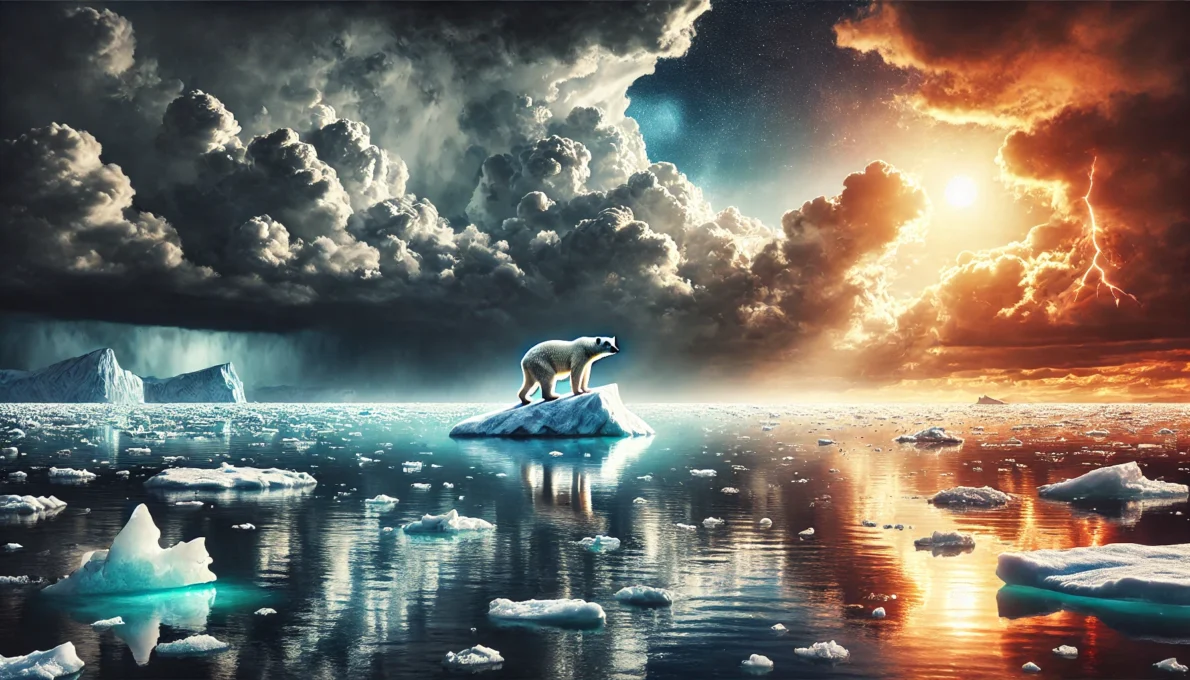
You don’t have to look far to see the impacts of climate change. Devastating wildfires, increasingly intense tropical storms, prolonged droughts, and the destruction of ecosystems are just a few phenomena that have become more frequent.
-
The Instagram you pay to use has arrived in Brazil: for just 10 reais a month, the new Instagram Plus offers a feature many people have dreamed of, viewing stories completely anonymously, in addition to keeping posts online for twice as long.

-
Meteorite found in the Sahara could be a piece of a lost world that existed 4.5 billion years ago, after crystals revealed pressures impossible for a common asteroid and reignited the mystery about destroyed planets in the early Solar System.

-
Comet coming from outside the solar system intrigues scientists after James Webb detects methane for the first time and reveals that 3I/ATLAS may have originated in another planetary system.

-
YouTuber connects 400 car batteries, creates a circuit with over 160,000 amperes, uses 450 kilograms of copper, and demonstrates a force capable of destroying metal in an impressive experiment.


Here in Brazil, for example, unprecedented wildfires have destroyed vast areas of forest, and once-mighty rivers, such as the São Francisco, are drying up quickly.
The term “unprecedented” has been widely used this year, especially in reference to extreme weather events, such as Hurricane Milton, which intensified unusually, and Super Typhoon Yagi, which caused significant damage in Vietnam. These events are just a sample of what may come if global warming continues to advance.
On the Road to a 2.7 °C Warming
A global warming of 2.7 °C is a catastrophic scenario that is increasingly becoming reality. Despite promises made by governments around the world to reduce greenhouse gas emissions, the reality is that these emissions continue to rise.
The consumption of fossil fuels, in particular, remains at record levels, despite the growth of renewable energies such as wind and solar.
The report reveals that, although clean energy production has increased, it is still not enough to offset the massive use of fossil fuels, which is 14 times greater. This reliance on fossil fuels is pushing the planet toward a future of dangerously high temperatures.
In 2023 and 2024, daily global average temperatures have already reached record levels, with the prediction that this year will be the hottest on record.
The report also highlights that of the 35 vital signs monitored on the planet, 25 have already reached record levels, all heading in the wrong direction.
Irreversible Impacts for Future Generations
Human beings are not accustomed to living under extreme weather conditions. For the past 10,000 years, human civilization has thrived in a stable environment, without drastic temperature fluctuations. However, this balance is at risk. Future generations, including the grandchildren of those living today, will face a much more aggressive and inhospitable climate than anything our ancestors experienced.
In addition to rising temperatures, there are other alarming consequences. The concentration of carbon dioxide in the atmosphere has surpassed 422 parts per million (ppm), a significant increase from the previous year when it was at 418 ppm. Methane, an even more potent greenhouse gas, is also rising at an alarming rate, despite global pledges to address it.
Another factor exacerbating the crisis is the reduction of atmospheric aerosols, small particles that help cool the planet. While reducing pollution is a positive development, the decrease of these aerosols means that global warming may accelerate even further, as they play a crucial role in mitigating the effects of warming.
Deforestation and Sea Ice Loss
Deforestation, particularly in the Amazon, is another factor accelerating global warming. Forests play an essential role in absorbing carbon dioxide, but the destruction of these critical areas is hindering the planet’s capacity to cope with emissions, creating a vicious cycle.
As the climate warms, more trees die, which in turn raises global temperatures.
The loss of sea ice is also amplifying warming. When ice melts, it exposes the dark ocean water, which absorbs more sunlight, further heating the planet.
This change in albedo (the ability to reflect sunlight) significantly accelerates global warming.
The Future of Coastal Communities with Global Warming
As temperatures rise, sea levels are also rising. In the coming decades, millions of people living in coastal areas will face the threat of displacement, as flooding becomes more frequent and severe.
Communities around the world, from small islands in the Pacific to large coastal cities, will face unprecedented challenges.
Cop 29, which will take place in Azerbaijan next month, will be a crucial opportunity for world leaders to take more aggressive and coordinated action to mitigate the impacts of climate change. However, without much stricter policies and concrete actions, the future looks increasingly bleak.
Time is running out, and the planet, as we know it, may be on the brink of an irreversible transformation.






Be the first to react!