Portuguese
  Spanish


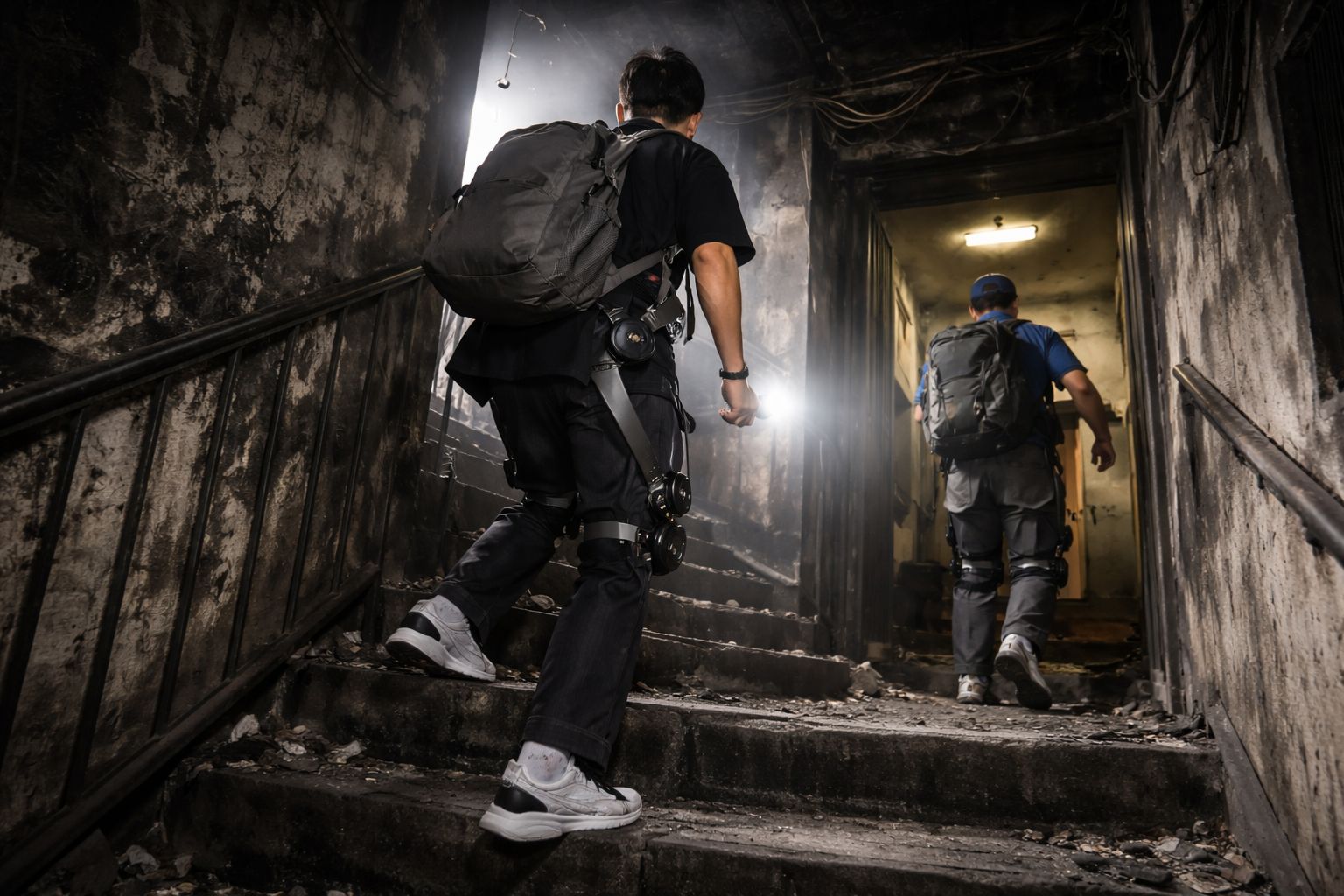

Survivors of the fire that destroyed the Wang Fuk Court complex in Hong Kong and killed 168 people are using robotic exoskeleton legs to climb dozens of floors and retrieve belongings. With 31-story buildings without operating elevators, elderly people like 59-year-old Fanny Mok train with equipment from the Chinese company Hypershell to have only three hours of access to the apartments.
More than four months after the fire that destroyed the Wang Fuk Court housing complex in the Tai Po district, north of Hong Kong, and killed 168 people, the survivors are finally preparing to return and collect what remains of their lives. But to reach their apartments, many of them elderly, are using borrowed robotic exoskeleton legs that help them climb stairs in 31-story buildings where the elevators are not functioning. Fanny Mok, 59, who lived on the 13th floor of the complex for the past 30 years, is one of dozens of victims training with the robotic legs to complete the climb. “My knees hurt, I have no strength and I get short of breath,” she said, describing why the equipment is essential.
The operation to return to the apartments will take place between April 20 and May 4, and each family will have only three hours to collect their belongings. The robotic legs are manufactured by Hypershell, a robotics company from Shanghai, and were made available by an NGO called AidVengers Federation, which also offers training sessions for former residents to learn how to operate the exoskeletons safely. The approval rate in the usage tests has been 70%, which means that about 30% of the survivors trying to use the robotic legs are unable to operate them and will need to find other ways to climb to their former homes.
The fire that destroyed the Wang Fuk Court and left 4 thousand people homeless

image: EPA/BBC
The fire in the Wang Fuk Court housing complex occurred in late November of last year and was one of the deadliest in Hong Kong’s history. The fire consumed seven towers of the complex, killed 168 people, and displaced more than 4,000 residents who have since been living in temporary accommodations scattered throughout the city, including shelters and makeshift rooms. The Wang Fuk Court was built in the 1980s and housed 4,600 people, more than a third of whom were over 65 years old.
-
Apple Raises MacBook and iPad Prices as Memory Costs Surge by Up to 98%, Losing Edge Over Rivals and Highlighting AI Boom’s Impact on Consumers

-
China Establishes State Centers to Train Humanoid Robots, While the West Lags Behind with Makeshift Solutions
-
The Trap of Modern Technology: How Screen Overload and Digital Connections Can Impact Your Mental Health and Well-being
-
Wyoming Couple Grows Tropical Fruits Year-Round in -40°C Using Geothermal Greenhouse, Demonstrating Earth’s Heat Can Produce Oranges and Lemons in Snow Without Traditional Heating





The combination of an old housing complex, with outdated fire safety infrastructure, and a predominantly elderly population made the disaster particularly devastating. For the survivors, the four months of waiting to return to their apartments were filled with anguish, not knowing if their most important belongings, including documents, money, family photos, and sentimental items, survived the fire and the water used to extinguish it. The return with the robotic legs is the first chance they will have to find out.
How Robotic Legs Help the Elderly Climb 31 Floors

According to information from the Reuters portal, the robotic legs used by the survivors are exoskeletons that attach to the user’s legs and provide motorized assistance during walking and climbing stairs. The equipment compensates for the loss of muscle strength, joint pain, and respiratory issues that would make it impossible for many elderly people to climb more than ten floors on foot, especially in a complex where the elevators are out of operation after the fire.
Fanny Mok, who needs to reach the 13th floor, has been practicing climbing using the robotic legs in a building near Wang Fuk Court. “There is a real need. If I were 30, I wouldn’t need this. But at 60, I really do”, she explained, summarizing the situation of dozens of former residents facing the same challenge. Betty Ho, 61, who lived on the 15th floor for 35 years, is also preparing for the climb with robotic legs, hoping to recover money stored in the apartment and family photo albums that document decades of her life.
The Challenge of Condensing 30 Years of Life into Three Hours
The three-hour limit imposed by the return operation adds a layer of emotional urgency to the physical challenge of climbing with robotic legs. The former residents need to climb, select what to take, pack, and descend with their belongings in a timeframe that would barely be sufficient for a regular move, let alone to separate valuable items among the debris of a fire in an apartment where they lived for decades.
Betty Ho expressed the difficulty directly. “How is it possible to part with everything you’ve lived with for decades in just three hours? It’s practically impossible. Letting go of things is really very hard”, she said, hoping to find and save photo albums that cover her childhood to adulthood. For many survivors, the robotic legs solve the problem of reaching the apartment, but the time limit creates another problem that no technology can solve: choosing what matters when everything matters.
The Chinese Technology Behind the Robotic Legs Helping Hong Kong
The robotic legs used by the survivors are manufactured by Hypershell, a robotics company based in Shanghai that develops exoskeletons for various applications. The equipment was provided by the NGO AidVengers Federation, which organized training sessions with former residents to ensure they knew how to operate the exoskeletons safely before climbing dozens of floors in buildings damaged by fire.
The qualification process is not automatic. Each user must pass a test before being authorized to operate the robotic legs, and the 70% approval rate indicates that the equipment requires a minimum level of motor coordination and strength that not all elderly individuals can achieve. For the 30% who do not pass the test, the ascent must be done with the help of younger volunteers or family members, an additional challenge in a complex where most residents were elderly.
What the story of robotic legs in Hong Kong reveals about aging and technology
The scene of 60-year-old seniors using exoskeletons made in China to climb stairs in a fire-damaged building is a concentrated portrait of several themes that define the 21st century. The aging population, the precariousness of housing infrastructure in large cities, the ability of technology to compensate for human limitations, and the fragility of entire lives destroyed in hours converge in this operation that mixes cutting-edge robotics with human desperation.
For Fanny Mok, Betty Ho, and the hundreds of survivors waiting for the return window, the robotic legs are not a technological curiosity; they are the difference between being able to recover the last remnants of 30 years of life in an apartment that may never be habitable again. The technology solves the ascent, but it does not solve the loss. When the three hours are up and the survivors descend with what they managed to save, the robotic legs will have fulfilled their function. The work of rebuilding the rest falls solely on them.
Fire survivors in Hong Kong use robotic legs to ascend to the 13th floor and recover belongings. Could you condense 30 years of life into three hours? Should this technology be available in more emergency situations? Share your opinion in the comments.