Portuguese
  Spanish




Japanese team identifies rare submarine volcano near Minamitorishima in the Pacific, and discovery helps expand understanding of the Earth’s mantle
A Japanese team identified a submarine volcano about 3 million years old under the Pacific Ocean, near Minamitorishima Island, in a remote area of Japan. The discovery is important because it expands knowledge about the Earth’s interior and volcanic activity beneath oceanic plates.
Find in a remote area of the Pacific
The submarine volcano was located in an ancient section of the Pacific Plate, near Minamitorishima Island, at the easternmost point of Japan.
The structure belongs to a rare class called small point volcanism. Confirmation came after sampling in deep waters.
-
She spent 73 years breathing inside an iron lung, survived the aftereffects of polio, and became the last woman in the United States dependent on the equipment before dying at 78 years old.

-
Brazilian students created a $1 filter using pine bark, cotton, and 3D-printed parts to clean cassava wastewater, reduce the toxicity of a hazardous waste, and transform contaminated water into biofertilizer.

-
Astronaut from Artemis II steps down after mission to the Moon and decision surprises after a record of 406,771 km, a historic 10-day journey, and an unprecedented achievement for Canada.

-
A fossil kept for years in a small museum in Montreal concealed 450-million-year-old soft tissue, a discovery that has only happened once before in history.


The study was published in the journal Deep-Sea Research Part I: Oceanographic Research Papers.

How scientists reached the structure
The investigation began with bathymetric data collected by the Japan Coast Guard. The information showed an unusual formation beneath the seabed near Marcus Island.
Initial observations pointed to a small volcanic structure that was out of the ordinary for the ocean floor in that region.
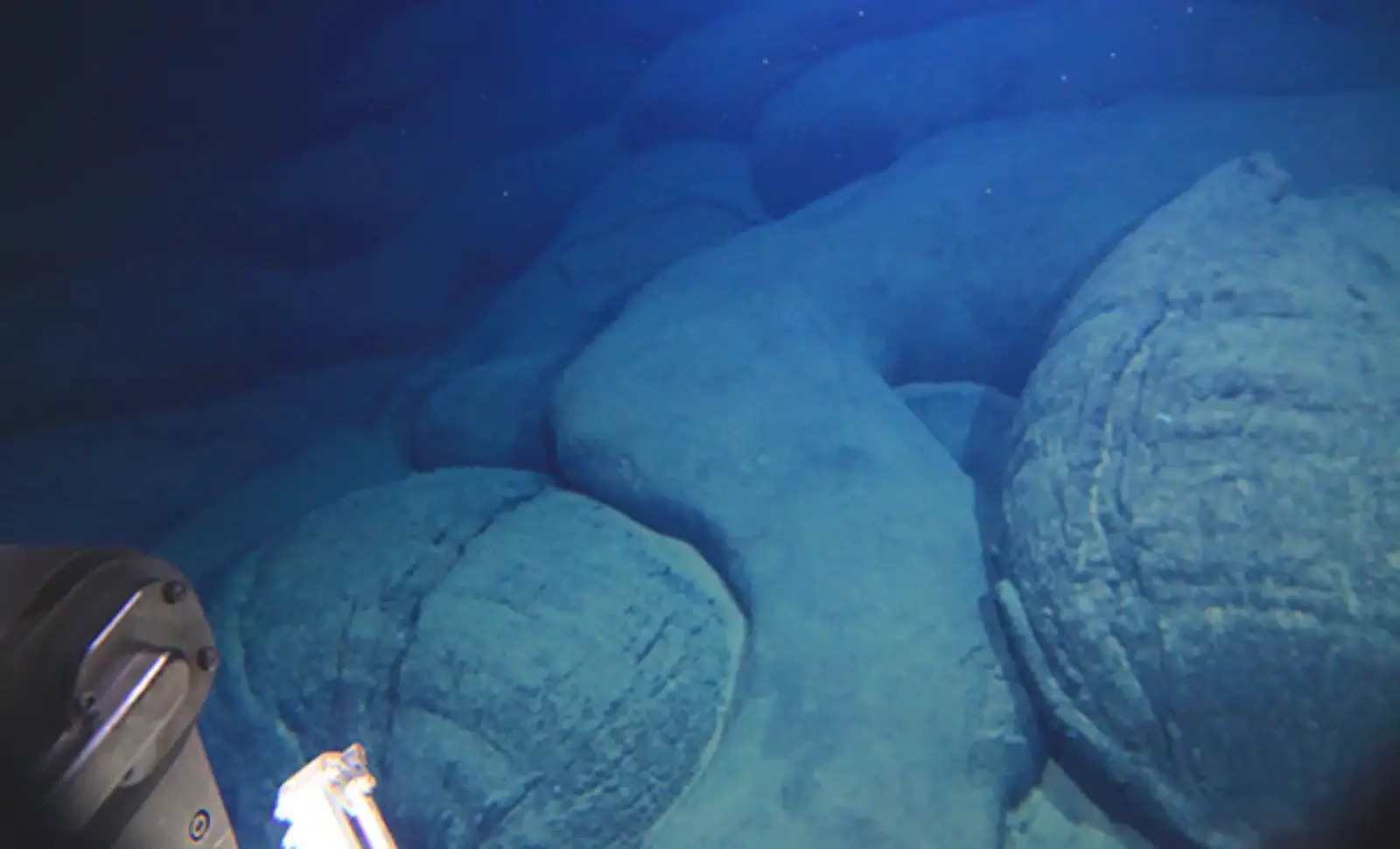
To deepen the investigation, scientists used the Shinkai 6500, a manned submersible capable of diving up to 6,500 meters.
The vehicle allowed for direct inspection of the site and the collection of rock samples taken from the suspected formation.
Researchers reported that the suspicion of a small volcano’s presence arose after analyzing bathymetric data obtained by the Japan Coast Guard.
The samples collected during the dives confirmed the presence of volcanic material and validated the interpretation that the structure was indeed a submarine volcano.
The work indicated that the combination of mapping and direct sampling was essential to confirm the nature of the site.
What are small point volcanoes
Small volcanoes form through a tectonic process related to the bending of tectonic plates.
When oceanic plates submerge and bend towards the mantle, fractures can open within the plate itself.
These fissures create pathways for magma to rise from deeper regions of the Earth.
Dr. Naoto Hirano, from the Northeast Asian Studies Center at Tohoku University, stated that these volcanoes are young and arise along fissures at the base of tectonic plates.
He explained that these fissures are linked to the mechanical deformation of the Pacific Plate as it sinks into the mantle.
The origin of magma and the role of the mantle
The magma from these eruptions comes from the asthenosphere, the upper layer of the Earth’s mantle. Researchers claim that this zone plays an important role in the movement of tectonic plates.
It is also from this layer that the material feeding small volcanoes in regions where oceanic plates flex comes.
A statement published by Waseda University reported that recent studies in the eastern Japan Trench found volcanoes of this type expelling alkali-rich magma enriched with carbon dioxide.
Why the discovery is noteworthy
Small volcanoes are valuable because they expose components of the asthenosphere that would not be accessible through surface geology.
The study of these formations helps scientists better understand the composition of the mantle and the melting processes that occur beneath tectonic plates.
The newly identified structure near Minamitorishima expands the known locations where this type of volcanic activity can occur in the ocean.
Dr. Hirano stated that the discovery of the new volcano offers an opportunity to better explore the area and, hopefully, reveal other small volcanoes.
The assessment indicates that the region may contain other still-unknown structures formed under similar conditions.
The discovery reinforces the value of the submarine volcano as an important piece for studying the behavior of oceanic plates and deep mantle activity.
With information from Daily Galaxy.