Portuguese
  Spanish


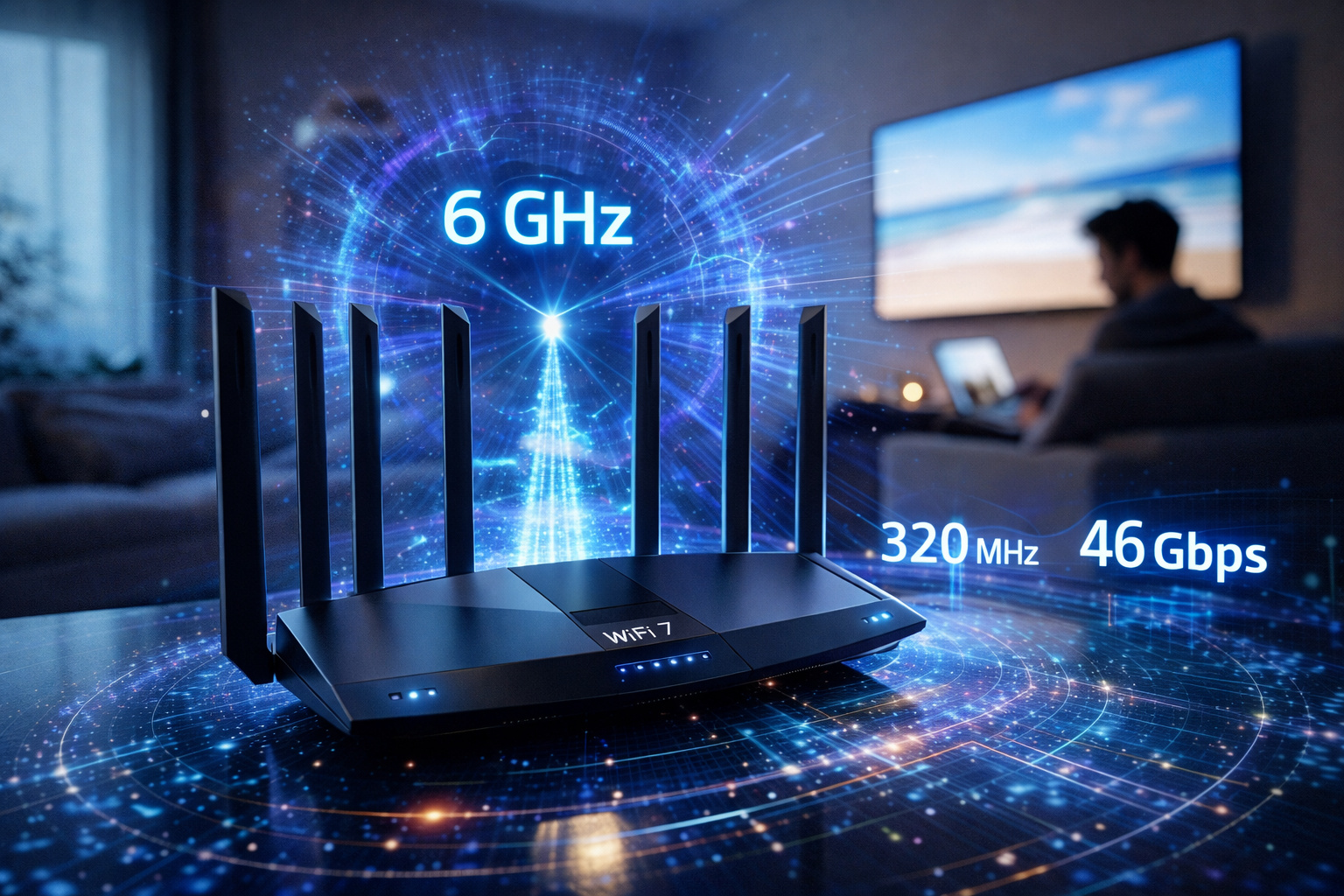

Wi-Fi 7 begins to advance in Brazil with the use of the 6 GHz band, 320 MHz channels, and potential of up to 46 Gbps in home internet.
The advancement of Wi-Fi 7 in Brazil is directly linked to recent regulatory decisions by the National Telecommunications Agency (Anatel). In 2024 and 2025, the agency consolidated the allocation of the 6 GHz band for unlicensed use, allowing the operation of technologies such as Wi-Fi 6E and Wi-Fi 7 in part of the spectrum. This decision is considered strategic because it significantly expands the capacity of home wireless networks, creating space for new standards with greater bandwidth and less interference.
In technical presentations by Anatel itself, the lower 6 GHz band enables much wider channels, reaching up to 320 MHz, a significant leap compared to previous standards. As a result, home networks now have the potential to achieve speeds of up to 46 Gbps, depending on the configuration and connected devices.
The central point of this change is straightforward: the historical limitation of home Wi-Fi networks ceases to be the technology standard and begins to depend mainly on the available infrastructure within the home.
-
Spain Launches World’s Largest Floating Dry Dock: 56-Meter Giant Produces Massive Concrete Structures in A Coruña Using Technology Proven in Brazil

-
AI-powered toys that talk, recognize faces, and collect data face scrutiny from Brazilian government over children’s privacy concerns

-
4,000-Year-Old Child’s Skull Unveils Ancient Burial in 7,500-Year-Old Norwegian Rock Shelter, Impressing Archaeologists

-
Norway Defeats Brazil in World Cup but Invests Billions to Preserve the Amazon, Strengthens Amazon Fund, and Joins Brazil in Leading Global Effort Against Tropical Deforestation




Wi-Fi 7 expands channel width and redefines transmission capacity
The main technical innovation of Wi-Fi 7 lies in the expansion of channel width. While previous standards operated with smaller channels, the new standard allows for the use of up to 320 MHz, doubling the transmission capacity compared to Wi-Fi 6.
This expansion allows for more data to be transported simultaneously, reducing congestion and increasing network efficiency, especially in environments with many connected devices.
This change is not just incremental but structural, as it redefines the volume of data that can be transmitted within a home network.
6 GHz band reduces interference and improves connection stability
Another determining factor for the performance of Wi-Fi 7 is the use of the 6 GHz band, which has less interference compared to the traditional 2.4 GHz and 5 GHz bands.
In urban environments, where multiple networks operate simultaneously, interference has always been one of the main performance limiters. The new band increases the number of available channels, reducing signal overlap.
This translates to more stable connections, with lower latency and greater performance consistency, even in high device density scenarios.
Growth in the number of connected devices drives the need for new technology
The evolution of Wi-Fi 7 also responds to a structural change within Brazilian households: the constant increase in the number of connected devices.
Smart TVs, cell phones, notebooks, cameras, virtual assistants, and automation devices have started to share the same home network, creating a much greater demand for transmission capacity. The old model of routers is no longer sufficient to support this growing volume of simultaneous connections.
Higher speeds meet new demands like streaming and online gaming
With the popularization of high-resolution streaming services, online gaming, and video conferencing, the demands on the home network have increased significantly.
Wi-Fi 7 emerges as a response to this scenario, offering speeds far superior to previous generations, allowing for multiple simultaneous activities without performance degradation. Home internet is no longer a bottleneck and keeps pace with the evolution of digital services.
Internal infrastructure of the home becomes a decisive performance factor
With the evolution of the Wi-Fi standard, the quality of the connection depends not only on the plan contracted with the provider but also on the internal infrastructure of the residence.
Factors such as router positioning, the number of connected devices, and the quality of equipment now have a direct impact on network performance. The home is no longer just a point of access to the internet but becomes an active part of the connection’s performance.
Transition to Wi-Fi 7 occurs gradually in the Brazilian market
Despite regulatory and technological advances, the adoption of Wi-Fi 7 in Brazil tends to occur gradually. This is due to the need to replace equipment, both routers and compatible devices.
The technology is beginning to reach the market, but its popularization depends on factors such as cost, availability, and the natural renewal of devices by consumers. The change is not immediate but follows a transition process that is already underway.
New standard brings home networks closer to professional performance levels
With greater capacity, lower latency, and more stability, Wi-Fi 7 brings the home environment closer to standards previously restricted to corporate or industrial networks.
This opens up space for new applications, including advanced automation, high-demand devices, and services that require constant and high-quality connections. The home network is no longer a limited resource and begins to operate at a more advanced technical level.
Decision on spectrum aligns Brazil with global trends
The allocation of the 6 GHz band by Anatel aligns Brazil with decisions made by other countries that have also advanced in releasing spectrum for Wi-Fi.
This convergence facilitates the adoption of global technologies and expands device compatibility, accelerating market evolution. The country is now part of a global movement for the expansion of high-capacity wireless connectivity.
The new generation of Wi-Fi redefines the connection experience within homes
The combination of wider channel bandwidth, less interference, and increased speed redefines the internet usage experience inside homes.
The connection becomes more stable, faster, and capable of supporting multiple simultaneous demands, reducing failures and interruptions. The internet ceases to be a limiting factor and begins to keep pace with the complexity of today’s digital environment.
And you, do you believe that Wi-Fi 7 will really quickly replace current routers, or will this change still take a few years to become standard in Brazilian homes?