Portuguese
  Spanish


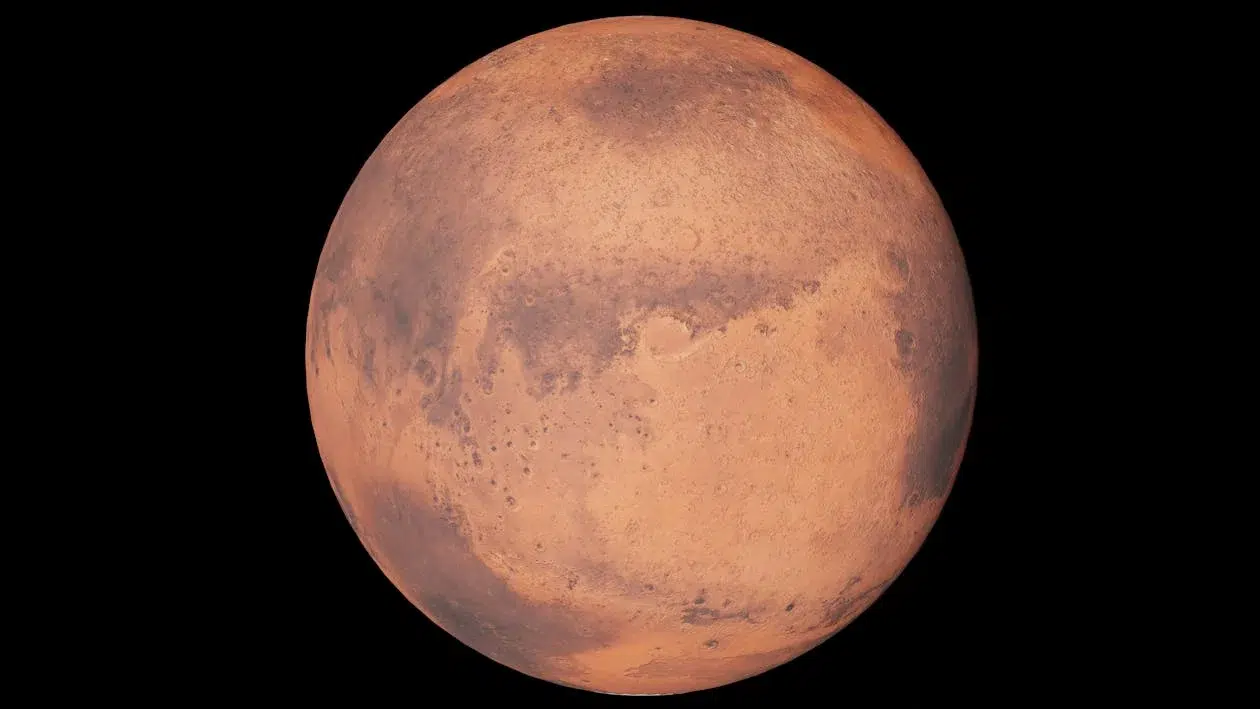

Scientists Study Ways to Quickly Increase Temperatures on Mars. Strategies Could Accelerate Planet Adaptation to Human Presence
Bringing human life to Mars has always been a distant dream. But a new study has presented a concrete proposal to make the red planet more Earth-like. The idea is to use nanoscale aerosols made of graphene and aluminum to warm the Martian atmosphere and initiate a process that, in the future, could allow human presence there.
The work was led by Edwin S. Kite, associate professor at the University of Chicago and a member of the Curiosity rover team. The research was presented at the 2025 Lunar and Planetary Science Conference.
Scientists from Northwestern University, NASA’s Jet Propulsion Laboratory, and other institutions also participated.
-
New Study Finds Brief Stress Episodes Can Alter Blood and Increase Risk of Clot Formation

-
Ukraine Escalates War Efforts with Plan to Deploy 25,000 Ground Drones, Test Phantom MK-1 Humanoid Robot, Use Armed Mini-Tanks, and Expand Automated Attacks up to 15 km from Frontline

-
New Superfiber Developed by Imperial College Researchers and Approved by the EU Promises to Increase Satiety and Help Prevent Weight Gain
-
Harvard Researchers Develop Biological Clock to Estimate Life Expectancy, Potentially Transforming Human Aging Studies


The Goal of the Research
The long-term mission is to enable humans to live on Mars. To achieve this, it is necessary to warm the planet, melt the ice, and thicken the atmosphere. The study presented proposes to initiate this process by releasing aerosols that absorb and scatter light in the mid-infrared spectrum.
These aerosols, composed of graphene nanodisks and aluminum nanorods, would be launched from two sources located on the planet’s surface.
The intention is for them to spread globally within a year, increase the atmospheric temperature by more than 35 kelvin over a decade, and initiate the melting of the polar ice caps.
How Terraforming Works
Terraforming Mars is a complex process. Simplified, it involves three main steps: warming the atmosphere, thickening it, and melting the ice from the caps and permafrost.
The release of gases such as carbon dioxide would further help to warm the planet, creating a continuous cycle of temperature increase and atmospheric thickening.
The warming caused by the aerosols would result in the release of liquid water and vapor into the atmosphere, as well as releasing CO₂ stored in the polar ice caps. This would intensify the local greenhouse effect, increasing the warming.
Study Uses Advanced Simulations of the Martian Environment
To develop the study, the team utilized the Mars Weather Research and Forecasting (MarsWRF) model and a general circulation model to track the aerosol plumes. These simulations also included natural dust, released by seasonal storms.
The tested particles absorb and scatter light at specific wavelengths, around 10 and 20 micrometers. This contributes to the warming of Mars’s upper atmosphere, creating favorable conditions for large-scale climate transformations.
Results Indicate Significant Warming
According to the models, the aerosols could warm the Martian atmosphere by more than 35 kelvin over 10 years. This would be sufficient to initiate the melting of ice at the poles, releasing more water and gases and helping to thicken the atmosphere.
The warming would also double atmospheric circulation, creating patterns similar to those on Earth, with warm air rising at the equator and descending in the polar regions. This would generate stronger winds near the surface.
Mars Temperature: Aerosols as a Viable Alternative
Other terraforming proposals have been made. Some involve spreading dark material over the polar ice, while others suggest using chlorofluorocarbons (CFCs) or importing gases from other planets like Venus or Titan.
However, these alternatives require significant resources and technologies that are still far from reality. Aerosols, on the other hand, represent a more accessible solution with practical application potential, according to researchers.
Nonetheless, important questions remain. Among them are how the aerosols would disperse, how long they would remain active, and whether the release location would affect the outcome. It is also necessary to better understand how warming interferes with Martian climate dynamics.
Previous Studies Served as a Foundation
The new work builds on an earlier study led by Samaneh Ansari from Northwestern University. In that study, the team had already tested the use of nanoparticles made from resources from the planet itself to generate heating.
Now, the latest study expands on this approach and combines different simulations to analyze the effects on a planetary scale. The results confirmed that it is possible to control warming by altering particle size, allowing for adjustments as needed.
Challenges and Perspectives
Despite the advances, there are still obstacles. It is necessary to prevent the particles from clumping together and to include the Martian water cycle in the models. It is also crucial to maintain a constant release of aerosols until the atmosphere is dense enough to retain heat autonomously.
Even so, the team believes that the use of designed aerosols is a promising first step. This technique could be the beginning of a larger process that, in the future, controls Mars’s temperature and transforms the planet into a habitable place.
The research does not represent an immediate solution but indicates that it is possible to begin terraforming with resources and technologies under development. This is an important advancement in the plans for colonizing the red planet in the coming decades.
The proposal presented at the conference shows that, for the first time, a technique to decrease Mars’s temperature presents viable results in scientific simulations.
With information from Universe Today.