






 Portuguese
  Spanish


According to Exame, PitCap was created at the end of 2025 by Antony Fedlallah in São Paulo, with a national machine to sanitize helmets for R$ 10. The automated service uses steam and UV rays, operates in four minutes, and aims for 200 to 300 locations by 2026 through franchises in the country.
The motorcycle helmet has become the center of a new franchise model created in São Paulo. PitCap, a company founded by Antony Fedlallah at the end of 2025, developed a national sanitization machine to serve motorcyclists at gas stations, supermarkets, and other daily circulation points.
According to a report by Exame, published on May 2, 2026, the company has eight machines installed in São Paulo and the interior of the state. The goal is to earn R$ 12 million by the end of 2026 and reach 200 or 300 units in operation through franchises.
Market emerged from the routine of motorcyclists
The idea of PitCap stems from a simple demand: the frequent use of helmets by motorcyclists who work, commute, or make deliveries in cities. In São Paulo, according to data from the Brazilian Association of Motorcyclists cited by Exame, there are about 10 million motorcyclists.
-
Orphaned Youth Turns Dismissed Idea into Global Prestige with Innovative Wristwatch

-
English Skills Boost Career Opportunities in the Oil and Gas Industry

-
Brazil Secures Second Place at WorldSkills 2024 in Lyon, with 64 Young Professionals and 8 Medals, Including Gold from a Rio de Janeiro Hairdresser

-
3,000 Military Personnel from 10 Countries, Including US and Chinese Marines, Train Together in Brazil’s Savanna: Operation Formosa Becomes Largest Naval Ground Exercise Before First Cancellation Since 1988



This volume creates a market for recurring services around the motorcycle. Helmet sanitization enters this space as a convenience solution, not as a luxury product or occasional item.
The initial inspiration came from a trip to the United States, where Fedlallah observed motorcyclists in line to sanitize helmets. Later, after researching the model and visiting China in search of technology versions, the founder began to assess the potential for adaptation to the Brazilian market.
Before PitCap, he worked with clothing stores in Brás, São Paulo. In the new business, the focus shifted to automated service, franchises, and high-traffic locations, focusing on a need that is little explored in the daily life of motorcyclists.
National machine was chosen for operational control
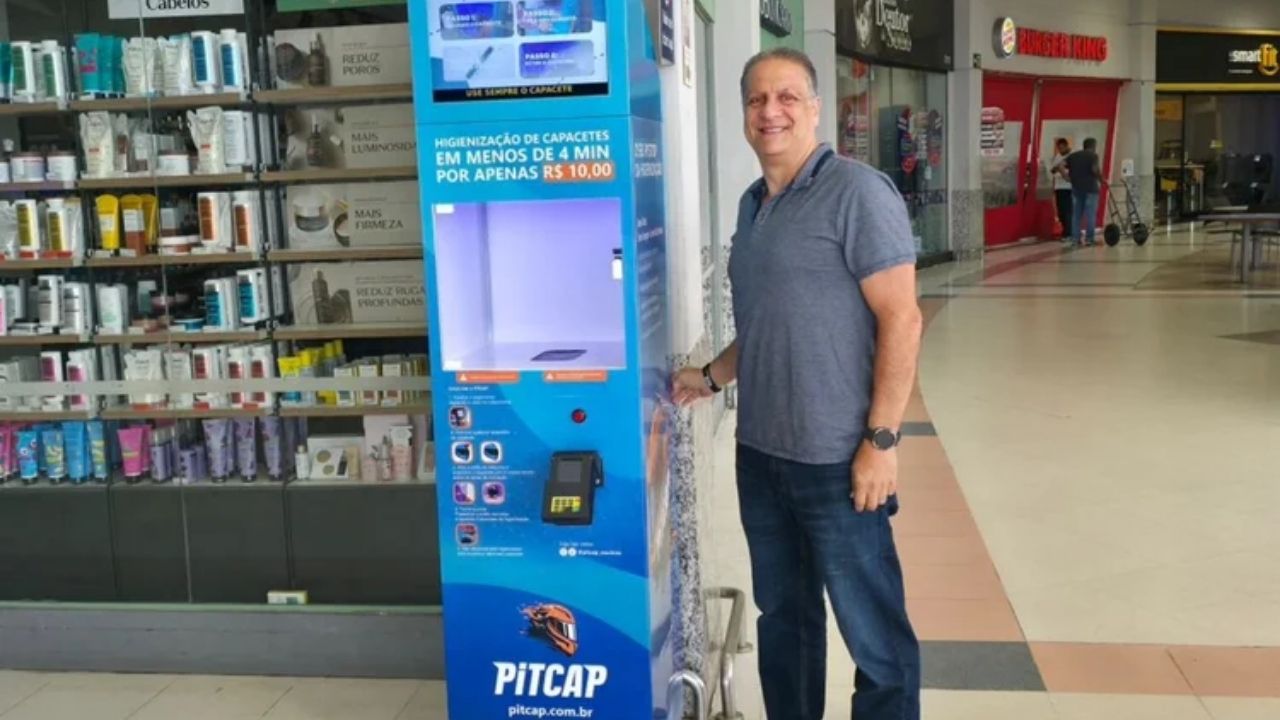
Unlike importing a ready-made solution, PitCap chose to manufacture the machine in Brazil. According to Fedlallah, local production allows greater control over the process, as well as facilitating maintenance and replacement of parts if necessary.
This decision is relevant for the franchise model. When the equipment is the heart of the operation, technical assistance, standardization, and availability of parts directly influence expansion.
The machine is presented by the company as 100% national. Exame reports that the equipment performs cleaning in less than four minutes, with steam and UV rays, leaving the helmet clean, sanitized, and scented.
The operation is automated. The user places the helmet in the compartment, makes the payment, and the machine performs the cleaning cycle without the need for a complex operation at the point of sale.
Service costs R$ 10 per wash
The price reported for each wash is R$ 10. This value helps position the service as a one-time and affordable expense for those who frequently use motorcycles, especially in urban areas with high traffic of delivery workers and employees.
PitCap’s logic depends on volume. The business makes sense when the machine is at a point with a constant flow of motorcyclists, such as gas stations, supermarkets, and areas near delivery services.
The source does not report the average number of washes per machine, profit margin, or revenue per installed point. Therefore, the confirmed data is the service price, not the exact profitability of each unit.
Even so, the founder claims that, with a good point of sale, it is possible to achieve significant revenue. This statement should be read within the context of franchises, where location, flow, and operation influence the result.
Franchise uses reduced initial investment
The expansion model of PitCap will be done through franchises. According to Exame, the initial cost reported is R$ 6,000 for the franchise fee and R$ 17,500 for the machine. From the fifth machine onwards, the franchisee no longer pays the fee.
This structure aims to make the business accessible to entrepreneurs interested in automated services. The proposal is to sell a lean operation, based on equipment, strategic location, and low daily complexity.
The company already has franchisees in Minas Gerais and Sobral, according to Fedlallah. The report does not detail how many units are active in these locations nor the installation schedule outside São Paulo.
The goal, however, is clear: to reach 200 or 300 points in operation by the end of 2026. This range shows that the company is working with accelerated expansion but still dependent on franchisee adherence and the choice of good locations.
Eight machines already operate in São Paulo
At the time of the report, PitCap had eight machines installed in strategic points of the capital of São Paulo and the state’s interior. The initial presence in gas stations and supermarkets reinforces the attempt to be where the motorcyclist already circulates.
This type of distribution is crucial for the service. A helmet sanitization machine needs to be on the user’s path, not in a location that requires specific travel.
The automated operation also favors installation in different types of commerce. Since the process lasts only a few minutes and does not require continuous specialized service, the equipment can function as a complementary service in transit locations.
Even so, the expansion needs to maintain a standard of use, maintenance, and clear communication to the consumer. In machine-based franchises, the reliability of the equipment weighs as much as the location.
Motorcycle fleet expands potential market
Exame cites data from Abraciclo according to which the national motorcycle fleet grew 42% between 2015 and 2024. In 2024, the total of motorized two-wheel vehicles reached 35 million in Brazil.
This number helps to size the potential market for the helmet as a recurring consumption object. The greater the daily use of the motorcycle, the greater the exposure of the equipment to sweat, dust, rain, pollution, and inadequate storage.
The expansion of transportation and delivery apps also increased the urban use of motorcycles. Platforms like Uber, 99, and iFood have started to have categories or operations linked to motorcycles, which reinforces the daily circulation of helmets in large cities.
The source does not inform how many delivery drivers or riders use PitCap’s service. Even so, the growth of the fleet and the presence of motorcycles in apps help explain why the company sees room to scale the business.
Sanitization combines convenience and recurrence
PitCap’s differential is not only in the machine but in the attempt to create a consumption habit. The helmet is mandatory for the motorcyclist, but cleaning is usually irregular, done at home or simply postponed.
By transforming cleaning into a quick and cheap service, the company tries to fill a gap between domestic cleaning and professional maintenance. The challenge is to make the user see value in paying R$ 10 for a four-minute process.
The use of steam and UV rays appears as part of the service’s technical proposal. According to the founder, the helmet comes out free of viruses and bacteria, but the report does not present independent reports or technical details about laboratory tests.
Therefore, the safest point is to treat the technology as the company’s claim, without expanding the promise. The verifiable data at the source is the automated operation, the price, the operation time, and the expansion strategy.
Expansion depends on the right locations
The goal of 300 locations by the end of 2026 requires more than selling machines. PitCap needs to find locations with adequate flow, ensure maintenance, train franchisees, and maintain a simple experience for the motorcyclist.
In automated businesses, location can define performance. Gas stations, supermarkets, and high-traffic areas make sense because they reduce friction: the customer can clean the helmet while performing another task.
Another factor is the repetition of use. For the model to gain scale, the service needs to stop being a novelty and become part of the routine for those who frequently use motorcycles.
Exame reports that the company wants to grow nationally but does not present a list of priority cities beyond the franchisees mentioned in Minas Gerais and Sobral. Thus, the expansion should still be monitored by the brand’s next moves.
Helmet became an opportunity in an underexplored market
The case of PitCap shows how a common item in traffic can generate a specific service when there is a large fleet, recurring use, and suitable points of sale. The helmet, once seen only as safety equipment, becomes also an object of maintenance and hygiene.
The company’s bet is to transform a little visible demand into a scalable franchise, with a national machine, automated service, and fixed price per wash.
Do you think helmet cleaning can become a habit among motorcyclists in Brazil, or does it still depend on consumer education and the right location? Leave your opinion in the comments.







Thanks for being a positive force that makes social media actually worthwhile for people