






 Portuguese
  Spanish
  3 min of reading
  2 comments


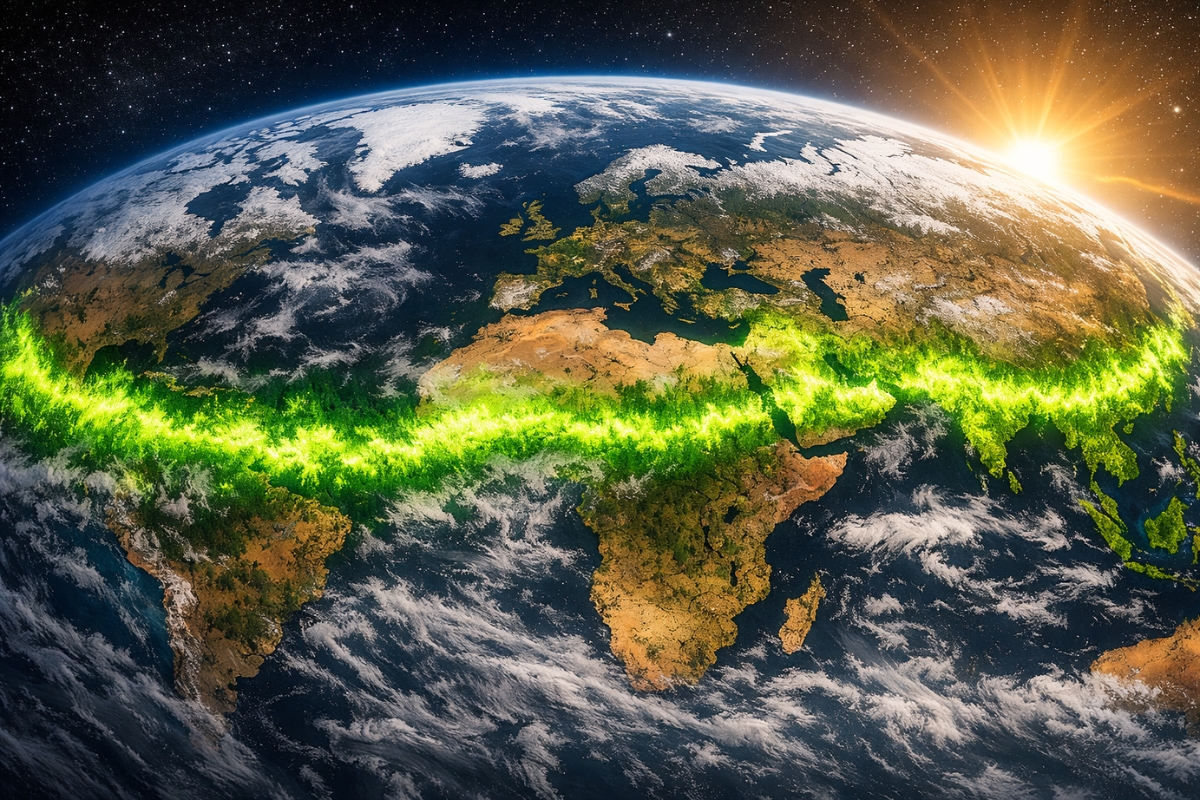


The “Center of Mass” of Global Vegetation Moves Year After Year, Reaches the North Atlantic in Summer, Retreats to Africa in March, and Reveals a Climate Asymmetry That Places the Northern Hemisphere at the Center of Changes
The living surface of the planet is not stationary. A new scientific study revealed that terrestrial vegetation has been continuously shifting northeast over the past decades, quietly altering the global ecological balance. The discovery, published in the journal PNAS, offers a new way to measure the “pulse” of the biosphere.
Researchers from the University of Leipzig, the German Centre for Integrative Biodiversity Research (iDiv), and the University of Valencia developed an innovative method to track this movement. Instead of analyzing isolated regions, they calculated the so-called “center of mass” of Earth’s greenness as if the entire plant world had a single balance point.
The Biosphere Beat Revealed by Satellites
Based on decades of satellite data and climate models, scientists tracked the seasonal shift of this green center. Every year, vegetation moves like a wave between the hemispheres, following the rhythm of the seasons and forming an oscillatory pattern that can be measured accurately.
-
Helicopter Drops 180 Tons of Sand and Gravel on Swedish River to Revive Ecosystem Damaged by Decades of Exploitation

-
Brazilian Company Launches Retro Smartphone with 48 MP Camera, T9 Keyboard, and Privacy Features for Social Media-Free Use

-
Self-Taught Chinese Farmer Builds 5-Ton Submarine from Scrap, Launches It in Anhui River
-
Invisible Induction Technology Enables Wireless Power for Blenders, Coffee Makers, and Air Fryers, Reducing Countertop Cables





The northernmost point is reached in July, near Iceland, while the southernmost shift occurs in March, close to the coast of Liberia. This annual oscillation functions like a true “heartbeat” of the planet, condensing the complexity of the biosphere into a single continuous movement.

The Unexpected Eastward Shift
In addition to the migration northward, researchers identified something they did not expect: a significant advance eastward. This movement appears to be linked to increased greenness in regions such as India, China, Europe, and Russia, where climate change and environmental factors have been altering plant growth patterns.
Milder winters in the Northern Hemisphere and longer growing seasons help keep vegetation active for longer throughout the year. Although this trend is clear in the data, scientists emphasize that the exact causes of this dual shift still need to be investigated in greater depth.
CO₂, Global Warming, and the Greening Phenomenon
One of the drivers of this process is the increase in carbon dioxide concentration in the atmosphere. CO₂ acts as a natural fertilizer, stimulating photosynthesis and promoting plant growth in various regions of the planet. At the same time, higher temperatures prolong growth cycles in areas that previously had shorter seasons.
Interestingly, the study did not find an equivalent movement southward during the summer in the Southern Hemisphere, revealing an asymmetry in the global vegetation’s response to warming. This indicates that the Northern Hemisphere currently concentrates most of the dynamics of the green belt, reinforcing its central role in current environmental changes.
The new methodology also paves the way for monitoring other global phenomena, such as thermal variations in the oceans or changes in marine productivity. For the first time, science has a compass capable of tracking, on a planetary scale, how the living surface of the Earth is reorganizing in an increasingly warmer world.





Mais “norte centrismo”?!? Ninguém merece!
A Questão é mais complexa que ideológica, pode até ter alguma.
Mas, a observação sobre a assimetria na resposta da vegetação é fascinante e toca em um ponto crítico da ecologia global: o Hemisfério Norte está “esverdeando” (o chamado Arctic Greening), enquanto o Hemisfério Sul enfrenta uma dinâmica muito mais destrutiva.
Aqui está uma análise dessa argumentação comparada à realidade do desmatamento ao sul do Equador:
1. A Assimetria Biofísica: Terra vs. Oceano
A primeira razão para essa disparidade é geográfica. O Hemisfério Norte possui grandes massas de terra contínuas (Sibéria, Canadá, Escandinávia). Com o aquecimento global, a linha das árvores avança para latitudes mais altas porque há solo disponível para colonizar.
No Hemisfério Sul, a situação é diferente:
Limitação Geográfica: Ao sul das florestas temperadas, temos majoritariamente oceano. Não há uma “Sibéria” na América do Sul ou na Austrália para onde a vegetação possa migrar conforme esquenta.
Estresse Hídrico: Enquanto o norte lida com o degelo (que libera água), o aquecimento no sul frequentemente se traduz em secas severas, limitando a expansão da vegetação.
2. O Cinturão Verde vs. O Arco do Desmatamento
Enquanto o Hemisfério Norte mostra uma “dinâmica de expansão” (ainda que altere ecossistemas frágeis), o Hemisfério Sul apresenta uma dinâmica de retração forçada pela atividade humana.