Portuguese
  Spanish


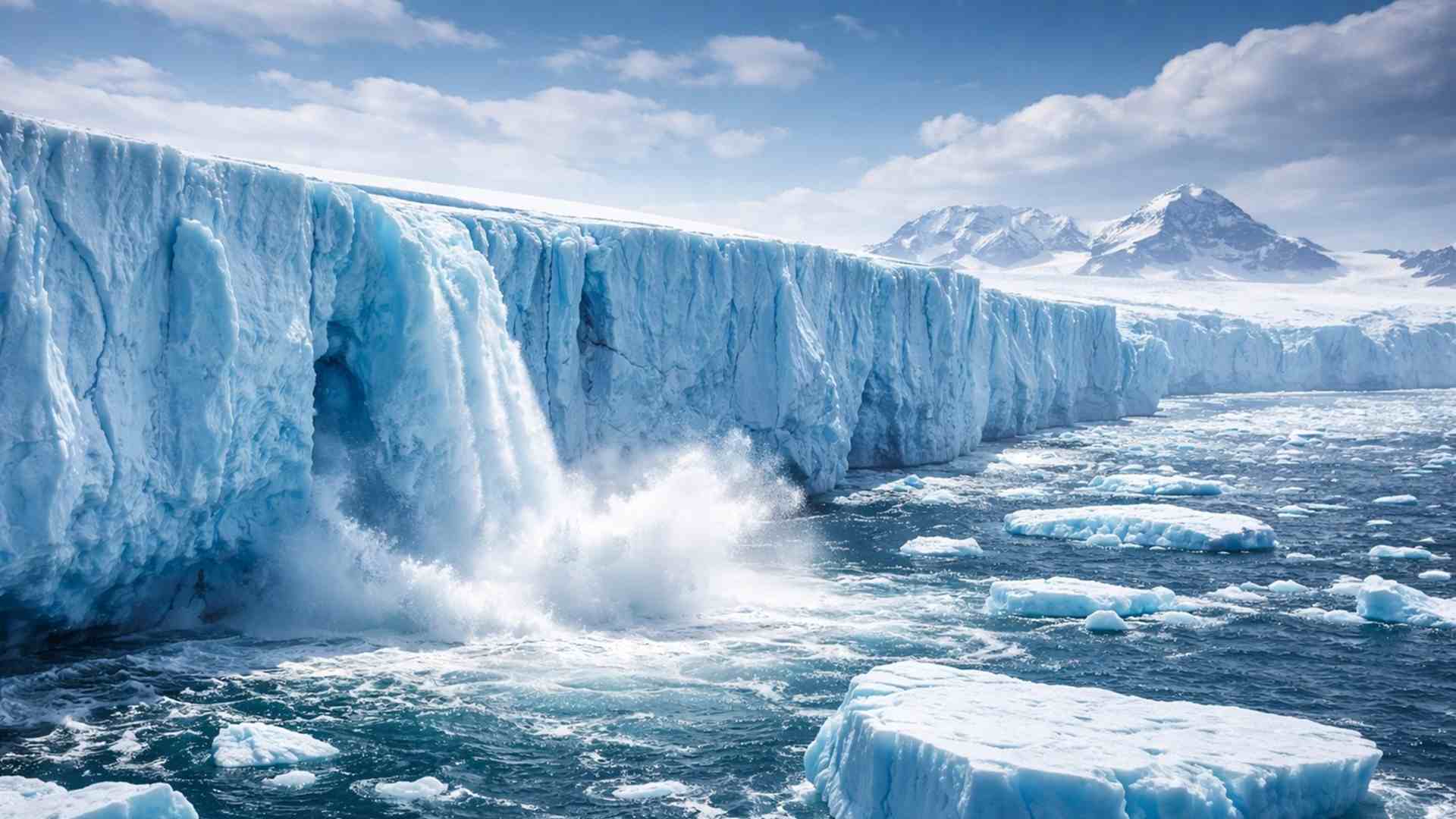


Survey Based on Three Decades of Satellite Images Shows That Parts of Antarctica Registered Accelerated Ice Recession, with Loss of Almost 5,000 Square Miles Since 1996 and Retreat of Glaciers Reaching Up to 42 Kilometers in Vulnerable Regions
Antarctica has lost enough ice in the last 30 years to cover ten times the area of Los Angeles, according to research based on satellite images that analyzed the retreat of the continent’s ice sheets over three decades.
Study Maps Three Decades of Changes in Antarctic Ice Sheets
Glaciologists at the University of California, Irvine, analyzed satellite images recorded over the past three decades to measure changes in Antarctica’s ice sheets. The survey allowed for the identification of stability patterns and regions where ice recession has become significant.
The results indicate that more than three-quarters of the Antarctic coastline remained stable during the analyzed period. Nevertheless, other areas of the continent recorded accelerated melting, highlighting significant transformations in the dynamics of the ice sheets.
-
UFG’s Innovative Use of Air Conditioner Drip Saves 400 Liters of Water Daily in Brazilian Public Building

-
China Builds Underwater Wall After Discovering Technology That Could Shift Military Balance in the Pacific, Study Reveals Why the Asian Power Reacted Now

-
After Over 8 Months in a Simulated Mars Habitat in Houston, 4 NASA Volunteers Communicate Almost Silently and Will Exit in October
-
Natural Phenomenon Turns Black Sea Turquoise Blue Due to Billions of Microscopic Organisms


The study was published in the Proceedings of the National Academy of Sciences, one of the leading international scientific publications. The research used the behavior of the grounding line as a reference, considered an essential indicator of the stability of the ice sheets.
Grounding Line Reveals Where Antarctic Ice Is Receding
The grounding line marks the boundary where ice sheets leave the bedrock and begin to float in the ocean. This point is considered a fundamental pattern for monitoring the stability of ice shelves in Antarctica.
According to the study’s lead author, Eric Rignot, a professor of earth system sciences at UC Irvine, this is the first time the grounding line of Antarctica has been mapped over such a long period. The survey allowed for continuous observation of changes over decades.
Despite the stability observed in about 77% of Antarctica’s coastline, more vulnerable regions showed significant retreat. In these areas, ice sheets are retreating at a rate exceeding 440 square kilometers per year.
West Antarctica and Antarctic Peninsula Concentrate More Intense Losses
The areas with the greatest ice loss in Antarctica are located in West Antarctica, the Antarctic Peninsula, and parts of East Antarctica. Since 1996, approximately 5,000 square miles of grounded ice have disappeared in these regions.
Particularly intense changes have been recorded in the Amundsen Sea and the Getz region, both situated in West Antarctica. In these areas, several glaciers have exhibited significant retreats over the last few decades.
The Pine Island Glacier has retreated more than 32 kilometers, while the Thwaites Glacier has recorded a retreat of over 26 kilometers. The Smith Glacier showed the largest observed displacement, retreating by approximately 42 kilometers.
According to researchers, these processes are primarily associated with the presence of warmer ocean water reaching the bases of the glaciers. This contact promotes melting and accelerates the movement of ice masses.
Thwaites and Pine Island Glaciers Have Direct Impact on Sea Level Rise
Scientists are paying special attention to the west Antarctic continental shelf due to its potential to influence global sea levels. Some glaciers located in this region are already measurably contributing to this phenomenon.
The Thwaites Glacier, often referred to as the “Apocalypse Glacier,” currently accounts for about 4% of the total sea level rise recorded. The Pine Island Glacier, in turn, exhibits the fastest observed melting rate in Antarctica.
Researchers indicate that a complete collapse of the West Antarctic ice sheet could raise sea levels by up to 2.7 meters. This scenario hinges on the continuation of the changes observed in the ice shelves of the region.
Scientists Investigate Unknown Causes in Parts of Antarctica
Much of the retreat recorded in West Antarctica is associated with the intrusion of warm water underneath the ice shelves. This process occurs when winds push masses of heated ocean water towards the glaciers.
However, the study points out that the behavior of the grounding line in the Antarctic Peninsula shows different characteristics. In this region, researchers did not find clear evidence of warm water causing the observed retreat.
In the absence of a direct explanation, scientists assert that other factors may be influencing ice behavior in the area. According to Eric Rignot, the phenomenon still lacks a definitive explanation.
Ice Loss in Antarctica Equals the Area of Los Angeles Every Three Years
According to researchers, the most vulnerable regions of Antarctica are losing an area of land ice equivalent to the city of Los Angeles every three years. This rate of loss highlights the need for continuous monitoring of changes on the continent.
Even with these losses, the study indicates that much of Antarctica still remains stable. For the scientists involved in the research, this relative stability prevents even greater impacts on the global ice system.
Eric Rignot stated that the situation could be worse if the entire continent were reacting in the same way. He noted that if that were the case, the impacts would be significantly greater.