Portuguese
  Spanish


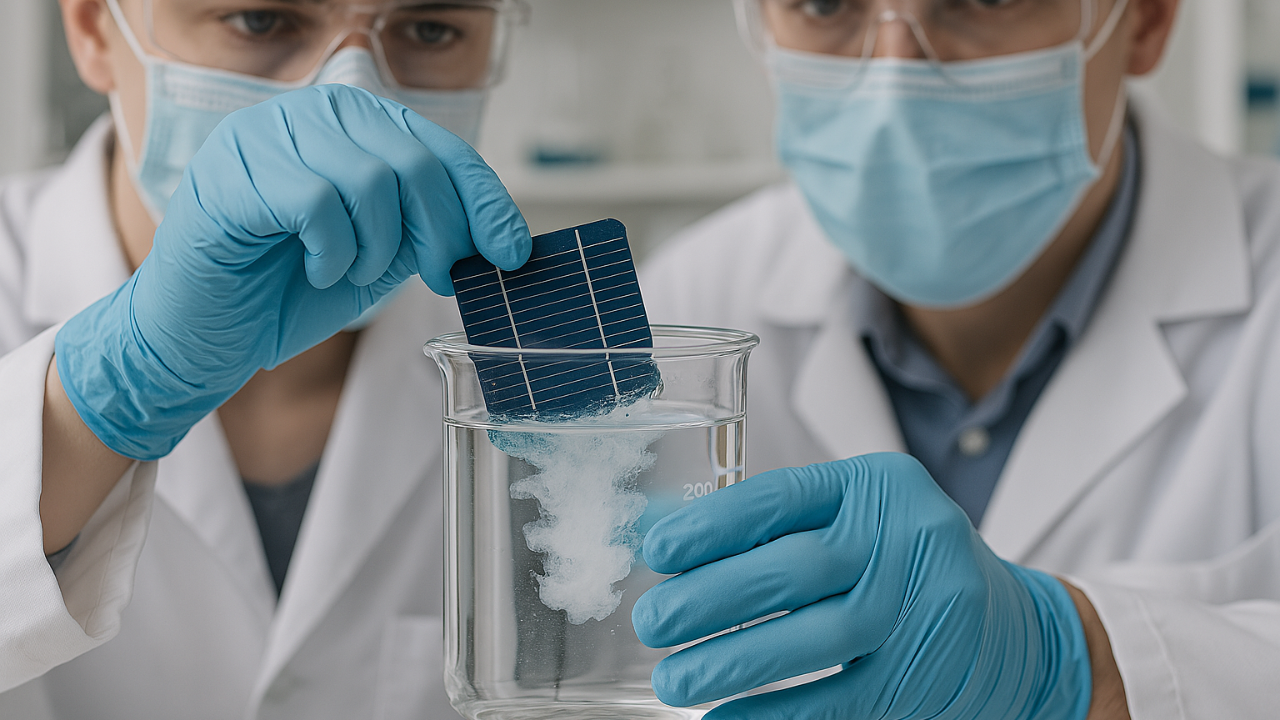

Swedish Scientists Developed A Sustainable Method To Recycle Perovskite Solar Panels Using Water, Eliminating Toxic Solvents And Making Solar Energy Even More Ecological.
The transition to clean energy sources is essential to ensure a sustainable future. In this context, solar panels stand out as one of the most promising solutions. However, the production and disposal of these devices still pose environmental challenges. Recently, scientists from Linköping University in Sweden developed a revolutionary method that uses water to recycle perovskite solar panels, making the process more ecological and efficient. This discovery promises to transform the production and disposal chain of solar panels, making solar energy even more sustainable.
The Problem of Solar Panel Waste
Traditional silicon solar panels have a limited lifespan, and as a result, large amounts of old solar panels end up in landfills, representing a significant environmental problem.
According to Xun Xiao from the Department of Physics, Chemistry and Biology at Linköping University, “currently, there is no efficient technology to deal with waste from silicon panels. That’s why old solar panels end up in the landfill.”
-
She spent 73 years breathing inside an iron lung, survived the aftereffects of polio, and became the last woman in the United States dependent on the equipment before dying at 78 years old.

-
Brazilian students created a $1 filter using pine bark, cotton, and 3D-printed parts to clean cassava wastewater, reduce the toxicity of a hazardous waste, and transform contaminated water into biofertilizer.

-
Astronaut from Artemis II steps down after mission to the Moon and decision surprises after a record of 406,771 km, a historic 10-day journey, and an unprecedented achievement for Canada.

-
A fossil kept for years in a small museum in Montreal concealed 450-million-year-old soft tissue, a discovery that has only happened once before in history.


The technology developed by the scientists at Linköping University allows for the complete recycling of perovskite solar cells without compromising their efficiency.
The method uses water as the main solvent, replacing toxic substances like dimethylformamide, which is widely used in traditional recycling processes.
Dimethylformamide is a common solvent in paints but is highly toxic and potentially carcinogenic, making its use an environmental and public health issue.
With the new technology for solar panels, degraded perovskites can be broken down in an aqueous solution, allowing for the recycling of all components, including cover glass, electrodes, perovskite layers, and the charge transport layer, Xun Xiao notes.
This represents a significant advancement in the circular economy of solar energy.
Benefits of the New Method
The new recycling method for solar panels developed in Sweden offers several environmental and economic benefits:
Sustainability: The use of water as a solvent reduces the environmental impact of the recycling process.
Energy Efficiency: Recycling does not compromise the performance of perovskite solar cells.
Waste Reduction: The total reuse of components prevents waste disposal in landfills.
The Importance of Perovskite Solar Cells
Perovskite solar cells are considered one of the most promising technologies for the next generation of solar energy.
In addition to being relatively cheap and easy to manufacture, they are lightweight, flexible, and transparent, allowing their application in windows, facades, and balconies.
However, one of the challenges of these cells is their shorter lifespan compared to silicon solar panels.
Additionally, they contain small amounts of lead, necessary for their high efficiency. Therefore, an effective and environmentally safe recycling method is essential for the long-term viability of this technology.
Impact of the Discovery on the Solar Energy Sector
With this innovation, perovskite can become an even more viable alternative to silicon, reducing the environmental impact of solar energy.
Companies in the sector are already showing interest in the technology, which can transform the market, making solar panels more sustainable and accessible.
“There are many companies that want to bring perovskite solar cells to market now, but we would like to avoid another landfill. In this project, we developed a method in which all parts can be reused in a new perovskite solar cell without compromising the performance of the new one,” says Niansheng Xu, a postdoctoral researcher at LiU.
The scientists at Linköping University published their study in the renowned journal Nature and have already applied for patents for their technology.
The next step is to develop the process for industrial scale, allowing this innovative solution to be applied on a large scale.