Portuguese
  Spanish


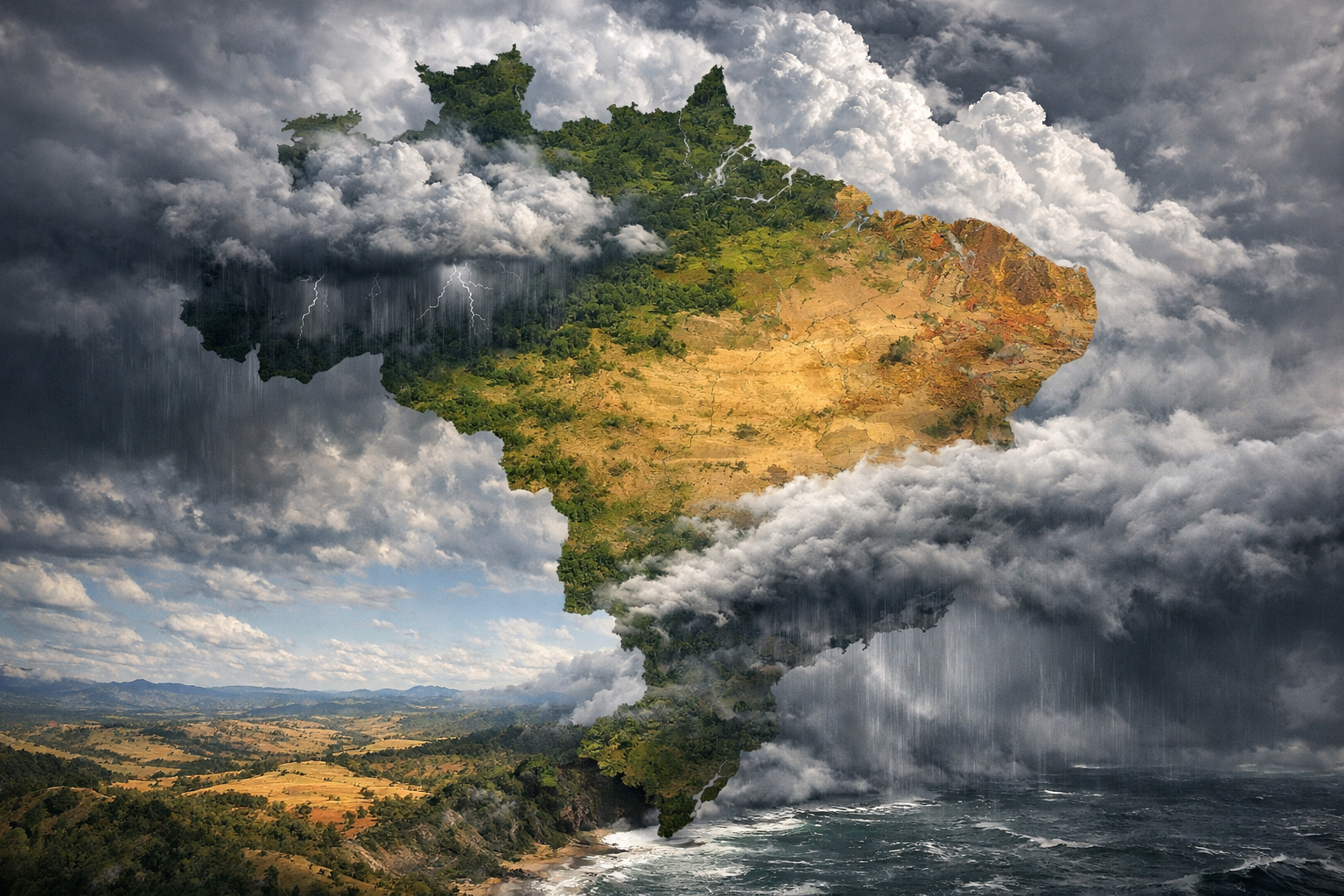

Sudden changes in the weather surprise the country with extreme rainfall, intense temperature variation, and advancement of cold air masses that are already starting to redefine the national climatic scenario
The second half of April begins with a true turnaround in Brazil’s climate. After a period of relative stability in some regions, the scenario changes rapidly with the return of rain, the presence of intense heat, and at the same time, the arrival of the first significant incursions of cold air of the year. This information was released by “Weather&Money”, a channel specialized in meteorology, which details a broad and technical overview of atmospheric behavior in the coming days.
Furthermore, the data indicates that between today and the 21st, a period coinciding with the long holiday, there is a forecast of significant rainfall mainly in the Northern region. In this sense, the accumulations vary between 45 mm and 100 mm in the areas highlighted in red, while regions in yellow may record between 25 mm and 45 mm. In the blue areas, the volumes range from 10 mm to 20 mm, while green indicates lighter rains, from 2 mm to 10 mm.
Intense rains in the North and Northeast contrast with dry weather in the Southeast and South during the holiday

Meanwhile, the distribution of rainfall in the country remains quite irregular. On one hand, states like Acre, Amazonas, and areas of Maranhão, Piauí, and Ceará are expected to receive significant volumes. In fact, there is a possibility of even more intense rains due to the so-called easterly waves, which can surprise and raise the accumulations above the forecasted levels.
-
Orphaned Youth Turns Dismissed Idea into Global Prestige with Innovative Wristwatch

-
English Skills Boost Career Opportunities in the Oil and Gas Industry

-
Brazil Secures Second Place at WorldSkills 2024 in Lyon, with 64 Young Professionals and 8 Medals, Including Gold from a Rio de Janeiro Hairdresser

-
3,000 Military Personnel from 10 Countries, Including US and Chinese Marines, Train Together in Brazil’s Savanna: Operation Formosa Becomes Largest Naval Ground Exercise Before First Cancellation Since 1988



On the other hand, regions like Bahia, Sergipe, and Alagoas have a more modest forecast, although isolated points may record unexpected volumes. In the Midwest, Tocantins is still receiving good volumes, while Mato Grosso concentrates rains mainly in the northern half, especially in the northwest.
In contrast, Goiás and much of the Southeast are facing a scenario of little rain. To illustrate the irregularity, Goiânia recorded an impressive 90 mm in just one day, accumulating 210 mm in two days — numbers that were not predicted in the meteorological models, which reinforces the unpredictability of the current pattern.
In the South and Southeast, therefore, the holiday will be predominantly dry. Still, there is a possibility of isolated drizzle due to the circulation of a cyclone located south of Uruguay, in addition to the entry of a drier air mass that keeps the weather stable.


Cold fronts, temperature drops, and frost risk mark the advance of cold at the end of April
Starting next week, however, the scenario begins to change again. Between Monday night and Tuesday, a cold front will advance through the South of Brazil, bringing rain and preparing the ground for the entry of more intense cold air.
In the next 15 days, until the beginning of May, rainfall volumes will remain high in the North, with accumulations that can reach between 100 mm and 260 mm, especially in areas of Amazonas, Pará, Amapá, and Roraima. At the same time, the Northeast also shows good indices, covering Maranhão, Piauí, Ceará, and even the coast of Bahia, with a significant improvement in volumes.
Meanwhile, the Southeast continues to experience rainfall below the ideal, with deficits ranging from 5 mm to 25 mm below average. This scenario is concerning, as the period marks the transition to the dry season, especially in May.
In the South, however, the pattern reverses. Rain returns with strength, with accumulations between 70 mm and 150 mm also extending to areas of Paraguay. This increase is directly linked to the frequent passage of cold fronts, including one expected for the middle of next week and another next weekend.
Additionally, temperatures begin to gradually drop. Until the 26th, there is still intense heat in regions such as western São Paulo, northern Paraná, Mato Grosso do Sul, and parts of Goiás, with highs between 32°C and 36°C. However, after the 24th and 25th, the cold intensifies, bringing colder mornings.
In fact, there are already records of temperatures between 0°C and 4°C in the Mantiqueira region, with occurrences of frost — a clear indication of the change in thermal pattern. In the South, new frost is forecasted between Sunday and Monday, especially in higher areas.
Thus, Brazil enters a period of strong climatic contrast: while some regions face heat and intense rain, others are already beginning to feel the effects of the typical autumn cold advancing.
In summary, the North and Northeast continue with consistent rains, the Southeast remains with precipitation below average, and the South begins a cycle of increased rains accompanied by temperature drops — a scenario that can directly impact sectors such as agriculture, especially during the harvest period.