Portuguese
  Spanish


A Viking gold treasure about 1,000 years old was found by chance near Rold, Denmark, after a resident saw pieces shining by the side of a forest road. The 6 solid gold bracelets total 762.5 grams and form the 3rd largest find of its kind ever recorded in the country.
The ground of Denmark returned a forgotten piece of the Viking Age. A resident walking along a forest road near Rold, in the north of the country, saw a metallic shine coming from the earth and ended up at the center of one of the largest ancient gold discoveries ever made there. The case was reported by the specialized site Heritage Daily.
What seemed like a detail at the edge of the path was actually a solid gold Viking treasure. In total, there are six bracelets weighing 762.5 grams, a very rare set that places the discovery among the three largest of its kind in Denmark’s history. It all started with a simple walk and a keen eye on the ground.
The discovery was not just luck: it became a case study for archaeology. Instead of taking the pieces home or trying to sell them, the resident handed the gold over to the regional museum, which allowed specialists to investigate the site calmly and recover the entire treasure. The result is a precious portrait of wealth and power at the end of the Viking Age.
-
Over 200 Cities in Southern Brazil on Storm Alert as Cyclone Near Uruguay Brings Heavy Rain, Hail, and Winds Up to 100 km/h

-
Archaeologists Discover 2,300-Year-Old Beer in Sealed Bronze Vessel from Ancient Chinese Tomb

-
35,000-Year-Old Saber-Toothed Tiger Cub Found Intact in Siberian Permafrost, Whiskers, Claws, and Skin Preserved Since the Ice Age
-
Scientists Uncover “Amazon Stonehenge” with 127 Giant Rocks, Shedding Light on Indigenous Solar Observations Before European Arrival



How the Viking treasure was discovered near Rold
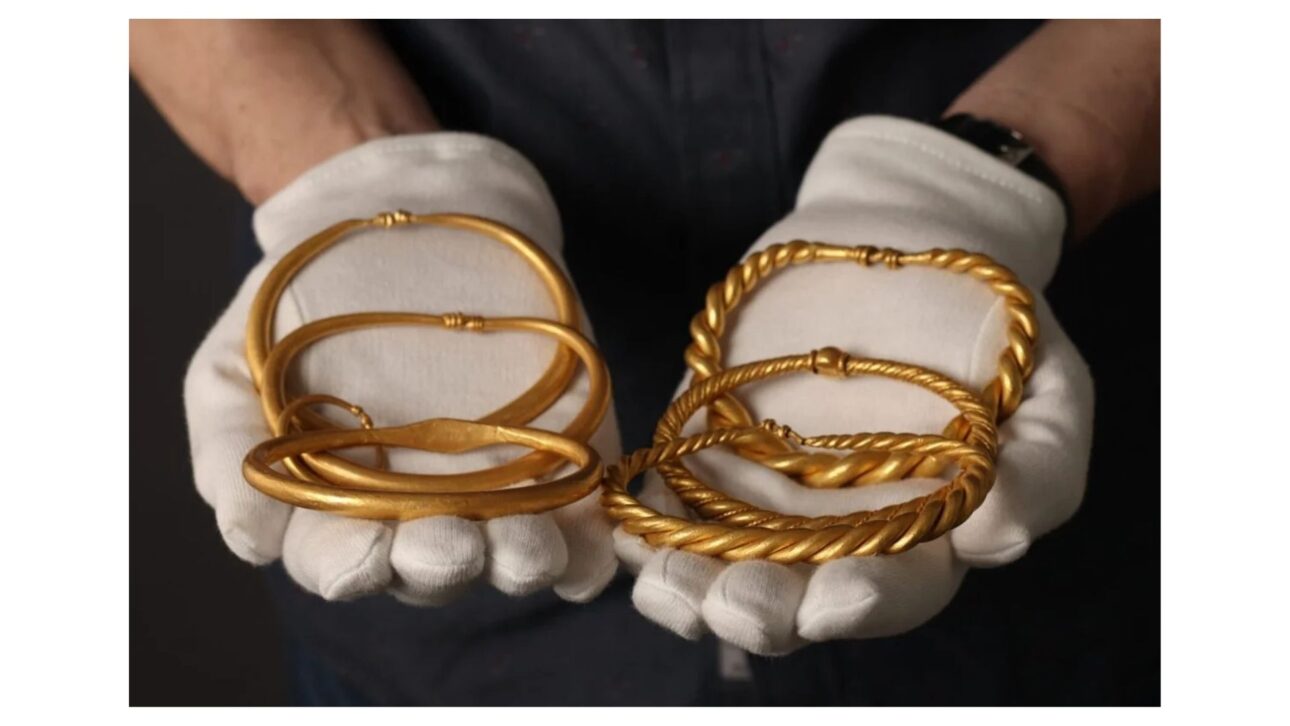
It all started with two heavy gold rings. According to Heritage Daily, a local resident noticed the pieces partially exposed in the soil, next to a forest road near Rold, in Himmerland, Northern Jutland. On April 22, he took the two objects to the archaeology department of the Museums of Northern Jutland (Nordjyske Museer), instead of keeping them.
The decision to notify the museum was crucial. With the information in hand, archaeologists went to the exact spot indicated by the resident and conducted a systematic search with a metal detector in the surrounding area. This is how the story gained momentum, and what seemed like an isolated find turned into a complete Viking treasure.
A scan revealed that there was much more gold buried there. Near the site of the first two rings, researchers found another bracelet, and about 15 meters ahead, four more emerged. Adding the two objects handed over by the resident, the collection reached six solid gold bracelets, all intact and in excellent condition.
By choice of those involved, anonymity was maintained. Both the resident who found the pieces and the owner of the land where the gold was preferred not to have their names disclosed, according to the archaeology portal Arkeonews. The focus, from the beginning, was on the historical value of the discovery, not on who would keep it.
What are the 6 gold bracelets of the treasure
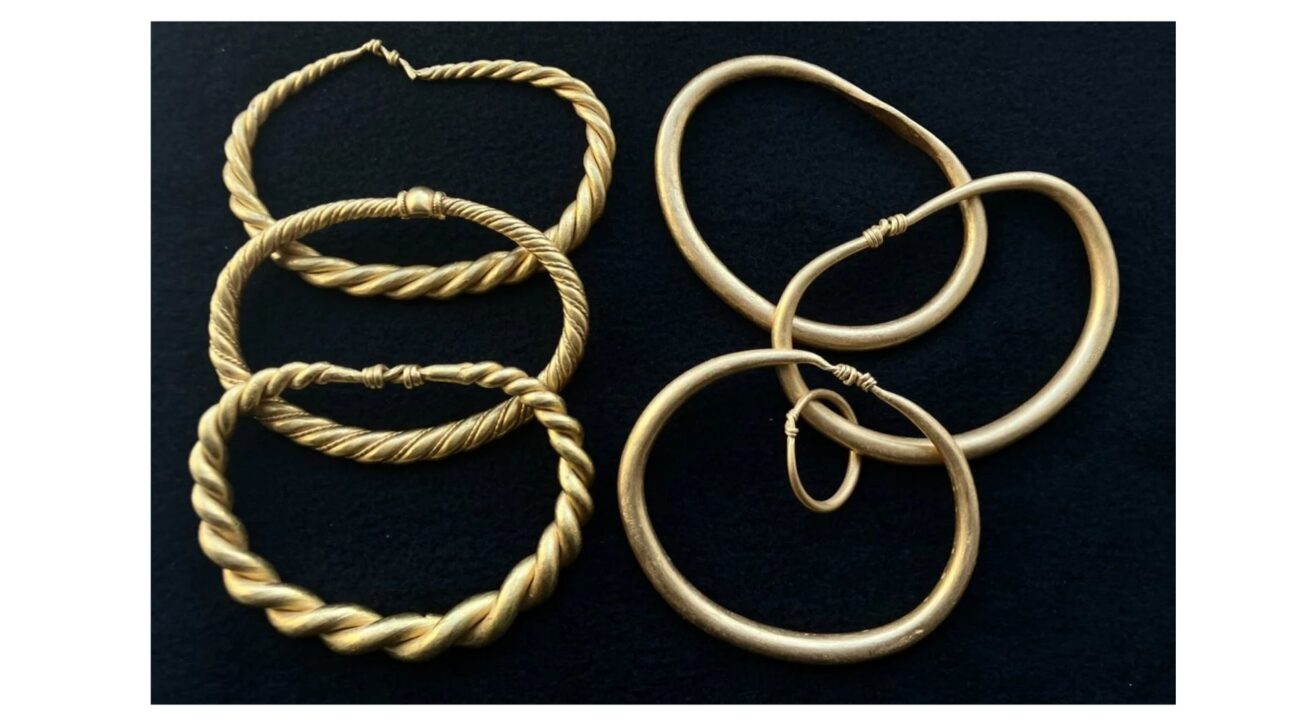
The collection stands out for the quality of the material. The six bracelets are made of almost pure solid gold, without significant mixing with other metals, which already indicates that they belonged to someone of great wealth. Together, they weigh 762.5 grams, equivalent to almost 1.7 kilos in ancient measures, an enormous amount of gold for the time.
The shapes vary greatly within the same treasure. According to Arkeonews, three of the bracelets were made by twisting two gold rods, with button-shaped clasps, while others were molded from solid bars or wires. There is also a piece decorated with zigzag and triangle patterns, and a bracelet that holds a smaller matching ring inside.
This variety tells a story about craftsmanship and prestige. Each manufacturing technique required the skill of specialized goldsmiths, and the finish shows that they were not ordinary objects, but pieces meant to be seen and displayed. For archaeology, the diversity of styles in a single Viking treasure helps to understand how gold was worked and valued in the Nordic world.
All this survived for about a thousand years underground. The fact that the six bracelets were found intact, without serious dents or missing pieces, is rare for such ancient objects. It is precisely this state of preservation that transforms the discovery of Rold into first-class material for studies on the Viking Age in Denmark.
Why it is Denmark’s 3rd largest Viking treasure
The discovery went straight to the top of a historical list. With 762.5 grams of gold, the Rold treasure is classified as the third largest Viking Age gold discovery ever recorded in Denmark. In a country with a long tradition of archaeological finds, reaching the podium is an achievement that few treasures attain.
Only two previous findings surpass Rold’s in the amount of gold. The first is the so-called Tissø ring, found in Western Zealand in 1977, one of the most famous Viking gold pieces in the country. The second is the Fæsted treasure, unearthed near Ribe in 2016, which for years ranked among the largest gold reserves of the period in Danish territory.
Being right behind these two names gives the real dimension of the find. We are talking about a collection that, in terms of gold volume, rivals discoveries that are already references in Denmark’s books and museums. It is no exaggeration to say that the Rold Viking treasure emerged overnight as one of the most important in the country.
The historical weight goes beyond the scale. More than the amount of gold, what impresses specialists is the combination of size, state of preservation, and the clarity with which the treasure was recovered, thanks to the resident’s action. All this makes local archaeology a winner, with an almost perfect case of documented discovery.
Who owned this Viking gold?
Gold in this quantity did not belong to just anyone. For researchers, a Viking treasure of this magnitude could only be in the hands of the elite who ruled the society of the time. Gold bracelets served as visible symbols of wealth, influence, and power, displayed by those at the top of the Nordic social pyramid.
The archaeologist leading the study got straight to the point. Torben Sarauw, responsible for the cultural heritage of the Museums of Northern Jutland, stated that “gold in the Viking Age was concentrated in the absolute elite of society” and classified the collection as “a completely unique find.” His statement summarizes why the discovery excited the scientific community so much.
These bracelets also had a political role, not just a decorative one. In the Viking world, gold rings and bracelets were used to seal alliances, reward loyal warriors, and demonstrate loyalty to powerful leaders. A chief who distributed gold among his allies bought support and cemented his position, in a system where generosity and power went hand in hand.
Therefore, the owners of the Rold treasure were likely connected to the rising power in Denmark. Those who gathered so much gold had contacts with the most influential families in the region and possibly with the royalty itself that was beginning to form around Harald Bluetooth. The collection is, in this sense, a material portrait of how wealth sustained power in the Viking Age.
The Viking Age and the unification of Denmark
The treasure belongs to a decisive moment in Nordic history. The bracelets are dated to approximately between the years 900 and 1000, the end of the Viking Age, precisely when Denmark was moving towards unification under a single king. It was a period of disputes, alliances, and concentration of power, and gold was at the center of this game.
This was the time of one of the most famous kings of northern Europe. It was during this era that King Harald Bluetooth strengthened royal power and helped consolidate the Danish kingdom. Around the year 965, he ordered his achievements to be inscribed on the famous Jelling Stone, a monument considered a sort of “birth certificate” of Denmark as a Christian and unified nation.
The connection with this king adds even more weight to the find. Since the Rold Viking treasure is from the same era when Harald Bluetooth reigned, it is plausible that its owners had a direct connection with the royal power that was then being established. The gold would cease to be merely personal wealth and become part of the web of loyalties that supported the throne.
Curiously, this medieval king became the name of a global technology. The wireless communication standard Bluetooth, present in billions of cell phones and headphones, was named in honor of Harald Bluetooth: just as the king united the peoples of Denmark and Norway, the technology would unite different devices. The Bluetooth symbol even combines the runes of his initials, permanently linking the Viking Age to the digital world.
Why was the Viking treasure buried?
Burying so much gold was no accident. Since the collection was found gathered and intact, archaeologists believe the treasure was deliberately deposited, not lost by carelessness. Someone chose that spot by the roadside and purposefully placed a small fortune in gold there.
The explanations for this follow two main lines. One possibility is that the owner hid the gold during a moment of instability or conflict, common at the time when Harald Bluetooth was fighting to consolidate the kingdom, intending to retrieve it later, in safer times, which never came to pass. Storing valuable goods underground was a common form of “safe” in a world without banks.
The other hypothesis has a religious character. For many peoples of the Viking Age, depositing precious objects in the earth or water could be an offering to the gods or part of some ritual, a sacrifice of wealth in exchange for protection, luck, or prestige. In this case, the gold would never be recovered, as it belonged to the sacred world.
Whatever the reason, the result is the same for science. The treasure remained where it was left for about a thousand years until the chance of a walk brought it back to the surface. For archaeology, this “message in a bottle” made of gold is a rare chance to directly glimpse the fears, beliefs, and strategies of those who lived at the end of the Viking Age.
What is danefæ and what happens now with the treasure
The fate of the gold follows an ancient and clear rule in Denmark. The six bracelets were declared danefæ, a term that, in practice, means “people’s treasure” or state property. Under Danish law, important finds of precious metals belong to the nation, and those who find them must hand them over to the authorities.
This system, however, does not leave the discoverer empty-handed. Whoever reports a find of danefæ receives a monetary reward, calculated based on the value and importance of the piece. It is precisely this model that encourages residents and ordinary people to notify museums, instead of hiding or selling what they find, as the resident of Rold did.
Now, the detailed study phase begins. The bracelets will undergo scientific analyses that help archaeology confirm the dating, understand the exact composition of the gold, and the manufacturing techniques. After that, the treasure is expected to be transferred to the National Museum of Denmark, the institution responsible for preserving the country’s most important finds.
The public will also have the chance to see the gold up close. According to Arkeonews, there are plans to exhibit the Viking treasure at the Aalborg Historical Museum before the summer, allowing anyone to admire the pieces that remained hidden for a millennium. Thus, a find that began by the roadside becomes accessible heritage for all.
What this Viking treasure has to do with Brazil
The first connection with Brazil is in the law. Here, the logic is similar to that of danefæ in a central point: archaeological finds do not belong to those who find them. Law No. 3,924, of 1961, and the Constitution define that archaeological sites and objects are the heritage of the Union, and any such discovery must be reported to Iphan, the federal institute that takes care of the heritage.
The difference lies in the incentive. While Denmark rewards in cash those who deliver a treasure, the Brazilian model focuses on protection and oversight, without the same payment system to the discoverer. Knowing cases like Rold’s helps understand why many countries discuss how to encourage people to report finds instead of hiding them from the authorities.
Brazil also has its own fascinating gold history. Although it doesn’t have Vikings, the country experienced the famous Gold Cycle in the 18th century, which filled cities in Minas Gerais like Ouro Preto and Mariana with wealth and baroque art. Here, gold shaped the economy, cities, and even the relationship with the Portuguese crown, showing that human fascination with the precious metal crosses continents and eras.
Finally, there’s the lesson about heritage and citizenship. Denmark’s case shows how the attitude of a single person, by notifying the authorities, can transform a lucky find into knowledge for the whole society. It’s a valid reminder for Brazil as well, where archaeological sites and fossils continue to appear and depend on the collaboration of those who find them to not be lost.
And you, what would you do if you found gold by the roadside?
The Viking treasure of Rold proves that history is still literally by the wayside. Six solid gold bracelets, totaling 762.5 grams and buried for about a thousand years, came to light because a resident decided to look at the ground during a walk and then did the right thing: notified the museum. The result is the third-largest gold find of the Viking Age in Denmark.
And you, have you ever imagined stumbling upon such a treasure in the middle of a walk? Share in the comments what you would do if you found ancient gold emerging from the ground, and if you think discoveries like this still hide many secrets about the Viking Age waiting to be revealed.