Portuguese
  Spanish


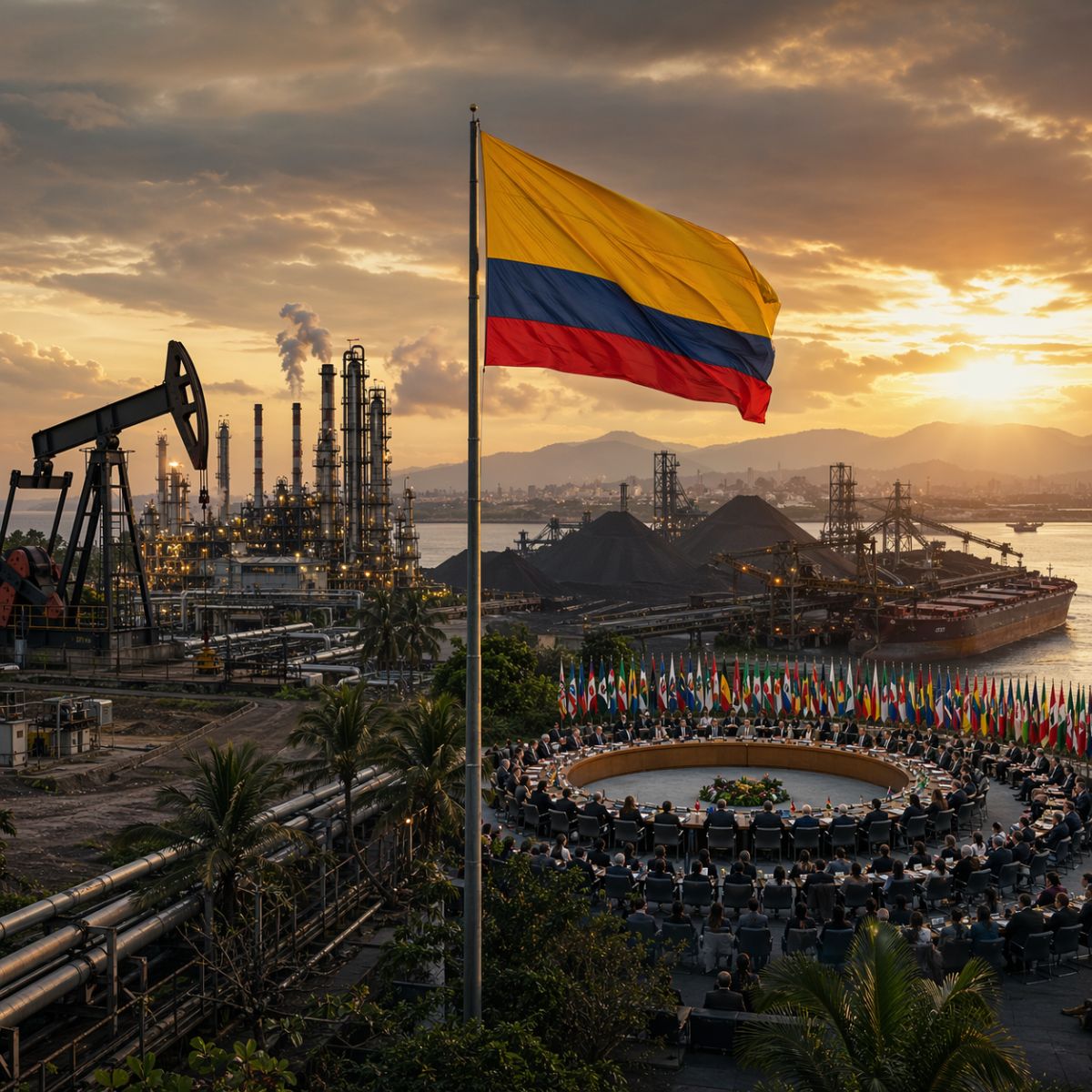

The city of Santa Marta, on Colombia’s Caribbean coast, hosted representatives from about 50 countries to negotiate a binding treaty for the gradual phase-out of fossil fuels, including oil, coal, and gas. The paradox is evident: Colombia is Latin America’s fourth-largest oil producer, coal and gas account for a third of its exports, and Santa Marta itself has been defined for decades by the coal economy.
Colombia has just hosted the most paradoxical conference on the 2026 diplomatic calendar. In Santa Marta, a city whose economy has been linked for decades to coal exports, representatives from about 50 countries gathered to negotiate the so-called Fossil Fuel Treaty, an initiative that seeks to curb the expansion of oil, coal, and gas production and negotiate a just transition away from existing exploitation. Organizers state that 18 nations are already working on a binding agreement to abandon the energy sources that contribute most to global warming.
Gustavo Petro’s government has doubled solar energy generation in four years, but experts warn that the energy transition is progressing much slower than official rhetoric suggests. Colombia’s Caribbean coast, precisely where the conference was held, continues to face power grid failures and high tariffs, exposing the contradiction between discourse and reality. For Latin America, which has abundant sun, wind, strategic minerals, and hydropower potential, the central question is whether the energy transition will actually reach homes and small businesses or remain a theoretical concept.
What the Fossil Fuel Treaty proposes and who is negotiating
According to information released by the DW Español Channel, the idea of stopping the use of fossil fuels is not new, but the Santa Marta conference represents a concrete step forward. Unlike UN climate negotiations, which operate by consensus and are historically blocked by oil-producing countries, the treaty seeks to advance with a smaller group of nations willing to commit. The model is inspired by the Treaty on the Prohibition of Anti-Personnel Mines, which started with few signatories and today brings together more than 160 member states.
-
Artesian Well Becomes Lifeline for Small Brazilian Farm: Drilling Reaches 60 Meters, Finds Marble, Navigates Rock Fissures, and Strikes Fresh Water

-
Street Cleaner in Brazil Finds Discarded Books That Helped His Wife Pass Civil Service Exam and Become Police Captain
-
July’s Night Sky to Feature Planetary Alignments, New Moon, Venus at Sunset, Buck Moon, and Two Meteor Showers

-
Fisherman Catches 18kg Catfish Near Brazil’s Itaipu Lake, Among Largest Recorded in Recent Years



Around 55 countries participated in the negotiations, and organizers hope that the regulatory and reputational pressure generated by the initial group will force others to join. At last year’s UN summit in Brazil, several states had already supported the gradual phase-out of fossil fuels, and the Santa Marta conference sought to leverage this momentum to transform intentions into formal commitments. The challenge is that a treaty adopted by a limited number of countries needs to generate enough practical consequences to influence the global energy system.
Why Colombia is the most contradictory host possible
Colombia is Latin America’s fourth-largest oil producer, and coal and gas account for a third of its exports. Hosting a conference on the end of fossil fuels while the national economy depends on them is a contradiction that the Petro government deliberately embraced, positioning the country as an example that even producing nations can lead the transition to clean sources.
The Colombian government has doubled solar generation capacity in four years, a significant advance, but one that represents only a fraction of the country’s total energy matrix. The Caribbean coast, where Santa Marta is located, suffers from inadequate grid infrastructure, high technical losses, and electricity tariffs among the highest in the country. Professor Clara Inés Pardo Martínez, from the Universidad del Rosário, points out that the true impact of renewable energy is being felt in self-generation and decentralized energy communities, not in the reduction of centralized system tariffs.
What the war in the Middle East has to do with the Santa Marta conference
The urgency of the conference gained an additional layer with the war in the Middle East. Experts present in Santa Marta argued that global dependence on oil and gas makes entire economies vulnerable to conflicts in producing regions, and that a single blocked shipping route can shake world markets. The phrase that summarized the argument was direct: if a maritime route can destabilize the global economy, that is not energy security, it is fragility.
The war has driven up prices for energy and agricultural inputs like fertilizers, affecting developing countries that rely on imports of fossil fuels. For Latin America, which has exceptional natural conditions for solar and wind generation, the crisis exposes the cost of not having accelerated the transition when prices were low. The argument of the treaty’s proponents is that continuing to expand oil exploration amidst a climate and energy crisis is not realism, but denial.
The obstacles preventing the transition from reaching people
The Colombian case illustrates a problem that is repeated throughout Latin America. More solar and wind energy does not automatically translate into lower tariffs for the final consumer, especially when transmission and distribution infrastructure is precarious. On Colombia‘s Caribbean coast, homes with solar panels show a real reduction in costs, but those who depend on the centralized grid continue to pay dearly for an unstable service.
The obstacles are multiple. Lack of accessible financing for renewable projects, legal impediments that delay implementation, and electricity grids that were not sized to receive decentralized energy form a set of barriers that no international treaty can solve alone. The energy transition needs to become reliable and equitable in all territories so that the benefits of clean energy reach the populations that need it most, and not just those who can afford their own generation systems.
What needs to come out of Santa Marta for the treaty not to be a dead letter


The Santa Marta conference will be judged by what it concretely produces in the coming months. For the treaty not to become just another document of good intentions, participants need to define financing mechanisms, remove legal impediments, and establish verifiable targets for reducing fossil fuel production. Professor Pardo Martínez emphasized that the key lies in operationalizing commitments with efficient management and attracting investments for renewable energy in regions that depend on coal and oil.
Renewable energies are in full global expansion. In 2025, they supplied all the growth in global electricity demand and surpassed coal as the main source of generation. But the speed of this transition varies enormously between countries and regions, and Latin America risks being caught between the ambitious rhetoric of international conferences and the reality of populations that still pay dearly for precarious electricity. Santa Marta could be the turning point, or another event where words replaced actions.
Do you think oil-producing countries like Colombia can credibly lead the energy transition, or is the paradox too great to be ignored? Tell us in the comments what you think about the future of fossil fuels and if clean energy has already reached your home.