






 Portuguese
  Spanish
  5 min of reading
  0 comments


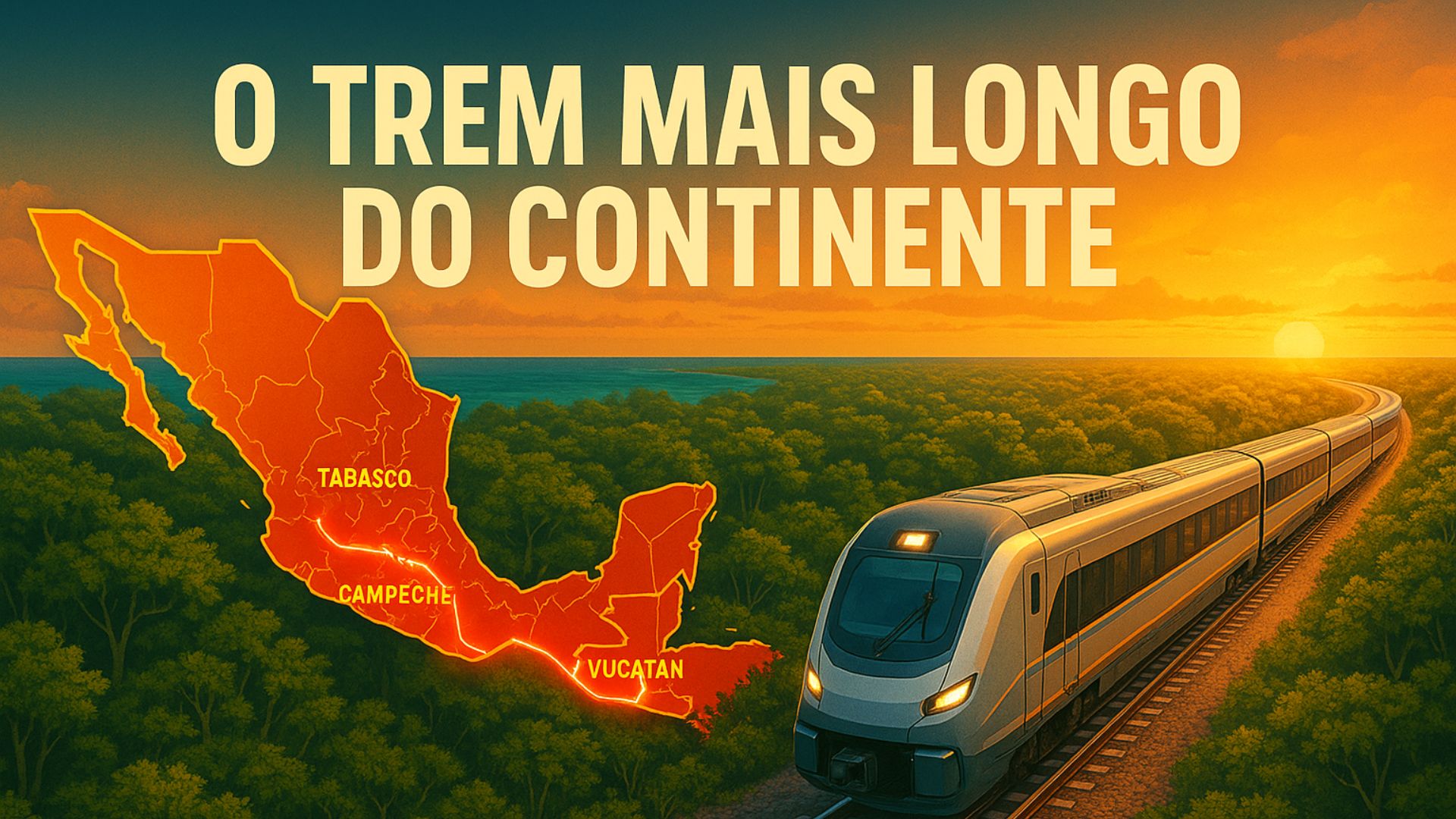
Large-Scale Railway Advances in Southeast Mexico and Reorganizes Transport, Tourism, and Regional Development.
With about 1,500 kilometers of track, officially 1,554 km, the Tren Maya is consolidating itself as one of the largest railway projects underway in Latin America, connecting five states in southeast Mexico and combining passenger transport, tourism, and freight in a single corridor.
The project, presented by the Mexican government as the largest recent public investment in railways in the region, crosses Chiapas, Tabasco, Campeche, Yucatán, and Quintana Roo, redesigning mobility in the Yucatán Peninsula.
Officially named Tren Maya, the system forms a large railway arc that starts in Palenque, Chiapas, heads toward the Mexican Caribbean, and closes a circuit around the peninsula.
-
Brazilian Joins Homeownership Consortium, Faces Decade of Dual Payments Totaling $141,000, Surpassing Traditional Mortgage

-
Land Rover to Halt Production in July, Putting 371 Jobs at Risk, as Chinese Automaker Negotiates to Convert Factory to 100,000 Vehicles Annually by 2027

-
Mexican Pest Threatens U.S. Cattle Herds at Historic Lows, Potentially Boosting Brazilian Beef Exports as Burger Prices Soar

-
Brazilian Freight Bill Progresses in Congress with $5,000 Minimum Wage, 70% Advance Payment, and Fines Up to $1 Million, as Agriculture and Industry Warn of Rising Costs and Legal Uncertainty


The line was conceived as an intermunicipal railway for medium and long distances, with trains for tourist use, regular passenger services, and freight trains, connecting airports, established tourist areas, and medium-sized cities that until then primarily depended on highways.
Section Structure and Regional Connections

Along the route, the Tren Maya currently has 34 stops, divided into 20 main stations and 14 intermediate stops.
Initially, the project was presented with “about 30 stations,” a number that was adjusted as the route was redesigned and new boarding points were included.
The route is organized into seven sections that, together, connect rural areas and urban centers.
Palenque, Mérida, Cancún, Tulum, Chetumal, and Campeche appear among the most important nodes of the network, serving as gateways to tourist destinations and productive areas.
At several points, the stations were built or remodeled outside the historic centers in an attempt to reduce direct impacts on protected areas and better organize the flow of passengers and vehicles.
In addition to state capitals and major cities, the route reaches smaller towns that historically have been left out of the main public investment axes.
The combination of larger stations with smaller stops aims to balance service to high tourist flow destinations and communities that rely on daily commuting for services, commerce, and work.
Economic Development Driven by the Tren Maya
From its inception, the Tren Maya was presented as a regional development project, not just as a passenger line.
The central objective is to boost economic growth in southeast Mexico, a region that, for decades, has received less investment than the center and north of the country.
The official promise is to diversify job opportunities, expand infrastructure, and redistribute part of the tourism concentrated on the coast of the Riviera Maya to the interior of the peninsula.
The railway was planned to better integrate sun and beach tourism with historical and cultural tourism.

By bringing resorts in Cancún, Playa del Carmen, and Tulum closer to cities like Mérida and Mayan archaeological areas, the project aims to prolong visitors’ stays and increase average spending per trip, benefiting small restaurants, boutique hotels, local guides, artisans, and rural producers.
The economic impact also manifests during the construction and operation phase.
Large-scale works required thousands of workers and contracts with national and foreign contractors, mobilizing supply chains of cement, steel, sleepers, railway equipment, and engineering services.
The government’s expectation is that with the full operation of the seven sections, job creation will stabilize in activities such as track maintenance, station operation, logistics, hospitality, and associated services.
Tourist, Passenger, and Freight Trains in the Same Network
Although it is widely publicized as a tourist train, the project was designed to combine three main functions: tourism, daily passenger transport, and freight movement.
Tourist-oriented trains operate with panoramic cars and differentiated onboard services, while regular trains serve local residents on daily or weekly commutes.
In freight transport, the railway opens a new avenue for the distribution of agricultural products, construction materials, and various goods, connecting ports, industrial hubs, and rural areas.
In the long term, the intention is for the Tren Maya to reduce logistical costs, alleviate congested highway sections, and increase the competitiveness of small and medium producers in the region.
At the same time, the network plays a strategic role in connecting airports and tourist destinations.
Stations connected to airports in Cancún, Campeche, and Palenque facilitate access for international and domestic visitors to the multiple points along the route, allowing the train to function as the backbone of regional mobility.

Environmental Impacts and Criticisms of the Project
Despite the official rhetoric of sustainable development, the project has faced criticism from environmentalists, scientists, and indigenous organizations since its inception.
Groups in the region report deforestation in areas of native jungle, fragmentation of ecosystems, risks to caves and aquifers in the peninsula, and impacts on traditional communities living near the route.
The construction and operation were subject to various legal actions and requests for suspension.
Organizations associated with Mayan people and environmental entities point to failures in prior consultations, fragmentation of environmental impact studies, and non-compliance with court orders that mandated the halting of specific sections.
Even with these challenges, the construction has progressed, and the service has started operating gradually.
In recent years, the Tren Maya has also recorded operational incidents, including derailments in sections of Yucatán, which reignited the debate about the quality of the work, track maintenance, and the safety standards adopted.
In one of the incidents, cars derailed at low speed, and passengers had to continue their journey by other means, leading to the establishment of investigation committees and renewed criticism about the rush to deliver the project.
Sustainability and Next Operational Challenges
To reduce the carbon footprint, part of the route has been designed with electrification, especially in the axis that connects Mérida, Cancún, and Chetumal.
In other sections, the trains use diesel or electro-diesel systems, a strategy that seeks to balance implementation costs and energy efficiency.
The official narrative links the project to the idea of sustainable tourism, with a promise to encourage the use of the train instead of buses and cars for long journeys across the peninsula.
The full operation of the seven sections paves the way for new integrations with other passenger railway corridors that the Mexican government intends to implement in different regions of the country.
These plans include the recovery of existing sections and the adaptation of lines currently used for freight, in an attempt to reposition passenger railway transport on the national infrastructure agenda.
Although the Tren Maya is already operational across its planned extent, the consolidation of its operation, correction of technical faults, mitigation of environmental impacts, and strengthening dialogue with local communities will be decisive in determining whether it is remembered as a catalyst for balanced development or as a megaproject marked by controversies.





Be the first to react!