Portuguese
  Spanish


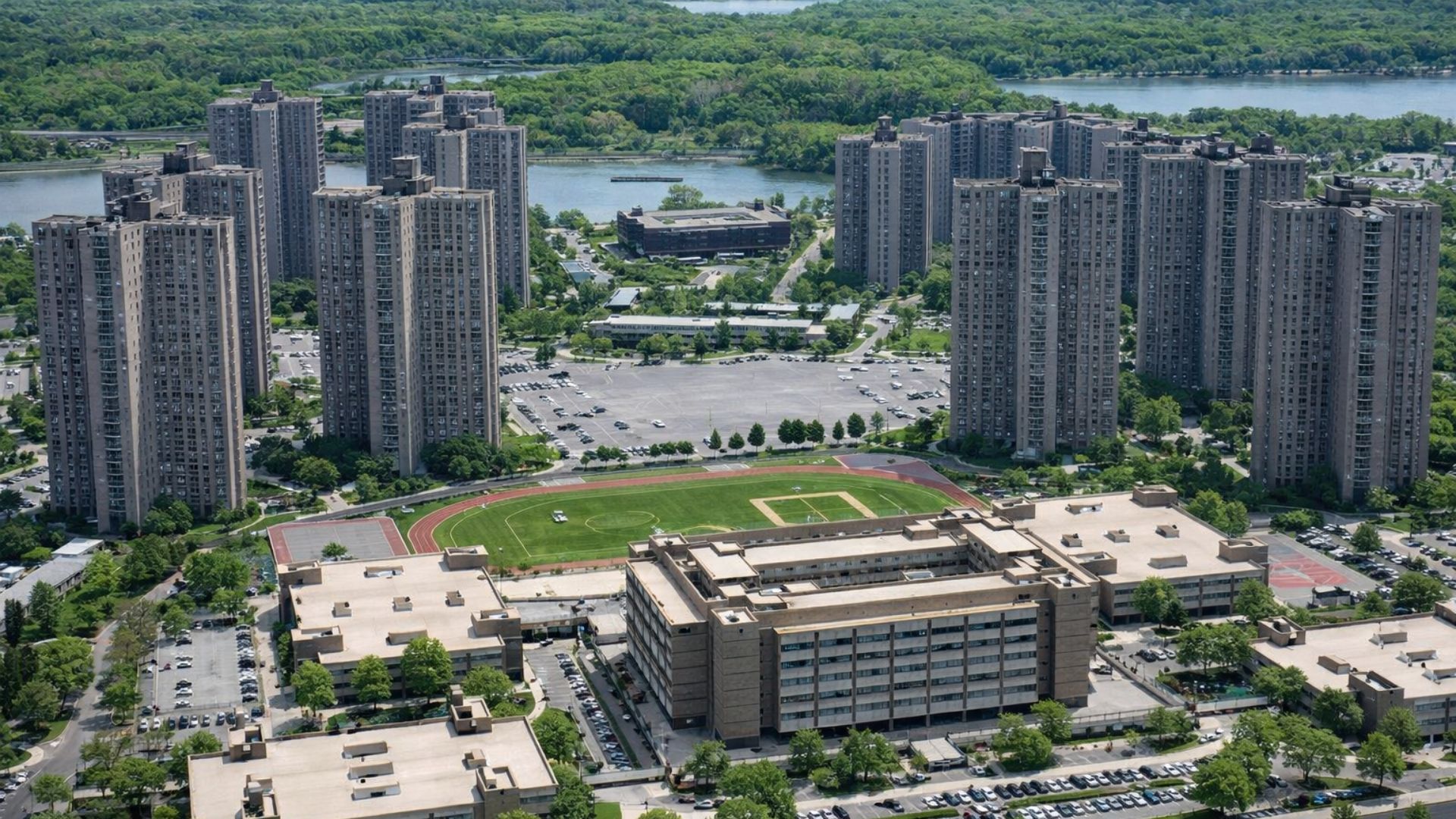


Large Residential Development in the Bronx Brings Together Tens of Thousands of Residents, With Its Own Educational Structure, Three Shopping Centers, and an Independent Energy System That Withstood Hurricane Sandy, Establishing a Rare Model of a Planned Neighborhood with Scale and Functioning Comparable to That of a City.
In the northeastern Bronx, New York, Co-op City brings together 15,372 apartments in a single residential development, housing a population that varies, according to the consulted public source, from about 50 thousand to more than 59 thousand residents, operating with services and infrastructure reminiscent of a city.
Housing Cooperative on an Urban Scale in the Bronx
Although many reports refer to the location as a “condominium,” Co-op City operates as a housing cooperative linked to New York State’s Mitchell-Lama program, a model where residents are shareholders and pay monthly fees to maintain operations and services.
The scale of the development is evident in its urban form: there are 35 high-rise residential buildings and seven townhouse complexes, arranged to create a planned neighborhood, with internal streets, green spaces, and community facilities integrated into daily life.
-
Abandoned Coal Crane at Copenhagen’s Old Port Transformed into Luxury Waterfront Retreat with Spa and Ship Views

-
Couple Sold Everything to Restore a 300-Year-Old Abandoned Mansion, Uncovering Ancient Books and Untouched Rooms
-
Couple Builds Sustainable Home from Straw Bales, Wood, and Clay in Brazil
-
At 64, Grandma Sônia Turned Homemade Recipes into a Family Business, Growing Casa de Bolos to Over 600 Locations and Expanding to Portugal




This level of consolidation is also reflected in a rare administrative detail for a residential complex: Co-op City has a unique ZIP code, 10475, adopted by residents and services to organize deliveries, mail, and routines.
Schools Within the Complex Reduce Commutes
The idea of a “city within a city” is reinforced in the educational area, as some schools are located within the development, reducing the need to traverse long distances to reach classrooms and school-related activities.
Public records and descriptions of the complex indicate the existence of an educational park that houses units geared towards different age groups, including high school, as well as intermediate and elementary schools, in a configuration designed to serve nearby families.

As a result, the flow of students and guardians tends to organize like in smaller urban centers: entry and exit times impact local circulation, and walking becomes a viable option for a significant number of residents.
Still, the presence of schools in the perimeter does not eliminate the connection to the rest of the city, as jobs, universities, and specialized services remain distributed throughout other regions of the Bronx and more central areas of New York.
Three Shopping Centers and About 150 Stores in the Same Neighborhood
Another pillar of internal functioning is commerce, as Co-op City is served by three shopping centers, mentioned in institutional materials and in journalistic profiles about the development, which describe the formation of a strongly concentrated consumer market.
Surveys about the neighborhood indicate that these centers boast around 150 stores, in a mix that typically includes everyday items, food, and basic services, making it possible to meet recurring demands without immediately depending on other commercial hubs.
In parallel, the commercial structure houses offices occupied by professionals from various fields, such as medicine and law, reinforcing the logic of solving part of daily issues in the nearest vicinity.
This combination of housing, education, and commerce in the same area helps explain why Co-op City frequently appears in urban analyses as an extreme example of residential planning at a large scale.
Security and Self-Management in a Neighborhood of 50 Thousand Inhabitants
To manage a complex of this size, governance also relies on internal mechanisms, including security routines and community communication, which are usually associated with neighborhoods possessing a high degree of self-organization.
The management of the development is attributed to the Riverbay Corporation, an entity linked to the cooperative, responsible for regulations, representation, and operational decisions that affect everything from building maintenance to shared services across the territory.
Even when the structure appears self-sufficient in various aspects, Co-op City remains integrated into the public rules and systems of New York, which means coexisting with state and municipal legislation on issues such as housing, energy, and infrastructure.
Cogeneration Plant Ensured Energy During Hurricane Sandy

The element that most differentiates Co-op City from conventional residential neighborhoods is the presence of a cogeneration plant of the CHP type, capable of producing electricity while simultaneously utilizing the heat from the process to meet the complex’s thermal needs.
Engineering documents and descriptions associated with the plant indicate a capacity of around 40 megawatts, and highlight the system’s role in local energy reliability, particularly by reducing part of the immediate dependency on the external grid for essential services.
This arrangement gained prominence after Hurricane Sandy, when technical materials and public accounts documented that the plant continued to operate during and after the storm, maintaining supply for residents even with extensive failures in the grid in nearby areas.
Although Sandy occurred in 2012, the event continues to be cited as a reference in discussions about resilience and distributed generation, as it provides a concrete case of how a local system can sustain basic services during extreme events.
Public Library Has Served Residents Since 1973

Daily life in the neighborhood also involves cultural and reading facilities, such as the Baychester Library of the New York Public Library, which serves the Co-op City community and surrounding areas since the unit opened on March 13, 1973.
In areas with a high concentration of residents, such structures often function as educational support and community spaces, directly impacting the routines of students, families, and seniors seeking nearby services without depending on long commutes.
By combining housing, schools, commerce, services, and its own energy infrastructure, Co-op City has become a unique case of density and planning within the urban fabric of the Bronx, raising ongoing discussions about how large metropolises organize access to services.
With cities around the world pressured by housing costs and the need for more reliable infrastructure, what kind of urban model could replicate part of this self-sufficient neighborhood logic without concentrating so many residents in a single development?