






 Portuguese
  Spanish
  5 min of reading
  2 comments


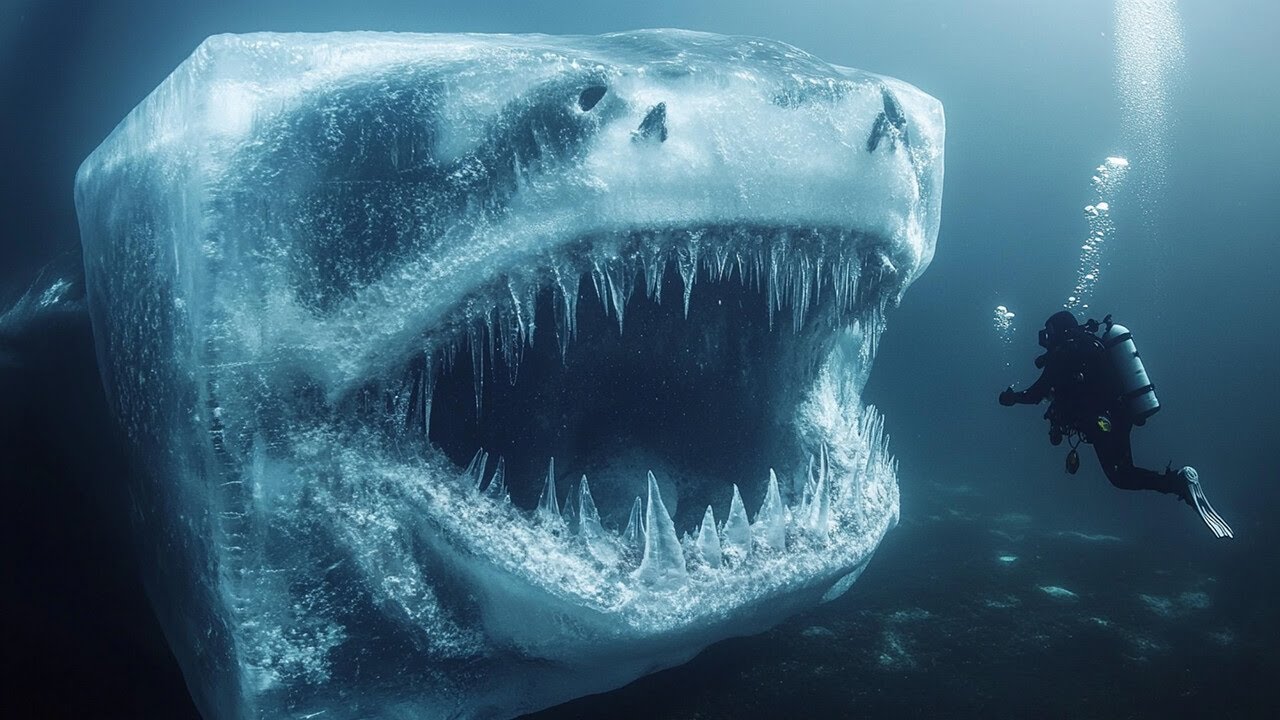


With Up to 15 Meters and Over 40 Tons, the Megalodon Was the Largest Shark in History. Understand Its Real Size, Teeth, Bite Force, and Why It Disappeared.
With a length of up to 15 meters, an estimated weight of over 40 tons, and a jaw capable of crushing bones, the Megalodon was not just a shark larger than the current ones — it was a biological colossus unparalleled in Earth’s oceans. Far beyond the image popularized by movies, the Megalodon indeed existed, dominated the seas for millions of years, and occupied an ecological niche that no other marine predator has reached since then. What science has been able to reconstruct about this animal reveals an extreme combination of size, strength, predatory efficiency, and adaptation that helps explain why it became the largest shark that ever existed.
What Was the Megalodon and When Did It Live
The Megalodon, whose most widely accepted scientific name today is Otodus megalodon, lived approximately between 23 million and 3.6 million years ago, during the Miocene and Pliocene epochs. It emerged after the extinction of large marine predators from the previous period and quickly took the absolute top of the ocean food chain.
Unlike dinosaurs or giant terrestrial mammals, the Megalodon thrived in an environment where size was a decisive advantage. Warmer oceans, a great abundance of primitive whales, and the absence of equivalent competitors allowed this species to reach unprecedented sizes.
-
11-year-old girl sees that the family didn’t have money for her father’s headstone, sets up a lemonade stand and raises almost $3,000 with the help of the community.

-
Archaeologists excavating a train project in France have found, under meters of mud from the Seine River, a Mesolithic camp from 10,000 years ago that seemed to have disappeared from human history.

-
Son finds father’s forgotten notebooks and helps scientists solve the mystery of a 55-million-year-old marine fossil that remained unanswered for almost three decades.
-
Sailor sails alone from Panama to Cuba carrying just over US$ 7,000 in food, medicine, and baby formula, spends hours at Santiago de Cuba customs, and delivers everything to Cáritas, linked to the Catholic Church, to distribute to the population.





Real Size: The Largest Shark Ever Documented
The most conservative estimates indicate that the Megalodon reached lengths of between 14 and 15 meters, but some biomechanical models suggest exceptional individuals even larger. The estimated weight varies from 30 to over 40 tons, depending on the body robustness considered in the calculations.


For direct comparison, an adult great white shark rarely exceeds 6 meters in length and weighs about 2 tons. This means that the Megalodon was more than twice as long and up to twenty times heavier than the largest modern predatory shark.
Its head alone could exceed 4 meters in length, and the mouth opening was large enough to swallow a whole adult human without any difficulty — and, in theory, could simultaneously bite through the ribcage of an average whale.
Jaw, Teeth, and the Most Powerful Bite in History
The most impressive aspect of the Megalodon was not just its size, but its ability to quickly kill giant prey. Its teeth, which are the most commonly found fossils today, reached over 18 centimeters in length, with serrated edges designed to cut through flesh and break bones.
Biomechanical studies indicate that the bite force of the Megalodon may have reached values between 108,000 and 182,000 newtons. For comparison, the bite of a great white shark is around 18,000 newtons, while that of a lion is below 5,000. No known animal, living or extinct, surpassed this capacity for force applied by its jaws.
This bite allowed the Megalodon to target vital areas of its prey, such as fins, spinal column, and ribcage, incapacitating whales in a matter of moments. Fossil marks on cetacean bones confirm this pattern of precise and devastating attacks.
Feeding and Absolute Domination of the Oceans
The Megalodon was a specialized predator of large prey. Its diet included primitive whales, giant dolphins, ancestral seals, and other large marine mammals. In many coastal and oceanic ecosystems, it acted as a population regulator, controlling large species.
Fossils show that the Megalodon preferred shallow coastal waters for breeding and juvenile growth, while adults patrolled deeper areas and whale migratory routes. This strategic behavior helped maximize predatory success and species survival.
For millions of years, there was no predator capable of directly competing with it. The Megalodon alone occupied the absolute top of the marine food chain.
Comparison with Modern Predators
Even the largest current predators seem modest compared to the Megalodon. An orca, considered today the most efficient marine predator, weighs up to 10 tons and measures about 9 meters. Although it hunts in groups and uses social intelligence, it would still be at a significant physical disadvantage against an adult Megalodon.
The great white shark, often associated with the Megalodon due to anatomical similarity, is in practice a functional miniature. Many hypotheses suggest that the emergence of the modern great white shark occurred precisely after the decline of the Megalodon, occupying part of its niche, but on a much smaller scale.
Why Did the Megalodon Go Extinct
Despite its absolute dominance, the Megalodon was not invincible. Global climate changes at the end of the Pliocene caused a cooling of the oceans, altering ocean currents and reducing shallow coastal habitats used as nurseries.
At the same time, various species of whales migrated to cooler waters, outside the ideal thermal range of the Megalodon. The reduction of large prey, combined with increasing competition from new, more agile predators — such as the early ancestral orcas — created an unfavorable scenario.
The extinction was not sudden, but gradual. The Megalodon disappeared when the environment ceased to support such a large, energy-intensive predator dependent on giant prey.
The Legacy of the Largest Shark That Ever Existed
The Megalodon has gone down in history as the largest shark — and one of the largest predators — that the planet has ever known. Its extreme size represents a rare biological limit, achieved only when environmental, climatic, and ecological conditions align perfectly.
More than a curiosity, it serves as a scientific reference to understand how the environment shapes the limits of animal size and how climate changes can topple even the greatest dominators of nature.
While modern sharks still inspire respect, none have returned to occupy the position that the Megalodon held for millions of years. It was not just large. It was the absolute pinnacle of marine predation.


Legal
Sensacional !