





 Portuguese
  English
  Spanish
  4 min of reading
  0 comments


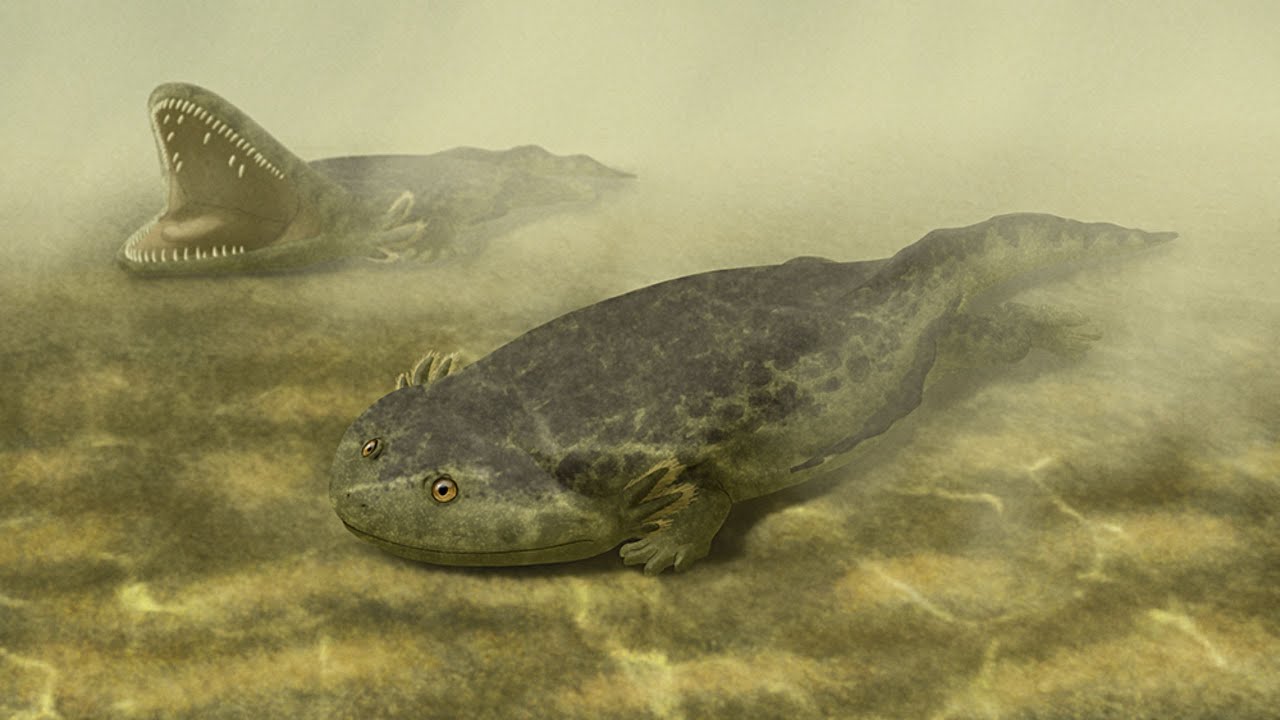
The Gerrothorax, Triassic Amphibian, Used Suction Feeding to Ingest Whole Fish and Survived for 35 Million Years in Shallow Lakes.
Few prehistoric animals can be simultaneously bizarre, efficient, and enduring like the Gerrothorax, a predatory amphibian that lived from about 235 to 200 million years ago, in the Late Triassic. With a body resembling a elongated frog and a flattened skull that looked like a bony plank with bulging eyes, it became one of the most impressive examples of predatory specialization in the fossil record.
The most curious thing? While much of Triassic life changed drastically, it changed little. This anatomical stability is known as “evolutionary stasis” — when an animal remains virtually unchanged for millions of years because its form is already perfectly suited to the environment and the type of hunting it performs.
The Design of an Ambush Predator
The body of the Gerrothorax reached approximately 1 meter in length, although some individuals could exceed this value.
-
A study proposes transforming the Moon into a kind of quarantine center for samples brought from Mars and other worlds, creating a sterile and isolated barrier that would filter any unknown organisms before the material reaches Earth and its ecosystems.

-
Wax notebook falls into latrine 800 years ago, survives intact in Germany and reveals Latin notes that may expose the routine of a high-status medieval merchant.

-
After more than 11 years orbiting Mars, NASA declared the MAVEN probe lost, which disappeared after passing behind the Red Planet in December, began to spin abnormally, depleted its batteries, and never responded to controllers on Earth again.
-
China creates a capsule with artificial intelligence that scans the stomach in just 8 minutes and can reduce costs by up to R$ 1,400, paving the way for a new era of gastrointestinal diagnostics without tubes, sedation, and discomfort for patients.


The eyes were located on the top of the skull, like modern crocodiles, allowing the animal to be submerged and nearly invisible, observing the water’s surface without exposing its body.

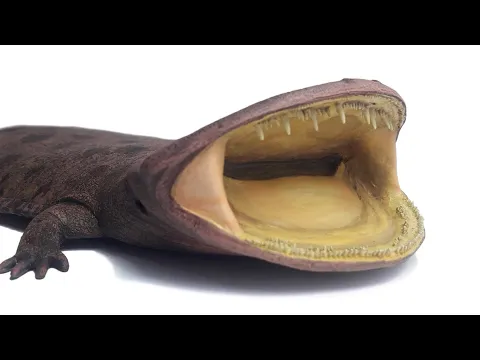
Its jaw functioned like a hydraulic trap: it was not designed for chewing, but rather for suction. Researchers discovered it had a robust hyoid, a structure that allows for creating negative pressure, sucking fish directly into its mouth, the same mechanism used by some modern fish such as the striped bass or the stonefish.
In other words, the Gerrothorax did not chase after food: it sat still at the bottom of the lake, with only its eyes above the sediment, and when a fish swam nearby, it would snap its mouth open and create a deadly vacuum. A fast, silent, and highly efficient attack.
A Fixed Neck and a Strange Way of Opening Its Mouth
Unlike crocodiles and mammals, the Gerrothorax did not lower its lower jaw to bite — it raised its skull. This happened because its neck was rigid, with vertebrae that limited movement.
This characteristic, typical of some temnospondyls, was confirmed by extremely well-preserved fossils in Europe and the United States.
The inverted jaw movement was such an unusual detail that it led paleontologists to nickname the pattern “cranial opening” — reinforcing the strange nature of this amphibian.
Dominated Environments and Long Evolutionary History
The Gerrothorax was not an isolated animal. It was part of a Triassic fauna filled with semi-aquatic predators in shallow lakes, swamps, and slow rivers. It shared these environments with:
• bony fish and primitive actinopterygians
• freshwater insects and crustaceans
• expanding archaic reptiles
• early archosaurs
Despite this competition, the Gerrothorax survived for about 35 million years with virtually no significant anatomical changes. This only happens when an animal finds a perfect ecological strategy — and remaining at the bottom of lakes sucking fish apparently was perfect.
The End of the “Sucker” Predator
The disappearance of the Gerrothorax coincides with the events that led to the end of the Triassic, when life faced mass extinctions, paving the way for dinosaurs to dominate the planet.
There are no signs that the Gerrothorax persisted after the onset of the Jurassic, indicating that global environmental changes likely sealed its fate.
Why Is This Animal So Fascinating?
The Gerrothorax combines a rare combination of traits that capture the interest of both specialists and laypeople:
• hybrid appearance between frog and crocodile
• suction attack with powerful negative pressures
• eyes designed for ambush
• little change over millions of years
• semi-submerged and silent behavior
It is a reminder that the pre-dinosaur era was much more complex and unpredictable than we usually imagine.
In the End, a Perfect Predator for a Lost World
The Gerrothorax may not have been the largest, most famous, or the scariest of prehistoric animals, but it was one of the most efficient and resilient. Imagine a silent hunter, motionless at the bottom of a Triassic lake, with only its eyes above the water, waiting for the exact moment to open its mouth and swallow a whole fish with a hydraulic snap.
On a planet where everything was changing, the Gerrothorax did not need to change — and that may be the greatest evolutionary compliment a predator can receive.







-

-

2 people reacted to this.