






 Portuguese
  Spanish
  5 min of reading
  0 comments


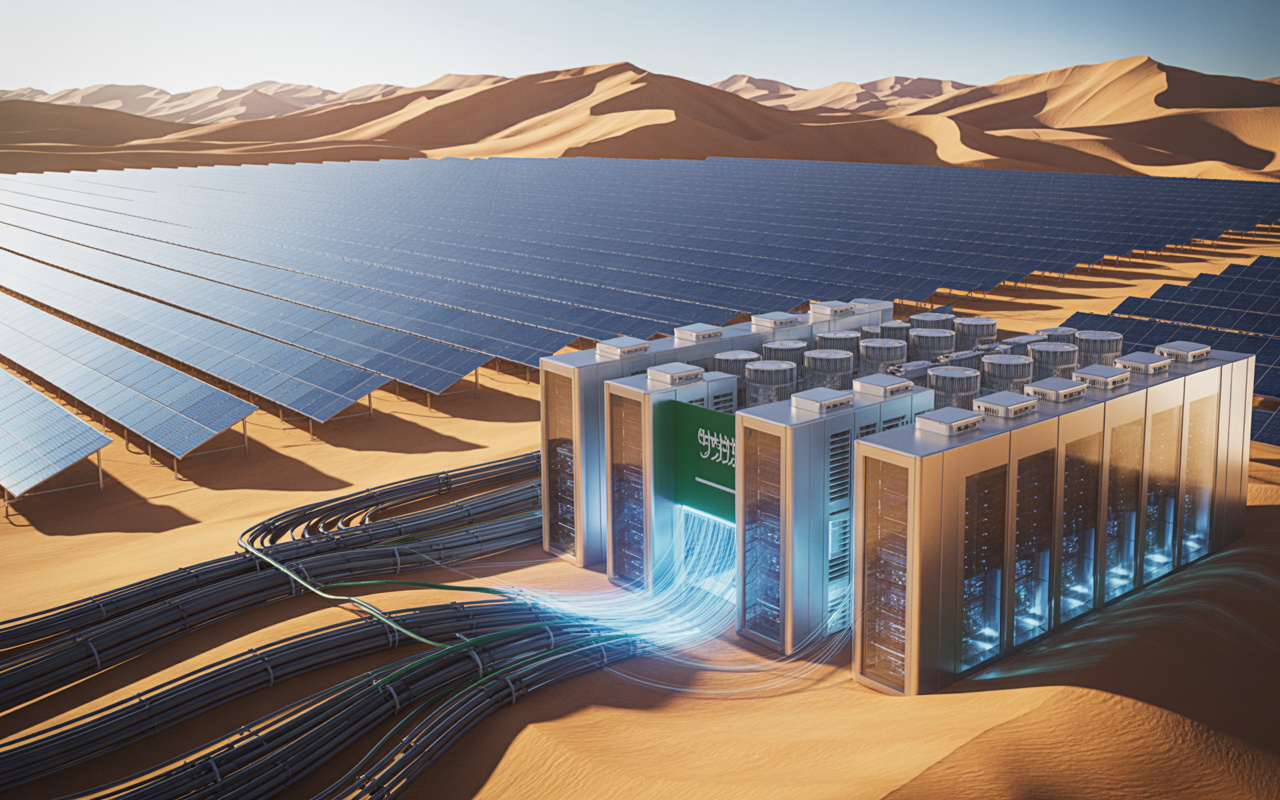
With Solar Energy at Just Over 1 Cent per kWh, Saudi Arabia Bets on Ultra-Cheap AI Data Centers to Become a Global Power in Artificial Intelligence.
Two hours south of Jeddah, on the shores of the Red Sea, a piece of the Saudi desert is transforming into one of the planet’s most strategic projects. The Al Shuaiba Solar Farm, covering about 50 square kilometers, is at the center of Saudi Arabia’s plans for a new kind of global power: computational power. The first phase of the project, expected to begin in 2024, aims to generate 600 megawatts of electricity at just 3.9 Saudi halalas per kilowatt-hour, just over one cent. For comparison, this cost represents about one-twentieth of the energy produced by the UK’s Hinkley Point C nuclear power plant.
This extremely cheap electricity is not just intended to supply cities or traditional industries. The plan is to direct it almost entirely to huge AI-focused data centers, a sector where energy costs have become one of the main economic constraints in the world.
Cheap Energy Became the Decisive Factor in Artificial Intelligence
The operation of AI systems basically depends on two ongoing costs: high-performance hardware and electricity to keep it running. Cutting costs on chips is often a strategic mistake, as the most modern models require more expensive and efficient processors. Therefore, the variable that really makes a difference is the cost of energy, and it is exactly at this point that Saudi Arabia has built its competitive advantage.
-
The “Chinese invasion” has arrived: BYD already dominates almost 45% of the electric buses registered in Brazil in May 2026, while 80% of the entire electric fleet in the country is concentrated in São Paulo with 1,300 vehicles.

-
From toy to track machine: Koenigsegg Sadair’s Spear made with over 327,000 Lego pieces reaches 111 km/h and surpasses the former Bugatti Chiron record.

-
Deep-sea marine animal can go more than 5 years without eating, combining physical adaptations and genetic mechanisms to survive in environments with extreme food scarcity; meet the Bathynomus.

-
Science wants to know what football does to you: study gathers smartwatch data to understand the real impact of World Cup emotions on the human body


While other countries try to reduce operational costs through marginal efficiency gains, the Saudis are betting on something structural: producing electricity on a colossal scale, at almost symbolic prices, and using this advantage to lower the cost of AI inference, the process of asking questions and getting answers from intelligent systems.
A National Priority Directly Supported by Political Power
The strategy has evolved from just a technological project to a national priority in May, with direct support from Crown Prince Mohammed bin Salman (MBS). To execute the plan, the company Humain was created, led by Tarek Amin, the current head of Aramco Digital, the technological arm of the Saudi state energy company.
Humain was incorporated into Vision 2030, the ambitious program aimed at reducing the country’s historical dependence on oil. According to Amin, the risk of failure is enormous but unavoidable. There is no alternative plan. The gamble must succeed.
Land, Licenses, and Energy: Three Advantages That Few Countries Have
In addition to cheap electricity, Saudi Arabia has two other critical factors for global-scale data centers. The first is physical space. The country is vast, sparsely populated, and allows for quick acquisition of construction permits when there is government support. In just two weeks, Humain identified more than 200 potential sites, with access to 15.6 gigawatts of electricity, including large areas already integrated into solar projects.
The second factor is the ability to integrate energy, infrastructure, and state. Few countries can align these three elements without prolonged regulatory hurdles.
Inference Chips and the Reduction of Cost per Token
The third pillar of the strategy involves artificial intelligence chips. The project began with an agreement between Aramco Digital and the American company Groq, valued at US$ 1.5 billion, specializing in semiconductors focused on inference, not on training models.
These chips are not favored by large AI labs, which seek maximum flexibility. However, they are ideal for reducing the cost per token, the basic unit charged for commercial AI services. Today, companies charge high prices for millions of processed and generated tokens. Humain’s proposal is simple: run models on Saudi soil, with extremely cheap energy and efficient chips, and sell tokens for about half the market price.
The Opening for Advanced Chips and Global Interest
In November, the project gained international political momentum. During MBS’s visit to the United States, a license was granted for the import of 35,000 advanced Nvidia chips, valued at nearly US$ 1 billion. Although this volume is not enough to supply all the planned data centers, it represents a significant change in the American stance, which previously restricted this type of technology to closer allies.
The movement has already attracted investors. AirTrunk, one of the world’s largest data center builders, signed a US$ 3 billion contract with Humain to develop a large infrastructure campus in the country.
Saudi Arabia Also Wants to Be a User of Its Own AI
The plan is not limited to exporting computational power. The country already utilizes its own systems. The ALLAM, an Arabic-language AI model developed in partnership with the Saudi Data and AI Authority (SDAIA), has begun to be used by public employees. In addition, Humain has made agreements with global companies like Adobe to incorporate the model into commercial software.
This dual strategy — infrastructure and application — strengthens the ecosystem and reduces dependence on external solutions.
From Data Centers to an “AI Operating System”
Humain’s horizon goes beyond hosting models. According to Tarek Amin, the long-term goal is to create the first corporate operating system based on AI, capable of replacing traditional functions in human resources, finance, and legal with intelligent agents, using interfaces based on chatbots instead of clicks and icons.
It is an ambition that many consider too bold, but it reveals the scale of the Saudi project. It is not just about cheap energy or data centers. It is about repositioning the country as one of the top five global hubs for artificial intelligence in the next five to seven years, according to PwC analysts.
Saudi Arabia, which built its wealth on oil, now bets that almost free solar electricity and planetary-scale computational power can be the foundation of its next historical cycle.


Be the first to react!