






 Portuguese
  Spanish
  3 min of reading
  0 comments


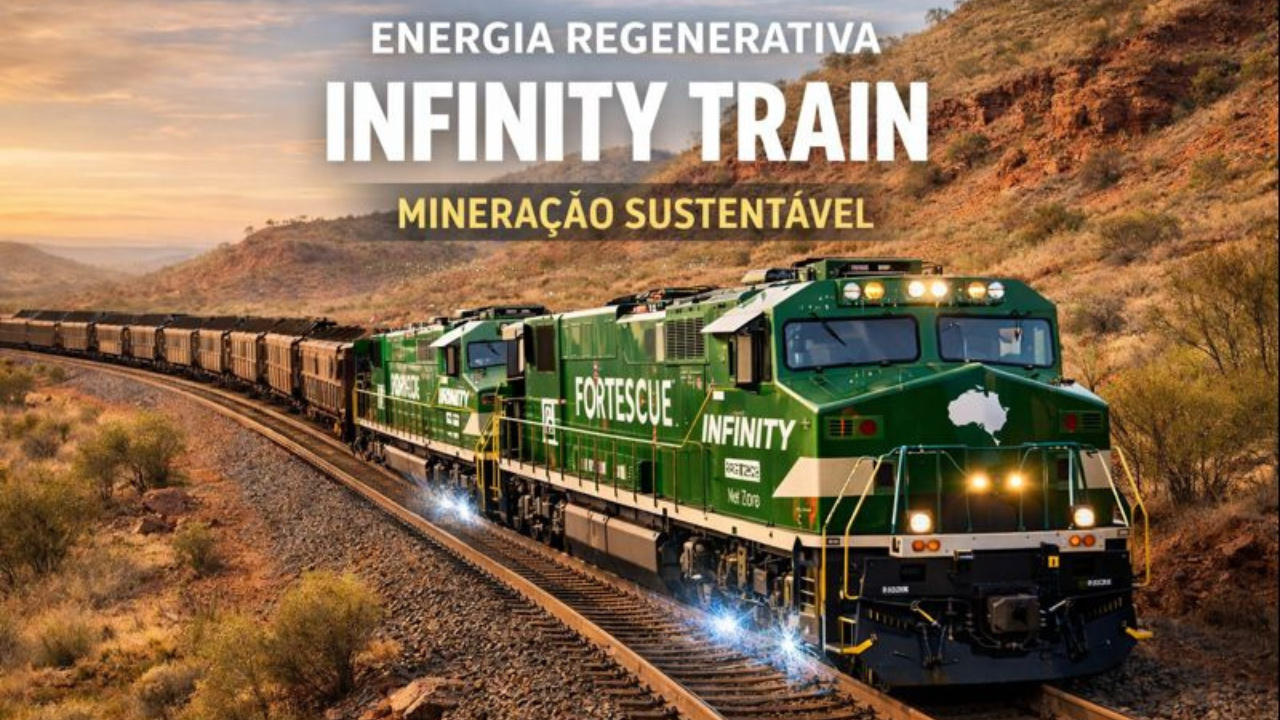
Infinity Train Starts Operating and Drives Industrial Decarbonization with Regenerative Energy in Electric Rail Transport.
Fortescue Metals has initiated the commercial operation of the Infinity Train at its mines in the Pilbara region of Western Australia.
Designed to operate without diesel and continuous external charging, the train uses regenerative energy generated by gravity itself.
The project was developed by Fortescue in partnership with Progress Rail, a division of Caterpillar, and Downer Group.
-
Railway returns to prominence in Brazil after STF approval: a R$ 25.2 billion project promises to save R$ 9 billion in freight, transport 50 million tons per year, and transform Sinop into a logistics powerhouse for agribusiness.

-
Retired trains leave European tracks and become tons of steel, aluminum, and copper in dismantling yards where recycling exceeds 90%, but batteries, composites, and electronics create a new frontier of railway waste.

-
The strategic railway of Santa Catarina will receive R$ 608 million, will undergo historic modernization, and could transform logistics between Mafra and the Port of São Francisco do Sul.
-
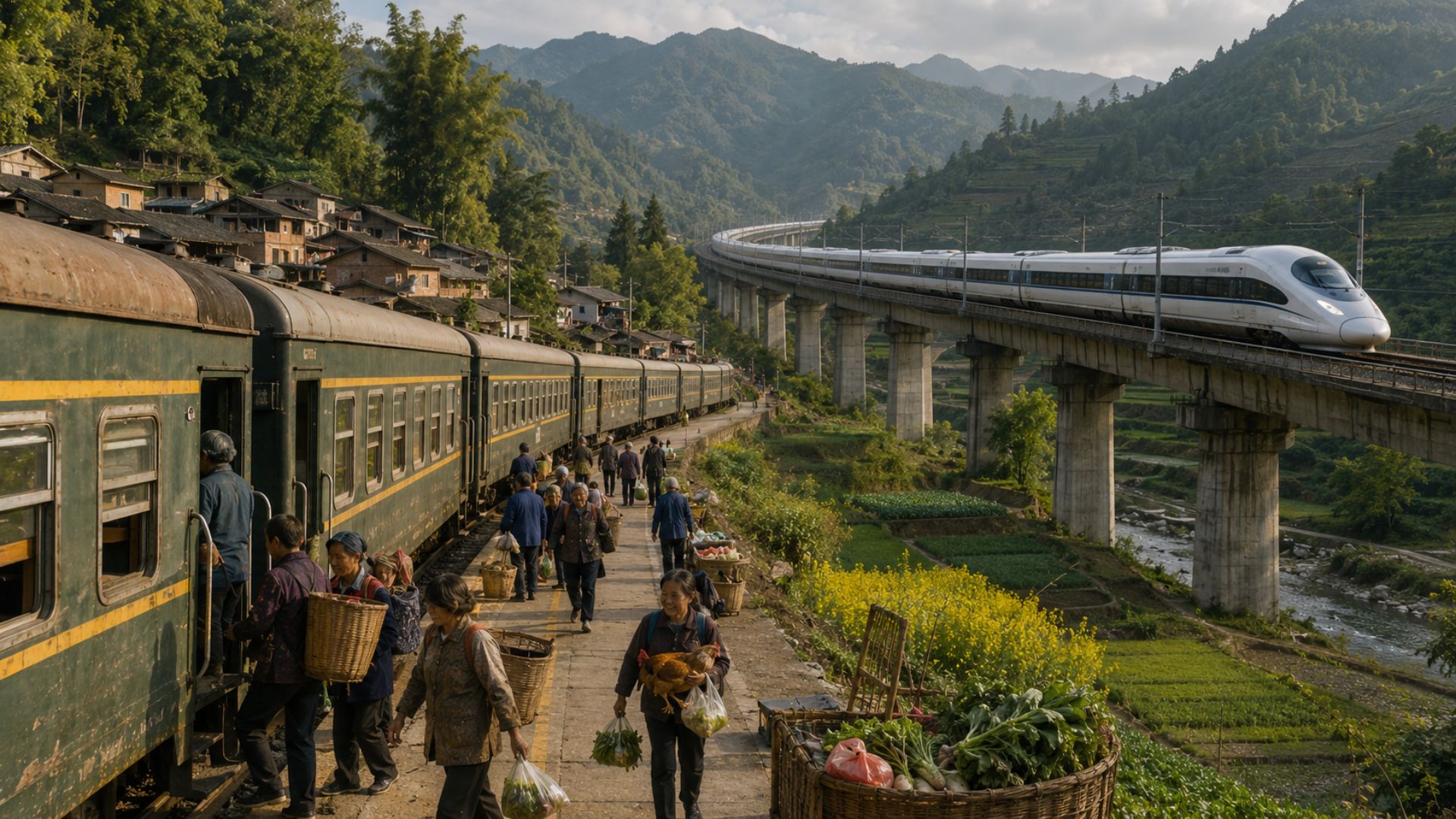
While showcasing bullet trains traveling at over 300 km/h, China maintains about 81 slow train lines that travel at 40 km/h, charge less than R$ 2 for a ticket, and cross remote villages carrying residents, students, and even chickens and vegetables to the market.


How the Infinity Train Works and Why It Is Different
The Infinity Train is equipped with giant batteries of 14.5 MWh, charged only once with energy from the power grid.
From that point on, the system remains functionally charged indefinitely, thanks to an intelligent regenerative energy mechanism.
In practice, when the train descends the sloped sections while transporting iron ore, the energy generated during braking is captured and stored in the batteries.
This electricity is sufficient to power the entire return journey, when the wagons ascend empty, without any external charging needed.
Regenerative Energy Eliminates Diesel and Additional Infrastructure
This operational model allows for the complete elimination of diesel use, as well as the need for complex charging infrastructure or the installation of additional renewable sources along the railway.
Therefore, electric rail transport becomes self-sufficient, using the region’s own topography as an energy source.
According to Fortescue, the adoption of the Infinity Train is expected to eliminate over 82 million liters of diesel per year.
This volume represents approximately 11% of the company’s direct emissions (scope 1), a significant impact within the strategy of sustainable mining.
Long-Distance Tests Proved Operational Viability
The company preceded the commercial debut of the Infinity Train with a rigorous 1,100-kilometer test between the cities of Perth and Pilbara.
During this journey, the prototype demonstrated full capacity to meet the demands of large-scale ore transport operations, including high weight, long distances, and steep altitude variations.
“It’s not every day that you welcome not one, but two of the world’s largest battery electric trains,” celebrated Fortescue Metals CEO, Dino Otranto, when announcing the start of operations.
Industrial Decarbonization Strategy and Real Zero Goal
The CEO of Fortescue Zero, Ellie Coates, also highlighted the project as a concrete advance towards the company’s goal of real zero emissions, known internally as “Real Zero”.
Unlike carbon offsets, the concept seeks to eliminate emissions directly at the source, especially in energy-intensive industrial operations.
In this context, the Infinity Train becomes a key piece of the industrial decarbonization strategy, targeting one of the main sources of emissions in mining: the transportation of large volumes of material.
Known Concept, Unprecedented Application in Heavy Trains
While companies had already explored the use of regenerative energy since at least 2017 in mining trucks operating in mountainous areas.
With almost 400 kilometers of dedicated tracks for iron ore extraction, Fortescue has managed to adapt its entire railway network to the region’s topographical conditions.
Thus, the loaded descent ceased to be just a logistical stretch and began to function as a true “mobile power plant” for energy generation.
Scalable Solution for Other Industrial Operations
In addition to reducing emissions and costs, the model of the Infinity Train positions itself as a scalable solution for other industrial operations that depend on intense electric rail transport and operate on routes with altitude variations.
Therefore, the technology allows sectors such as mining, steelmaking, and heavy logistics to replicate it in different regions of the world.
When Gravity Becomes Fuel
The Infinity electric trains reinforce that industrial electrification can go far beyond passenger cars.
Thus, by combining technology, the project shows that mining can transform even natural forces into allies of sustainability.
So, in an industry historically associated with high emissions, the Infinity Train emerges as a concrete example of how innovation can redefine standards and accelerate the transition to a cleaner and more efficient industry.







-

1 person reacted to this.