






 Portuguese
  Spanish
  6 min of reading
  0 comments


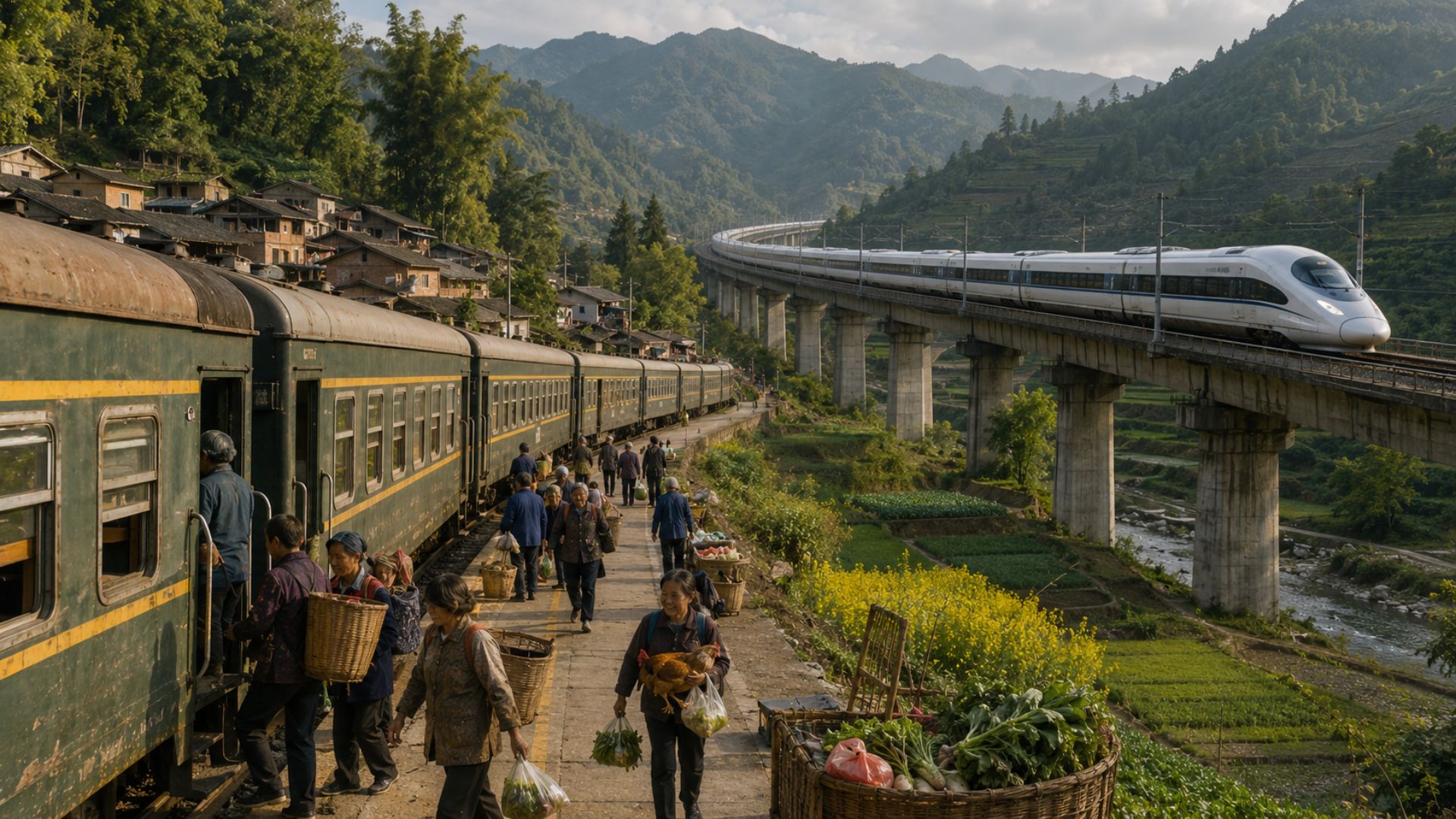
In the country of the world’s fastest tracks, trains that seem frozen in time survive: green, slow, and extremely cheap. They intentionally operate at a loss. The government funds them so that isolated villages in the mountains are not left behind, in a curious depiction of how speed is not always the priority.
While showcasing bullet trains of over 300 km/h to the world, China maintains about 81 lines of slow trains that travel at less than 40 km/h. These trains charge less than R$ 2 for the cheapest ticket, have not been adjusted for over three decades, and cross remote villages carrying residents, students, and even chickens and vegetables to market, in an impressive contrast with the country’s ultra-modern image.
The case was highlighted in May 2026 by the site Xataka, based on reports from outlets like People’s Daily, Xinhua, and Global Times. Officially known as social assistance trains, and nicknamed “slow trains for the poor,” they are a legacy from the era of Mao Zedong, who ruled China from 1949 to 1976, preserved today as a public service. It is important to note that much of the information comes from the Chinese state press, which tends to emphasize the positive aspects of these policies, but the basic data is consistent among different sources.
Trains that stop in time

Painted in military green with a yellow stripe, the classic image of Chinese railways before modernization, these trains stop at every station along the route, including small villages that have no connection to the outside world by any other means of transport, fulfilling a role that goes far beyond simple transportation.
-
Railway returns to prominence in Brazil after STF approval: a R$ 25.2 billion project promises to save R$ 9 billion in freight, transport 50 million tons per year, and transform Sinop into a logistics powerhouse for agribusiness.

-
Retired trains leave European tracks and become tons of steel, aluminum, and copper in dismantling yards where recycling exceeds 90%, but batteries, composites, and electronics create a new frontier of railway waste.

-
The strategic railway of Santa Catarina will receive R$ 608 million, will undergo historic modernization, and could transform logistics between Mafra and the Port of São Francisco do Sul.
-
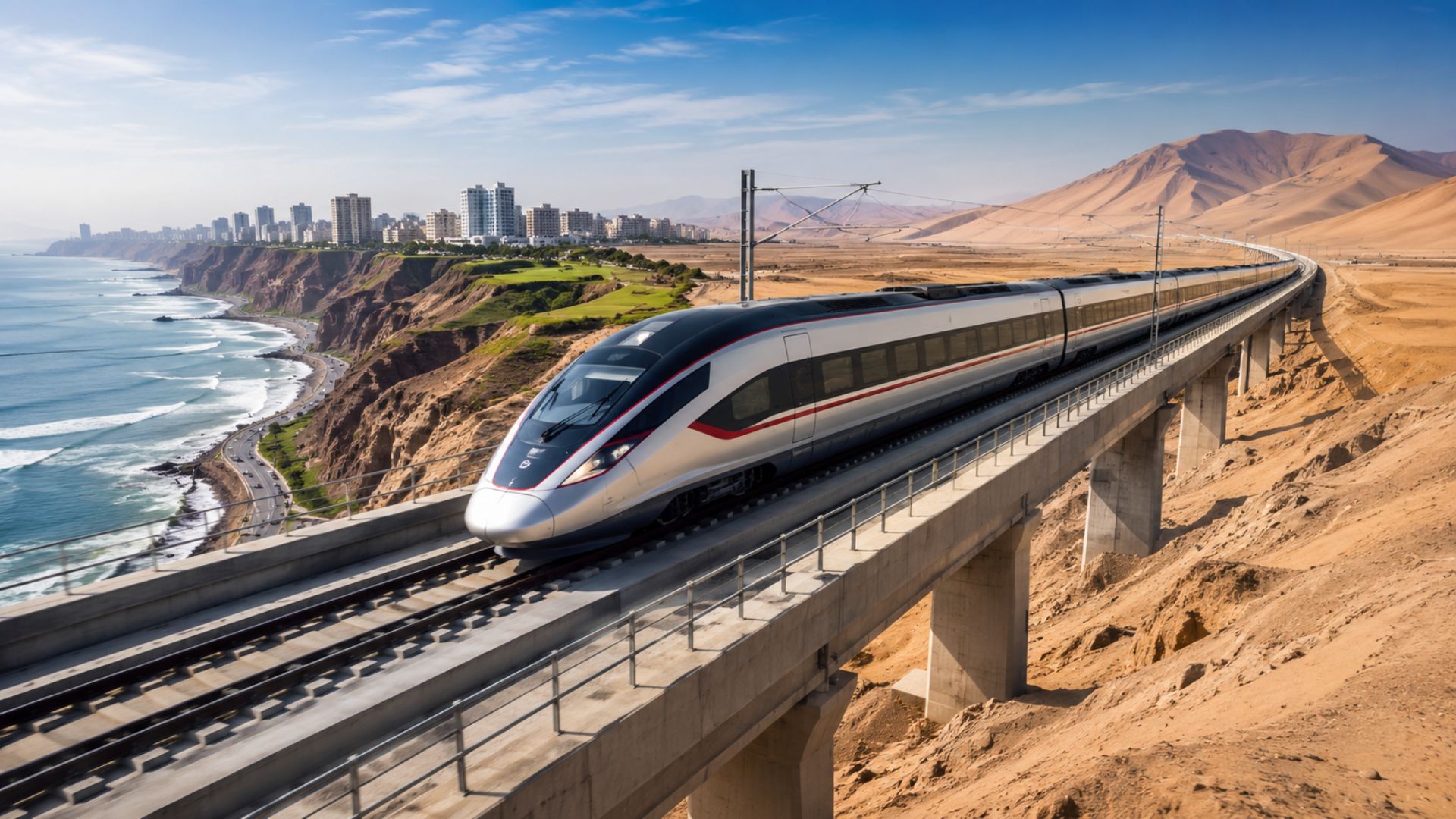
Peru plans to build, with Chinese technology and capital, what is intended to be the fastest train in South America, a high-speed line between Lima and Ica at up to 200 km/h, but the $6.5 billion project is only expected to be completed around 2032.


Some of them even boast a painted sign on the side identifying them as “slow train for poverty alleviation.”
According to the state agency Xinhua, these compositions function as a kind of mobile artery, taking residents to the market, transporting animals, and allowing children to attend school in nearby towns, in regions where transportation alternatives simply do not exist.
Tickets that cost less than a coffee
The price is, perhaps, the most surprising aspect of the whole story.
On train number 5633/5634, which travels 376 km between Puxiong and Panzhihua, in Sichuan province, on a journey of about 11 hours, the fare ranges from 2 yuan, equivalent to about R$ 1.4, up to a maximum of 25.5 yuan, less than R$ 20 for the entire route.
According to the People’s Daily newspaper, these prices have not changed for more than 30 years.
To give an idea of the intentional lag, while the ticket price has been frozen for three decades, the value of products like potatoes, one of the most transported items on these trains, has risen about ten times in the same period.
This shows that the fare does not keep up with inflation or costs: it is kept artificially low on purpose, precisely so that the poorer population can use it without straining their budget.
Chickens, vegetables, and a market on rails

In many of them, rows of seats have been removed so that farmers can board with their products, such as vegetables, chickens, and construction materials, without restrictions, turning the wagons into a true traveling market on rails that connects the countryside to the cities.
To further facilitate trade, some wagons even display panels with the prices of agricultural products, helping farmers and buyers to close deals during the journey.
These trains especially serve communities of local ethnicities, such as the Yi people, in mountainous regions where income has always been scarce and where access to the market makes all the difference in the lives of families.
A portrait of the country’s changes
Those who have worked on these trains for decades have witnessed firsthand the transformation of rural China.
Axi Aga, train attendant of train 5633 since 1996, reported that, in the beginning, passengers boarded carrying potatoes and cornmeal and barely had money to buy instant noodles during the trip, while today they are concerned with clothing, wear traditional outfits on holidays, and record videos for social media, according to statements given to an official Chinese government website.
According to her account, there have been significant social changes over the years.
Previously, girls were rare among the students who took the train to go to school; today, they represent about two-thirds of this group.
It is stories like this that give these trains the nickname “mobile village,” a space where the life of communities happens and transforms along the tracks, journey after journey.
From Simple Transport to Service Platform
Over time, these trains have ceased to be just a means of transportation.
According to the People’s Daily, some trains in northern China today feature bookshelves, study tables with outlets and school supplies for children to do their homework during the trip, as well as hot water, portable chargers, and carriages heated to 20 degrees in winter to protect passengers from the intense cold.
Over the years, these trains have incorporated improvements such as air conditioning, without abandoning their original mission of serving the population.
On one of the routes, there are reports that the train serves dozens of schools along the way, practically functioning as a school bus.
It is an evolution that shows how an old service can adapt to new times without losing its essential purpose.
Why Maintain Trains That Operate at a Loss
The inevitable question is: why sustain a service that doesn’t pay for itself?
The answer is that these lines operate at a loss because the fares do not cover operational costs, and the State subsidizes them directly, treating them not as a business, but as a strategy of social policy and territorial cohesion, to ensure that the most remote and poor areas are not isolated from the rest of the country.
According to the Global Times, these routes have been operating for more than 60 years and are considered by the national railway company as a structural measure to combat poverty, not a residual service about to be deactivated.
It is a choice that reveals a logic different from the purely commercial one: that certain services are worth more for their social impact than for the profit they generate, a debate that, incidentally, is also familiar to countries of continental dimensions like Brazil.
China’s slow trains are a powerful reminder that, even in the era of speed and high technology, there is room for simple solutions that change lives.
While bullet trains symbolize the future and the economic power of the country, these green and slow carriages play a silent but essential role, connecting those who need it most to the rest of society.
More than a curiosity, they raise a valid reflection for the whole world: the progress of a nation is also measured by how it takes care of those left behind, and not just by the speed of its tracks.
And you, what do you think of these slow trains that China keeps running even at a loss? Do you believe that Brazil should invest in similar transportation solutions to connect isolated regions? Leave your comment, tell us what surprised you most about this story, and share the article with those interested in trains, technology, and human stories around the world.




Be the first to react!