Portuguese
  Spanish


Retired railway giants become tons of recyclable metals in European industrial centers, but batteries, composites, and electronic systems challenge recycling and increase the environmental impacts of railway disposal.
Every year, hundreds of trains reach the end of their useful life in different parts of the world. After decades of transporting passengers and cargo, these giant machines leave the tracks and enter a stage little known to the public: industrial dismantling. Unlike automobiles, which usually gain attention only when they become scrap, the final destination of locomotives, subways, and high-speed trains rarely enters public debate.
However, a study published on ResearchGate conducted by researchers from the University of Florence in partnership with Hitachi Rail Italy points out that end-of-life railway vehicles represent an important source of recyclable raw materials, gathering large volumes of steel, aluminum, copper, glass, and other materials that can return to the production chain after dismantling.
What happens when a train of hundreds of tons reaches the end of its useful life
The operational life of a train can exceed 30 or even 40 years, depending on the type of vehicle and the modernization program adopted by operators. When maintenance is no longer economically viable or when new technological requirements render the fleet obsolete, the process of decommissioning begins. At this point, the vehicles are sent to specialized centers where they undergo inspections, decontamination, and controlled dismantling.
-
Brazil Plans $160 Billion Investment to Revitalize Railways and Reduce Reliance on Long-Distance Trucking

-
Retired Railway Workers in Brazil Preserve Locomotive for 52 Years, Now See It Donated by the Government

-
Railway returns to prominence in Brazil after STF approval: a R$ 25.2 billion project promises to save R$ 9 billion in freight, transport 50 million tons per year, and transform Sinop into a logistics powerhouse for agribusiness.
-
The strategic railway of Santa Catarina will receive R$ 608 million, will undergo historic modernization, and could transform logistics between Mafra and the Port of São Francisco do Sul.


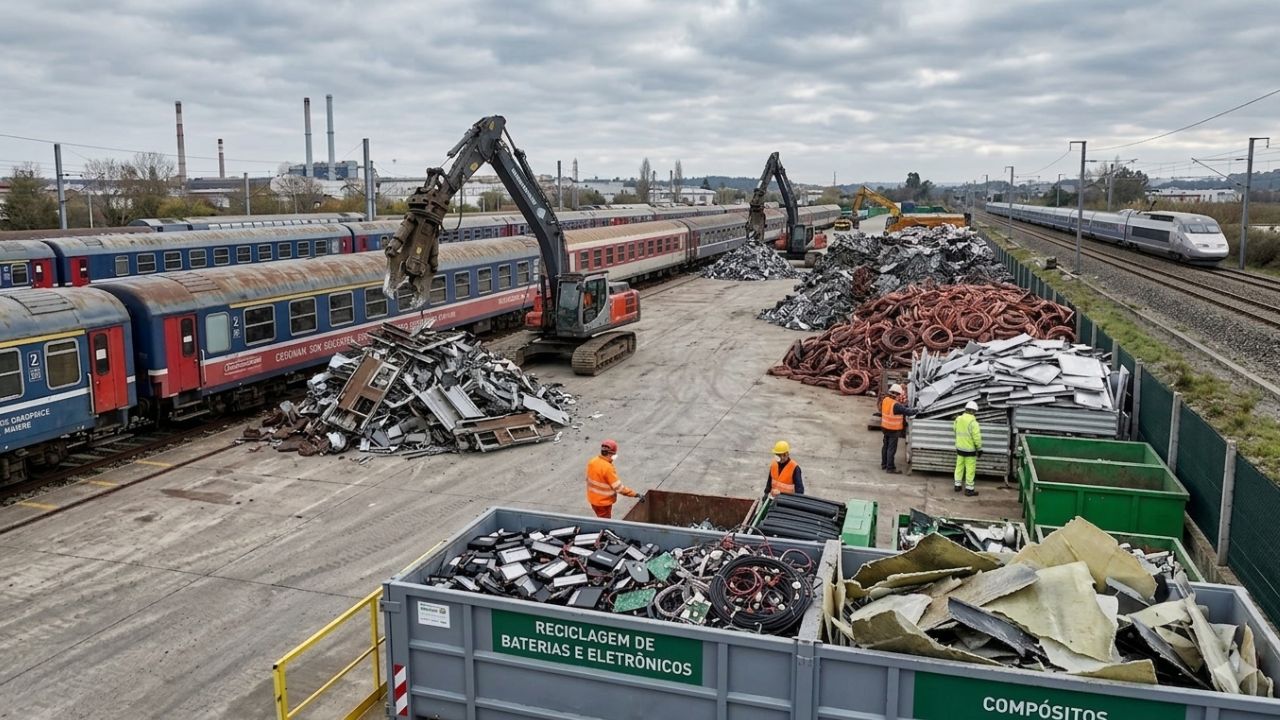
The end-of-life treatment of trains involves three main stages: pre-treatment, dismantling, and industrial fragmentation. Before any structural cutting, fluids, lubricants, fuels, batteries, and potentially hazardous materials need to be removed.
Most of a train can return to the industry instead of becoming waste
The most striking fact is the high recovery rate of railway materials. According to research conducted by the University of Florence in partnership with Hitachi Rail Italy, the recyclability and recoverability rates of the evaluated railway vehicles were above 90%, a result mainly attributed to the predominance of metals in their composition.
According to the researchers, steel, aluminum, and metal alloys represent the majority of the mass of modern trains. As these materials have highly developed recycling chains, much of the structure can return to the market as raw material for new industrial applications.
This means that a retired train rarely ends up in a landfill. In many cases, tons of metal are repurposed in sectors such as construction, automotive industry, equipment manufacturing, and even in the production of new railway vehicles.
Cables, seats, engines, and electronic systems are removed before cutting the structure
Dismantling does not start with the hull. According to a study published in the journal Frontiers in Built Environment, the process usually involves removing electrical cables, tables, seats, panels, electronic equipment, hydraulic systems, and mechanical components before the main structure is fragmented.
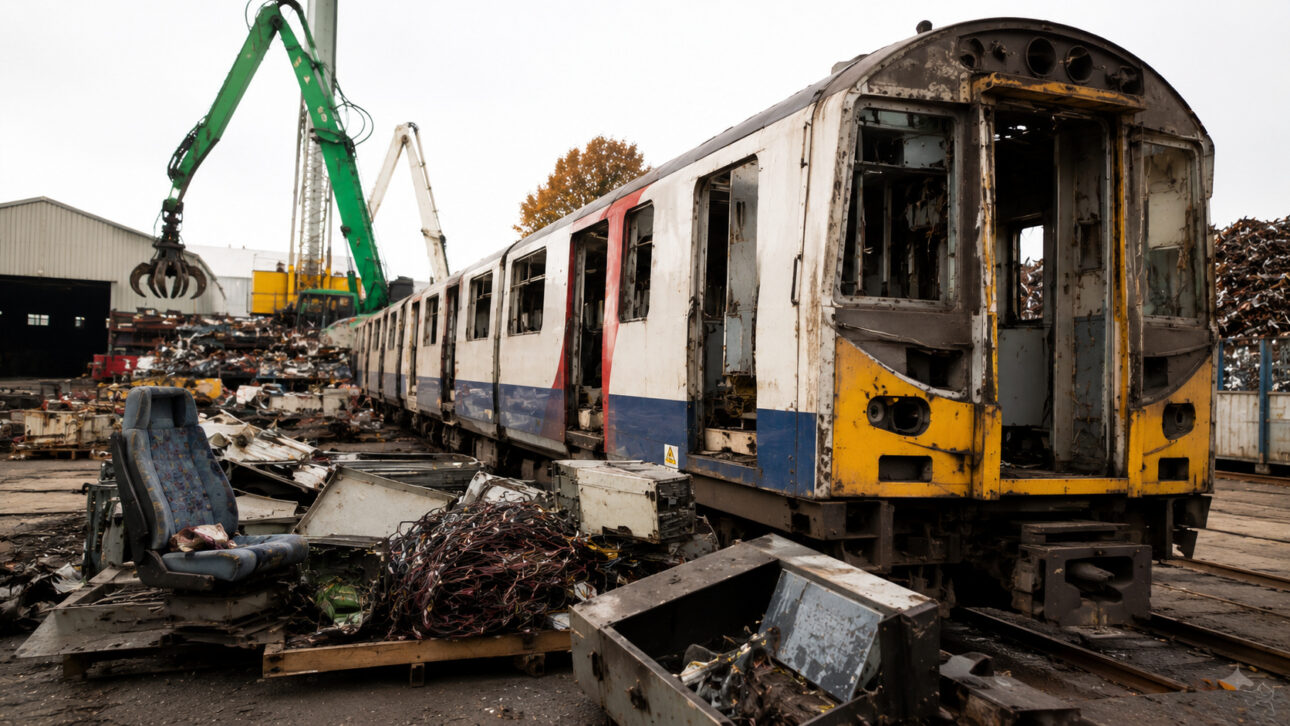
Electric motors, transformers, air conditioning systems, and electronic modules can be repurposed, sold as spare parts, or recycled separately. The copper present in the kilometers of electrical cables also has high economic value, making it one of the most sought-after materials during dismantling.
The challenge arising with more modern trains
Although railway recycling shows high rates, the situation is becoming more complex. According to researchers studying circular economy in the railway sector, new trains are increasingly incorporating composite materials, advanced electronic components, and energy storage systems that did not exist in previous generations.
Materials such as carbon fiber and reinforced polymers help reduce weight and energy consumption during operation, but present significant challenges when it comes time for recycling. There are still no economically efficient processes to recover some types of composites used in modern railway vehicles.
The battery revolution is creating a new category of railway waste
The expansion of hybrid and battery-powered trains is adding a new layer of complexity to the process. Several manufacturers are investing in vehicles capable of operating on non-electrified sections, using large lithium-ion battery packs.
These systems require specific procedures for disassembly, transport, and recycling. As with road electric vehicles, railway batteries contain strategic materials that need to be safely recovered to prevent environmental risks and waste of mineral resources.
With the advancement of circular economy principles in the railway sector, the management of waste generated at the end of trains’ life cycles is becoming an increasingly higher priority for manufacturers, operators, and maintenance companies.
An invisible industry that moves thousands of tons of materials every year
For most people, trains simply disappear after being taken out of circulation. In reality, there is a highly specialized industrial chain dedicated to dismantling, separating, classifying, and reinserting these materials into the economy.
Steel returns to steel mills, aluminum goes to foundries, copper is reused by the electrical industry, and many components find new uses even before being recycled. Thanks to the enormous concentration of reusable metals and the long lifespan of their structures, railway vehicles are among the modes of transport most aligned with the principles of the circular economy.
As the first generations of high-speed trains, modern subways, and hybrid vehicles begin to retire, a question that is rarely discussed outside the sector also grows: is the world prepared to efficiently recycle the machines that helped build the mobility of recent decades?