





 Portuguese
  English
  Spanish
  5 min of reading
  0 comments


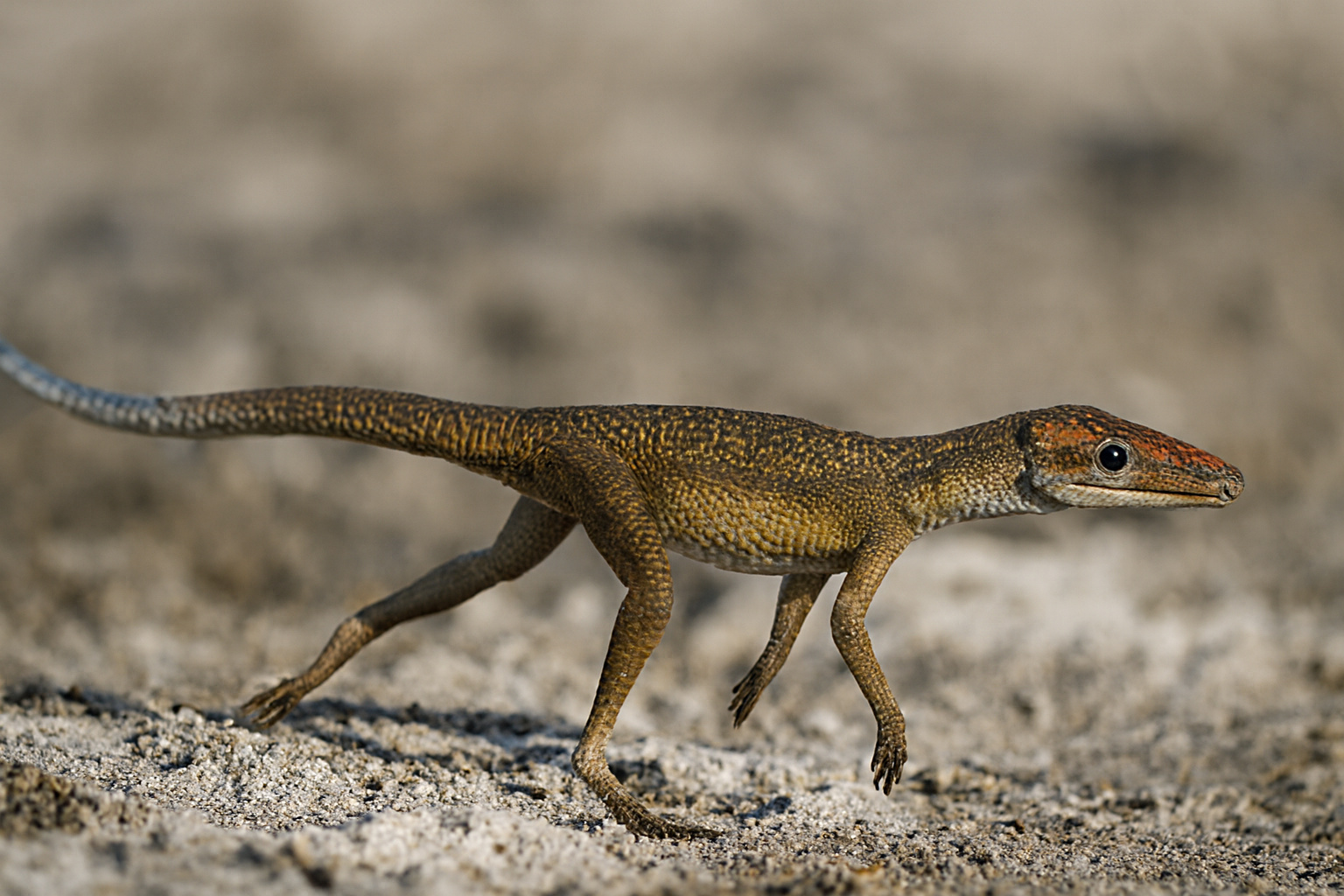
The Triassic Crocodyliform Terrestrisuchus gracilis Reveals That Ancestral “Crocodiles” Were Long-Legged, Upright Running Terrestrial Animals, Very Different From the Modern Ones.
When we think of modern crocodiles, the image is always the same: robust-bodied animals, a sprawling posture, half-closed eyes in the water, and explosive movements only when necessary. What is surprising is that, during the Late Triassic, millions of years before the emergence of the crocodilians we know today, their ancestors were almost the opposite. The Terrestrisuchus gracilis, a primitive crocodyliform described in European records, was small, slender, with long legs and an upright posture, adapted to running on land — an agile predator, far removed from the typical aquatic life of modern crocodiles.
This reversal of image helps to understand that modern crocodilians are just one of many branches of a deeply diverse lineage. In the Triassic, crocodyliforms were predominantly terrestrial, fast, and with morphological features that made them more akin to small dinosaurs than to the alligators and caimans that inhabit rivers and swamps today.
The Triassic Landscape and the Emergence of Running Crocodyliforms
The Terrestrisuchus lived about 205 million years ago, at the end of the Triassic, a period marked by semi-arid landscapes, extensive faunas of small archosaurs, and the beginning of the dominance of dinosaurs. The fossil record indicates that it occupied the ecological niche of a small terrestrial predator, likely feeding on insects, small reptiles, and juvenile vertebrates.
-
A war machine of over 10,000 tons, capable of destroying entire cities, cannot simply become scrap, and dismantling a retired nuclear submarine has become one of the most dangerous industrial operations on the planet, with radioactive reactors that need to be buried for centuries.

-
Labor shortage concerns return to Canada: retirements are already removing 25,500 workers per month from the market, and the country may face a lack of workers again even with unemployment still high.

-
In Brazil, fishermen become “cleaners” of the mangroves and remove 46 tons of trash in an attempt to revive natural nurseries suffocated by plastic, tires, sofas, and more than 1 million discarded items in the bays of Guanabara and Sepetiba.

-
A Canadian who has lived in Sri Lanka, India, and Portugal chose the small town of Timbó, in the interior of Santa Catarina, to raise his three children, attracted by the safety and climate, in a sincere account of the advantages and also the limitations of life as a foreigner in southern Brazil.


Unlike modern crocodilians, which heavily depend on aquatic environments, the Terrestrisuchus had a lightweight skeleton and long, upright hind limbs — a characteristic strongly associated with rapid locomotion on solid ground.
Evolutively, this reinforces that the transition of crocodilians to a semi-aquatic lifestyle occurred much later, likely during the Jurassic.
The Body of a Runner: Skeleton, Posture, and Locomotion
What makes the Terrestrisuchus so unique is the set of anatomical adaptations that reflect a way of life completely different from what we observe in modern crocodiles. Among the most discussed elements are:
• long legs positioned under the body,
• joints suggesting an upright posture,
• relatively stiff tail,
• narrow and lightweight skull,
• long and gracile bones.


This combination forms a profile associated with running and terrestrial pursuit. Instead of dragging the body or walking with legs splayed laterally (the typical posture of modern crocodiles), the Terrestrisuchus held its torso elevated and moved its limbs like a small cursorial archosaur.
This posture is considered one of the evolutionary milestones that facilitated the diversification of archosaurs — a group that includes dinosaurs, pterosaurs, and crocodilians.
The biomechanics suggested by the fossil indicate a style of movement closer to that of a modern running lizard or even small theropod dinosaurs than to a crocodile. Therefore, paleontologists frequently highlight the “deceptive appearance” of modern crocodiles, which do not reflect the ancestral diversity of the group.
A Discreet Predator in the Archosaur Kingdom
By the end of the Triassic, ecological competition was intense. Primitive dinosaurs were already occupying diverse terrestrial niches, and rival archosaurs were competing for space.
In this scenario, the Terrestrisuchus found an efficient role: a lightweight, fast, and opportunistic predator. Its small stature — estimated at under 1.5 meters — offered advantages in a world dominated by larger forms.
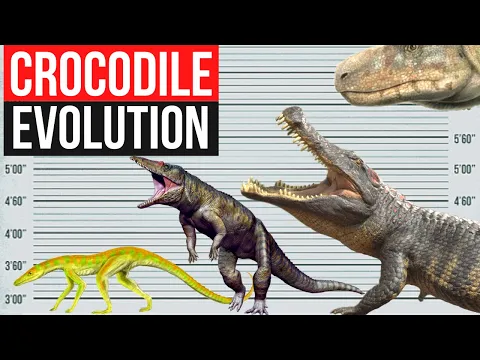
This strategy also helps to explain how crocodyliforms survived the great extinction at the end of the Triassic, an event that opened ecological space for the expansion of dinosaurs in the Jurassic.
Groups with ecological flexibility and varied niches had better chances of persisting, and crocodilians are an example of this: today, despite the standardized image, they range from semi-aquatic species to fossorial forms and even marine ones in the past.
The Transition Story: From Terrestrial Runners to Semi-Aquatic Predators
The Terrestrisuchus is a reminder that a lineage can transform its lifestyle over millions of years. The transition to semi-aquatic forms occurred gradually, with adaptations in the skull, tail, and limbs favoring swimming, ambushing, and life on riverbanks. This means that:
• the upright posture gave way to the sprawling posture,
• long limbs were replaced by short, robust limbs,
• the skull widened and strengthened for ambushing,
• the tail became a propulsive force for swimming.
When we observe a modern crocodile motionless by the riverbank, we are seeing a lineage that abandoned terrestrial sprinting to adopt aquatic ambush. It is a late specialization, not an ancestral model.
Why Does This Fossil Matter So Much to Paleontology?
The scientific value of Terrestrisuchus gracilis lies in clarifying three central questions about archosaur evolution:
- ancestral crocodyliforms were predominantly terrestrial,
- they possessed an upright posture, not a sprawling one,
- semi-aquatic life is a later evolutionary acquisition.
These conclusions are based on osteological analyses and comparisons with other Triassic crocodyliforms, showing that the group occupied much more diverse niches than previously thought.
Moreover, it reinforces that the evolution of archosaurs was not linear. While some branches followed the path of theropod and avian dinosaurs, others took alternative routes that only later converged into the “classic” morphologies known to the public.
A Fossil That Reconfigures Expectations
The case of Terrestrisuchus shows how small fossils can carry significant conceptual revolutions. By demonstrating that ancestral crocodilians could run, actively hunt on land, and compete in dry environments, it demystifies the idea that the group was always associated with rivers and swamps.
This revelation has value not only biologically but also culturally. It reminds us that current biodiversity is merely a recent snapshot and that each lineage carries improbable pasts. The crocodile lurking in the river is just a modern version of an archosaur that once ran upright and quickly across arid lands.
In paleontology, as always, time is the key to understanding the improbable.




-

-

-

-

12 people reacted to this.