






 Portuguese
  Spanish


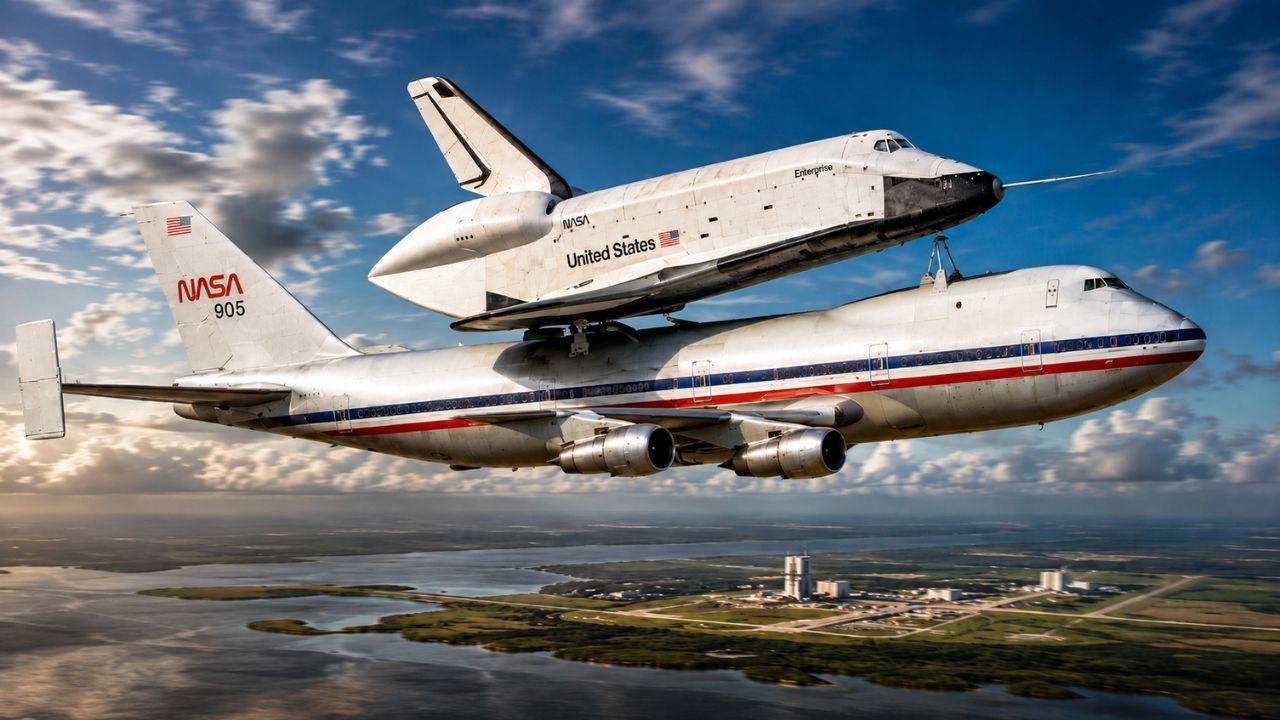


Before the Space Shuttle Columbia reached orbit, NASA converted a Boeing 747 to transport the Enterprise and release it in unpowered free flights. Purchased for about US$ 15.6 million, the jumbo paved the way for another aircraft and 87 transport missions of the American program orbiters.
The image of a Space Shuttle mounted on a Boeing 747 became one of the most recognizable symbols of the United States space program. This combination began to take shape in 1974, when NASA bought a used jumbo from American Airlines for approximately US$ 15.6 million and started its conversion to transport orbiters.
As explained in a video published by the channel Dobra Espacial, the modified plane, identified as NASA 905, played a decisive role even before the program’s first orbital mission. In 1977, at Edwards Air Force Base in California, it took the Enterprise prototype to great altitudes and released it in unpowered glide tests, allowing astronauts and engineers to evaluate how the vehicle would land after returning from space.
NASA needed to move a Space Shuttle that could not cross the country alone

As the program’s design advanced, NASA faced a practical problem: how to transport an orbiter built in California to test centers or to the launch site in Florida. The Space Shuttle was not designed to make long atmospheric journeys using its own engines.
-
OnePlus N6 Smartphone to Launch in India with 8,000mAh Battery and 45W SuperVOOC Charging, Lasting Up to Three Days

-
Scientists Plan to Release Air Bubbles Underwater to Protect Antarctica’s “Doomsday Glacier” from Melting

-
Chinese R6000 Drone Combines Airplane and Helicopter Features, Carries Up to 12 People for Multiple Missions
-
In the World’s Most Densely Populated Desert, Families Dig Funnel-Shaped Underground Cisterns to Capture Rare Rainfall and Store Drinking Water for Up to Eight Months



Upon returning from space missions, the difficulty could also reappear. Although the Kennedy Space Center was the main landing site, weather or operational conditions could lead a shuttle to land at Edwards Air Force Base, on the other side of the United States.
Transporting a vehicle of this size by land or sea would involve significant logistical limitations. NASA needed a solution capable of carrying the orbiter by air and, at the same time, helping to prove that it could glide and land safely.
The Boeing 747 emerged as the answer to both challenges. Converted into a carrier aircraft, it could traverse great distances with the orbiter on its back and still function as an atmospheric launch platform for the Enterprise tests.
Boeing 747 won the dispute against military transport alternative

Before choosing the jumbo, NASA evaluated alternatives to carry the orbiter. Among the models studied was the Lockheed C-5A Galaxy, a large-capacity military aircraft, as well as the Boeing 747 itself, which was still relatively new in the commercial aviation market.
The studies indicated advantages for the 747, such as the ability to perform transcontinental transport without the need for refueling, use of smaller runways, and a longer predicted structural life. There were also aerodynamic concerns involving the configuration of the orbiter on the C-5A.
With this evaluation, the agency abandoned previous plans to install transport engines on the orbiter itself and decided to acquire a Boeing 747 to fulfill the role of Shuttle Carrier Aircraft, or SCA, the carrier aircraft for the Space Shuttle.
The choice avoided making the spacecraft heavier and more complex just for relocations that would occur outside orbital missions. Instead, NASA would create a specialized plane to carry the orbiter wherever necessary.
First jumbo cost US$ 15.6 million and had its interior removed

On July 18, 1974, NASA purchased a used Boeing 747-123 from American Airlines for approximately $15.6 million. The aircraft, built in 1970 and later registered as N905NA, had accumulated about 9,000 flight hours before being transferred to the space agency.
The jumbo could not simply have an orbiter placed on its fuselage and take off. The adaptation required deep structural changes. The finish, seats, and much of the internal equipment located behind the front doors were removed to reduce weight and allow for the necessary reinforcements for the new mission.
Three external supports were also installed on the fuselage: one at the front and two at the rear. These points would secure the Space Shuttle to the transport aircraft, partially replicating the logic of the connection points used in the launch assembly.
The Boeing 747 stopped being a passenger plane and became an aerial platform built to carry an entire spacecraft on its back.
Tail gained reinforcements to maintain control with orbiter on its back

The presence of an orbiter on the 747 radically altered the aircraft’s aerodynamic behavior. The structure mounted on the fuselage interfered with the airflow and required changes to preserve stability and control during takeoff, cruising, and landing.
For this reason, NASA 905 received two additional vertical stabilizers at the ends of the horizontal stabilizer on the tail. The extra surfaces helped maintain directional stability when the plane flew with the Space Shuttle attached.
The aircraft also received instruments for the crew and engineers to monitor the orbiter’s systems during transport flights. In the Enterprise test program, the 747 also featured special equipment related to the safety of experimental operations.
The changes transformed the appearance of the jumbo. The assembly seemed improbable to the public eye, but each support and each modification to the tail responded to real engineering needs.
Enterprise was built to test flight and landing without going to space

The first orbiter used in this operation was the Enterprise, identified as OV-101. Unlike the spacecraft that would later travel to orbit, it was a prototype aimed at atmospheric tests and did not have the necessary systems for an operational space mission.
The Enterprise did not have operational main engines or functional thermal protection to withstand an orbital reentry. Its role was to allow engineers and astronauts to verify the aerodynamic behavior of the Space Shuttle design during approaches and landings.
This point was crucial because the orbiter would return from space as a glider. Without jet engines to correct a poorly executed approach, the crew would have only one chance to guide the aircraft to the runway.
Before sending astronauts into space, NASA needed to prove that this heavy vehicle, with compact wings and no propulsion during landing, could reach the ground with control.
Tests began with aircraft attached to 747 before free flights
The Approach and Landing Tests program, known by the acronym ALT, began in 1977 at the then Dryden Flight Research Center, at Edwards Air Force Base. On February 15 of that year, the set formed by NASA 905 and the Enterprise conducted three taxiing tests.
After this phase, NASA conducted five flights with the Enterprise attached to the Boeing 747 and without crew inside the prototype. The intention was to measure the aerodynamic performance of the complete configuration during takeoff, climb, flight, and landing.
Next, there were three captive flights with astronauts inside the Enterprise and systems activated. These tests allowed for testing procedures, instruments, and conditions that would be necessary when the time came to release the orbiter in the air.
The agency advanced in stages because any failure could compromise two aircraft at the same time: the transport jumbo and the Space Shuttle prototype mounted on it.
Boeing 747 released Enterprise in the first unpowered flight in August 1977

On August 12, 1977, the Enterprise made its first free flight. Astronauts Fred Haise and Gordon Fullerton were in the cockpit of the prototype when the Boeing 747 took it to the sky over the Edwards region and initiated the separation sequence.
At the planned point, the orbiter was released from NASA 905 and began to glide on its own. The flight lasted just over five minutes and ended with a landing on the dry surface of Rogers Lake, an area used for its large extent and safety margin.
It was the first time a Space Shuttle flew alone. The mission did not aim to reach orbit or test launch engines, but to verify if the final shape of the orbiter would respond adequately to controls during approach and landing.
The 747 not only transported the Enterprise: it made possible the moment when NASA discovered, in a real flight, if its new spacecraft could return to Earth like a glider.
Five free flights revealed a problem before the first orbital mission
In total, the Enterprise conducted five free flights during approach and landing tests. The crews formed by Fred Haise and Gordon Fullerton, as well as Joe Engle and Richard Truly, alternated in command during the trials.
In the first flights, the prototype used a tail cover designed to smooth turbulence in the rear region while attached to the Boeing 747. In the last two releases, this cover was removed so that NASA could assess conditions closer to the real orbital return configuration.
The fifth flight ended on a concrete runway, instead of the extensive surface of the dry lake. During landing, pilot-induced oscillations associated with the vehicle’s control system emerged, a problem that required investigation and correction before Columbia’s orbital debut.
The episode showed why testing the Enterprise was indispensable: a failure identified in a developmental gliding flight could be addressed before a Space Shuttle returned from a real mission.
Columbia opened the operational phase and transformed 747 into indispensable transport
After the tests with the Enterprise, Columbia conducted the first orbital mission of the program in April 1981. From then on, the orbiters began to travel to space on scientific, military, satellite maintenance, and International Space Station construction missions.
When a mission landed in California, the orbiter needed to return to the Kennedy Space Center in Florida for preparation for new launches. In these situations, the modified Boeing 747 ceased to be an experimental platform and assumed its more frequent logistical function.
The transport required the orbiter to be installed on the plane by special lifting structures. Once coupled, the set followed in a ferry flight, at altitudes and speeds limited by the enormous load mounted on the fuselage.
The operational success of the Space Shuttle did not depend only on the rockets and launch platforms; it also depended on a jumbo capable of bringing the spacecraft back to base when it landed far from Florida.
Second Boeing 747 reinforced fleet after years of the program


During the early years, NASA 905 was the only transport aircraft of this type used by the program. The situation changed when NASA incorporated a second Boeing 747, previously acquired from Japan Air Lines and converted to fulfill the same function.
The new plane, identified as NASA 911, entered service as Shuttle Carrier Aircraft in November 1990. Like the first, it received structural reinforcements, attachment points, additional stabilizers on the tail, and necessary adaptations to transport a Space Shuttle on its fuselage.
The incorporation of a second aircraft reduced the dependence on a single plane for an operation essential to the mission schedule. If one transporter was unavailable, the program would have another unit capable of executing transfers.
The image of the orbiter on the jumbo ceased to depend on a single plane and came to represent a small fleet dedicated to sustaining the American space operation.
Two jumbos carried out 87 missions in the operational phase of the program
According to NASA records, the Shuttle Carrier Aircraft carried out 87 transport missions during the operational phase of the Space Shuttle program. NASA 905 accounted for 70 of these flights, while the second jumbo increased service capacity after its entry into service.
Of the 87 missions, 54 occurred after orbiters landed at Edwards Air Force Base and needed to return to the Kennedy Space Center. The data shows that the work of the cargo planes was directly linked to the continuity of operations after landings outside Florida.
The jumbos also transported orbiters for other program needs, including relocations related to facilities and, after the fleet’s retirement, deliveries for public display. The Enterprise, which never traveled to space, also performed relocations on the NASA 905.
For three decades, the set that seemed like an impossible image became a routine tool to keep the American program running between landings, tests, and new destinations.
Planes that carried the Space Shuttle became historical pieces

The Space Shuttle program ended in 2011, after decades of missions and 135 orbital flights. With the end of operations, the aircraft that carried the shuttles also became part of the memory of American space exploration.
The NASA 905 was retired after performing final missions delivering orbiters to museums. It became part of a historical exhibit at the Space Center Houston, where it is displayed with a replica of a space shuttle mounted on its fuselage.
The NASA 911 was also retired and is on display in Palmdale, California. Although neither of the two jumbos traveled to space, both allowed the shuttles to be tested, relocated, and presented to the public at different stages of the program.
NASA bought a used commercial plane to solve a transportation problem and ended up creating one of the most enduring images of the Space Shuttle era.
Jumbo with spacecraft on its back showed that engineering also depends on improbable solutions
The Boeing 747 acquired for about $15.6 million was not chosen to launch astronauts into orbit nor to replace rockets. Its role was less spectacular on paper but decisive in practice: to transport a spacecraft that could not cross American territory on its own and help it prove it could land.
The Enterprise demonstrated, in five free flights, that the concept of the orbiter could work in the atmosphere. Decades later, the two converted jumbos had completed 87 transport missions in the operational phase, sustaining a routine that took the Space Shuttle to different runways, bases, and destinations.
What impresses most in this story: NASA placing an entire spacecraft on a Boeing 747 or the fact that this arrangement became indispensable for one of the most famous space programs in the world? Share your opinion.






What a brilliant alternative solutions for for Nasa space program. Engineering at its best.