Portuguese
  Spanish


Oceanix Busan Is The First Floating City Project On The Sea Supported By The UN. Planned To House 20,000 People, It Symbolizes The Future Of Sustainable Cities — But It Faces Technical And Political Challenges That Delay Its Implementation.
In the face of advancing climate change and rising sea levels, the world is seeking innovative alternatives to house populations in vulnerable coastal areas. Among the most ambitious proposals is the floating city of Oceanix Busan, developed in partnership with the government of South Korea and officially supported by UN-Habitat. With a planned capacity to accommodate up to 20,000 residents, this floating city project presents itself as a revolutionary model of urban infrastructure on the sea.
Announced with global enthusiasm, the project proposes not only housing but also a complete reconfiguration of how sustainable cities of the future might operate. However, although it has caused a stir in the international press and at events such as COP27, Oceanix Busan is progressing slowly, facing a series of structural, regulatory, and political challenges that reveal the complexity of building a city on the water.
Oceanix Busan: The Concept Behind The World’s First Sustainable Floating City
Officially presented in 2019 and detailed in 2022, Oceanix Busan is the first floating urban prototype endorsed by the UN-Habitat, the United Nations agency focused on sustainable urban development. It will be installed off the coast of the port city of Busan in South Korea and will function as a “living platform” for urban innovation.
-
New Study Finds Brief Stress Episodes Can Alter Blood and Increase Risk of Clot Formation

-
Ukraine Escalates War Efforts with Plan to Deploy 25,000 Ground Drones, Test Phantom MK-1 Humanoid Robot, Use Armed Mini-Tanks, and Expand Automated Attacks up to 15 km from Frontline

-
New Superfiber Developed by Imperial College Researchers and Approved by the EU Promises to Increase Satiety and Help Prevent Weight Gain
-
Harvard Researchers Develop Biological Clock to Estimate Life Expectancy, Potentially Transforming Human Aging Studies


Initially consisting of three interconnected platforms and expandable to a total of 20 units, the project will cover an area of approximately 6.3 hectares in its initial phase. The idea is to allow the city to expand as population demand and the maturation of the involved technologies develop.
According to the responsible architects — led by the Danish firm BIG (Bjarke Ingels Group), in collaboration with the firms Samoo and Oceanix — the project was designed to be self-sufficient in energy, water, and food, with closed-loop production systems, waste recycling, and modular construction adaptable to different climatic conditions.
Stage For Innovations: Solar Energy, Desalination, And Aquaponic Agriculture Are Present In The Floating City
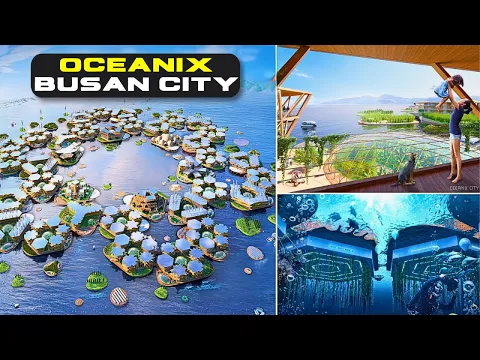

One of the most impressive promises of Oceanix Busan is its level of autonomy. The city will use solar panels for energy generation, desalination systems for potable water supply, and aquaponic agriculture technology for food production, integrating fish and vegetables in a single production cycle.
The constructions will be made of lightweight, durable, and corrosion-resistant materials, such as laminated bamboo and low-carbon marine concrete. The architecture is designed to withstand category 5 hurricanes, tsunamis, and maritime instability, according to documents from UN-Habitat and the Oceanix Institute.
This proposal positions Oceanix Busan within a new paradigm of energy and urban infrastructure: cities that not only occupy space but also respect and integrate their ecological rhythms, representing an alternative to traditional urban expansions on solid ground.
Oceanix As A Response To Global Climate Collapse
The strategic plan behind the project is directly linked to climate change. It is estimated that by 2050, more than 800 million people could be displaced by extreme events, according to the World Bank. Of this total, a large part lives in coastal areas vulnerable to rising sea levels.
The proposal for the floating city on the sea emerges as a radical solution to this scenario, allowing for the creation of new resilient urban settlements, without consuming natural land and with minimal environmental impact. It represents a new urban paradigm, built to coexist with the sea, not to fight against it.
According to Maimunah Mohd Sharif, former executive director of UN-Habitat, “the challenges of the future cannot be met with solutions from the past. We need cities that grow with the ocean, rather than retreat from it.”
Why Is The Project Progressing So Slowly?
Despite the initial enthusiasm, the floating city project faces difficulties in getting off the ground. Although the conceptual phase has been completed and the coastal area of Busan designated for installation is already set, physical construction has yet to begin, even after five years of planning.
Among the main obstacles are:
- Maritime regulatory issues: such as coastal zoning, trade routes, and environmental protection;
- High initial implementation costs: even in its pilot phase, it is estimated that the project will require hundreds of millions of dollars;
- Lack of legal and urban precedents for permanent floating settlements;
- Local political challenges, such as resistance from residents and disputes between government levels.
Additionally, there is a need to ensure that safety, evacuation, maintenance, and logistics systems function fully — which requires massive investments in energy and water transportation infrastructure that are not yet integrated into the current urban system of Busan.
Comparisons With Other Cities And Experimental Projects
Although it is the first project endorsed by the UN, Oceanix Busan is not alone in the world of floating cities. Countries like the Netherlands, Maldives, and the United Arab Emirates have already tested models of infrastructure on the sea, with limited success.
In Amsterdam, for example, the floating neighborhood Schoonschip houses about 100 people with sustainable technologies, but on a very small scale. In Dubai, the Heart of Europe created private artificial islands with residences on platforms, but focused on luxury tourism, not large-scale housing.
What sets Oceanix apart is its social and ecological proposal: a functional, accessible city, focused on the common good and prepared for the challenges of the 21st century.
Urbanism Over The Ocean: Solution or Utopia?
The concept of a floating city on the sea elicits both fascination and skepticism. On one hand, it represents a bold attempt to break through the physical and political limits that restrict urban expansion. On the other hand, it raises legitimate questions about viability, maintenance, cultural adaptation, and long-term sustainability.
Experts consulted by Bloomberg Green emphasize that the greatest risks of the project are not technological, but social. “The technology is ready. The problem is integrating people into a new style of life on the water,” stated South Korean urban planner Park Hyun-Soo.
Indeed, the abandonment of shopping centers, high-rise condominiums, and poorly integrated planned neighborhoods in various parts of the world serves as a warning: large visionary works can become symbols of urban failure if not supported by effective public policies and active community participation.
Next Steps And Expectations For The Next Decade
Despite the delays, the project remains alive. In 2023, UN-Habitat and the Oceanix Institute reaffirmed their commitment to start construction in 2025, with the first residential module ready by 2028. The goal is to house up to 1,650 people in the pilot phase, with gradual expansion until reaching full capacity of 20,000 residents.
The next steps include:
- Finalization of maritime licenses with the South Korean government;
- Securing public and private funding;
- Initiation of construction of floating modules in specialized shipyards;
- Environmental resistance and habitability testing.
If successful, Oceanix Busan will serve as a model for replicas in other vulnerable coastal cities — including areas in Bangladesh, Indonesia, West Africa, and Latin America, where the urban climate impacts are becoming increasingly severe.
Oceanix Busan is more than an engineering project: it is an urban manifesto against the traditional limits of the modern city. By proposing a sustainable floating city on the sea, it challenges not just rising ocean levels, but also the paradigm of how we live, build, and organize our societies.
Though the project’s pace is slower than anticipated, its conceptual impact is already underway. In a world facing simultaneous environmental collapse, urban space shortages, and housing inequality, thinking outside solid ground may be not only desirable but inevitable.
If Oceanix Busan succeeds, it may be remembered as the embryo of a new urban era. If it fails, it will leave valuable lessons about the limits — both technical and human — of our own future.