Portuguese
  Spanish


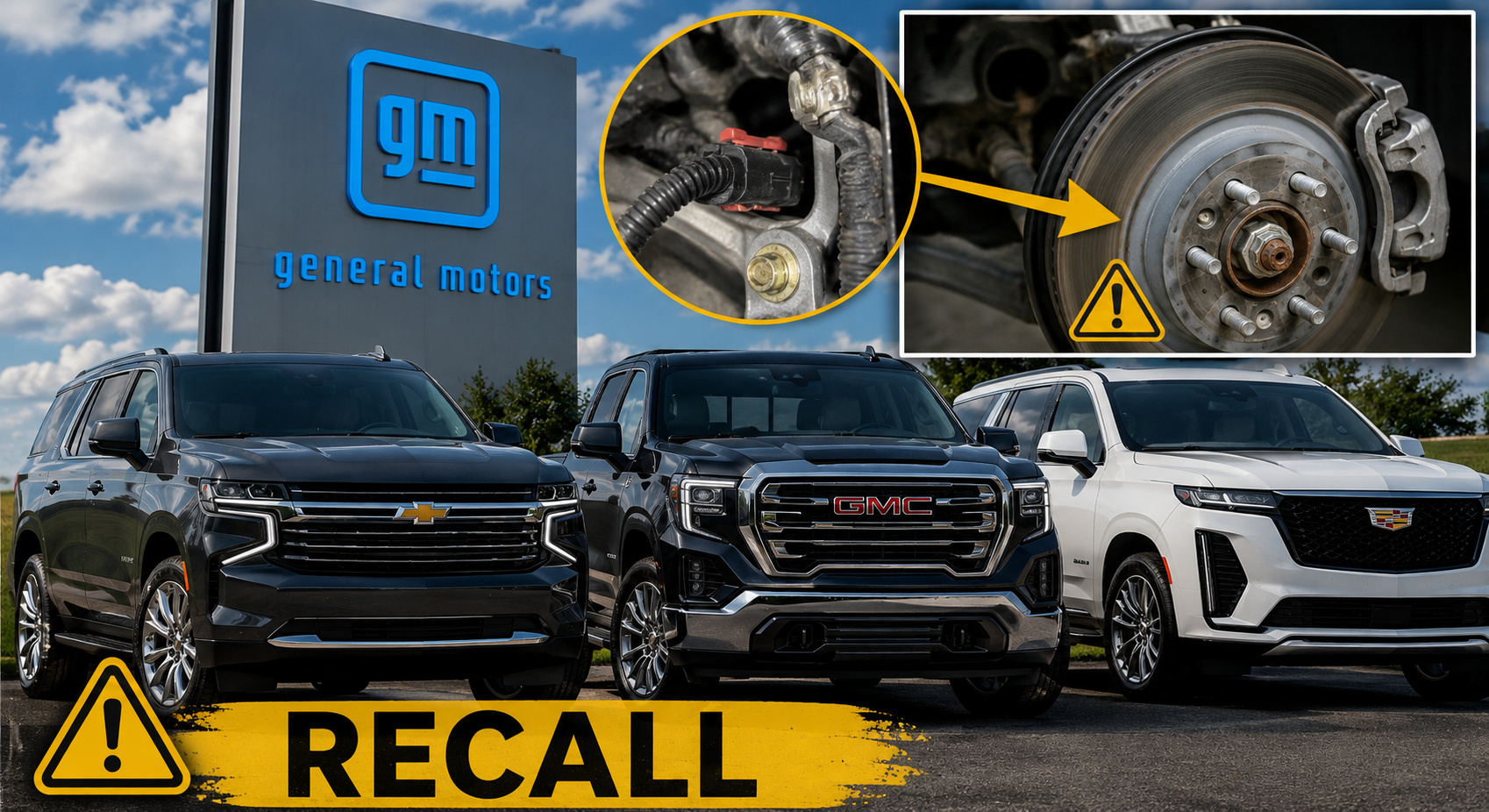

General Motors Recall Involves Chevrolet, GMC, and Cadillac SUVs and Pickups After Defect Could Lock Wheels During Driving.
General Motors has issued a “do not drive” alert for owners of Chevrolet, GMC, and Cadillac models after identifying a serious defect in the transfer case that could cause sudden wheel locking. The recall was registered with the NHTSA under number 26V289 and involves SUVs and pickups with 4×4 or AWD traction produced in different model years.
The affected vehicles include Chevrolet Silverado 1500, Tahoe, and Suburban, GMC Sierra 1500, Yukon, and Yukon XL, as well as Cadillac Escalade and Escalade ESV. According to official documents, some units from 2015 to 2020 are also included in the campaign because they may have received a replacement transfer case with the defect.
The issue drew attention because GM itself advised that the vehicles should not be driven until the repair is completed. This type of measure is rare in the automotive industry and usually occurs only when there is a potential risk of a serious accident.
-
Brazil’s Lula Government Allocates $463 Million Quota for Electric Car Parts, Waives Import Tax Until December, Sparking Competition Among BYD, Automakers, and Unions as Consumers Question Impact on Prices and Local Industry

-
Thinking of Installing LED Headlights? Why Replacing Halogen Bulbs is Still Banned, the Glare Risks Authorities Worry About, and How a New Proposal Could Allow Certified, Safe Installations

-
2027 Toyota Corolla Cross Unveiled: New Design, Enhanced Fuel Efficiency, Reduced Maintenance Costs, Advanced Technology, Connected Services, and Up to 10-Year Warranty
-
Fiat Cronos Precision 2018: Affordable Sedan with Spacious Trunk and Reliable Maintenance



Defect Involves Missing Part Inside GM Vehicles’ Transfer Case
According to NHTSA documents, the defect is linked to the absence of an internal oil pickup tube inside the transfer case. Without this part, the internal bearings may not receive adequate lubrication.


Over time, excessive friction causes accelerated wear of the mechanical assembly. In extreme cases, the failure can evolve into sudden locking of the front or rear wheels while the vehicle is in motion.
The NHTSA states that wheel locking significantly increases the risk of loss of control and collision.
General Motors Recall Affects Silverado, Tahoe, Suburban, Sierra, Yukon, and Escalade
Official documents indicate the following affected models:
- Chevrolet Silverado 1500 2026
- Chevrolet Tahoe 2016-2017, 2019, and 2026
- Chevrolet Suburban 2015, 2017-2020 and 2026
- GMC Sierra 1500 2026
- GMC Yukon 2019-2020 and 2026
- GMC Yukon XL 2018-2019 and 2026
- Cadillac Escalade and Escalade ESV 2015 and 2026
According to GM, the recall involves 66 vehicles in total. Despite the relatively small number, the case received significant attention because the defect directly affects a critical component of the transmission.
The campaign also includes a replacement transfer case that may have been installed in older vehicles during previous maintenance.
GM states that defect arose after failure in supplier’s control processes
GM reported that the problem was traced to Magna Powertrain of Mexico, the supplier responsible for manufacturing the involved transfer cases. According to the recall documents, standardized procedures and error detection protocols were not correctly followed during production.
This allowed some units to be assembled without the internal oil pickup tube. Without the part, the system loses adequate lubrication capacity during vehicle operation.
The automaker stated it has identified four complaints related to the defect but declared it is not aware of any accidents or injuries associated with the issue at this time.
Owners may hear noises before more severe failure occurs, says GM
The technical documentation of the recall informs that some drivers may notice signs before the severe failure of the transfer case. Among them are metallic noises, vibration, or grinding sounds coming from the transmission.
Even so, GM decided to recommend that the vehicles not be driven until a complete system inspection. This is because locking can occur without clear warning in some situations.
The repair will be done free of charge at dealerships, which will inspect and replace the transfer case when necessary. Notification letters to owners are expected to begin being sent in June 2026, according to the NHTSA.
Transfer case is a central part in SUVs and pickups with 4×4 drive
The transfer case is responsible for distributing torque between the front and rear axles in vehicles with all-wheel drive or four-wheel drive.
In large pickups and heavy SUVs, this component works under high load, especially in towing, off-road, and severe use. Any internal failure can directly compromise drivability and stability.
In the case of GM models, the defect affects precisely a system used in large and heavy vehicles, which increases the concern of safety authorities.
Recall reinforces growing pressure on automakers over transmission-related defects
The case arises at a time of increasing pressure on automakers for failures in transmission, software, and traction systems.
In recent years, recalls involving wheel locking, electronic failures, and power loss have received faster responses from the NHTSA due to the potential for serious accidents at speed.
The extreme “do not drive” guidance shows that GM and the American agency treated the defect as a significant risk to road safety.
The episode also reinforces an increasingly common reality in the industry: even a small and seemingly simple component can trigger critical failures in highly complex SUVs and pickups.