






 Portuguese
  Spanish


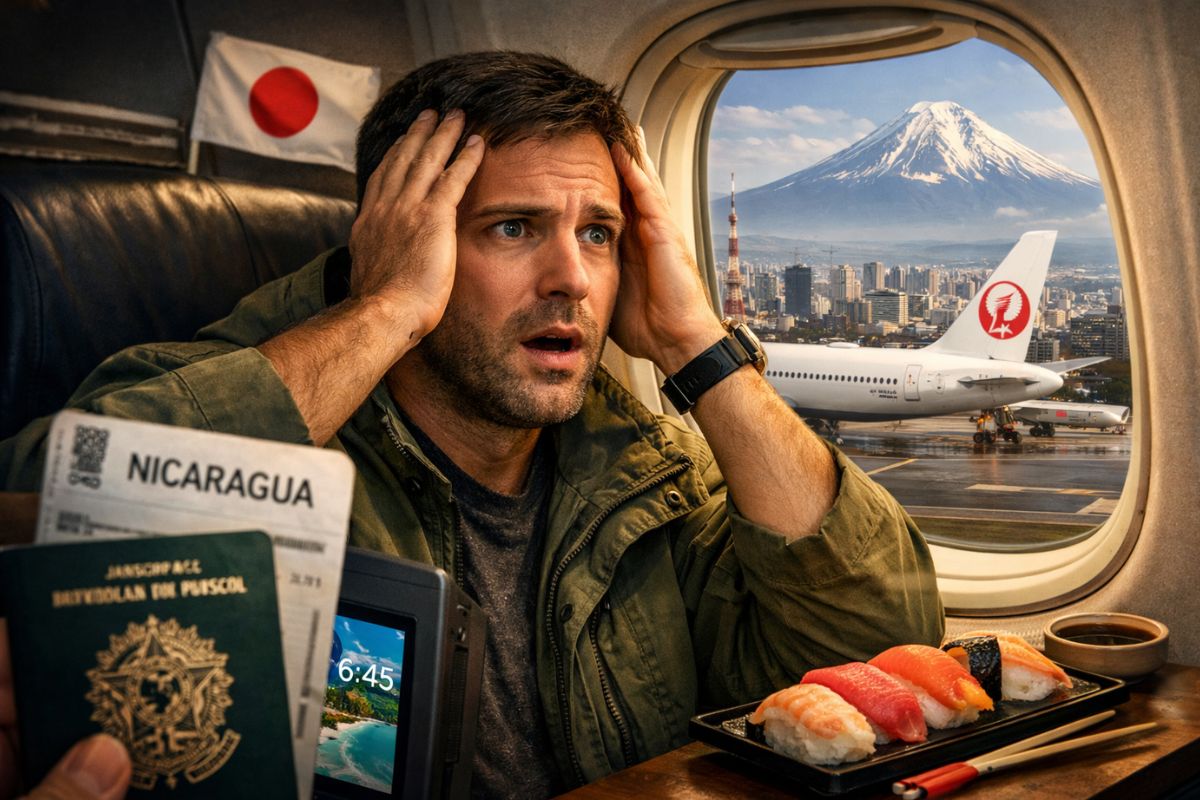


When Buying a Ticket from Los Angeles to Managua, a Passenger Ended Up on a Flight to Tokyo, Discovered the Diversion Only Six Hours Later, Arrived Two Days Late, and Opened a Debate About Gate Checks, Language Barriers, Refunds, and Safety of the Air Travel Process in Complex International Connections.
The ticket issued for the Los Angeles–Managua leg, with a layover in Houston, seemed like a routine few-hour journey until the first leg. Instead, the passenger only realized something was wrong in the air, about six hours into the flight, when they inquired about the delay and were informed that the plane was heading to Tokyo, Japan.
The unexpected route ended at Haneda Airport and turned a planned journey into a series of logistical corrections, additional costs, and a final delay of two days until arriving in Nicaragua. The case clearly highlights how a seemingly simple boarding error can escalate into an operational, financial, and human issue.
From Planned Itinerary to Wrong Destination: How the Case Unfolded

The original plan involved a ticket from United Airlines to leave Los Angeles, connect in Houston, and proceed to Managua. Under normal conditions, the first leg would take about three hours, which would make any time and route discrepancy more noticeable early in the journey. Even so, the discrepancy was only identified several hours later, already in the advanced phase of the flight.
-
Orphaned Youth Turns Dismissed Idea into Global Prestige with Innovative Wristwatch

-
English Skills Boost Career Opportunities in the Oil and Gas Industry

-
Brazil Secures Second Place at WorldSkills 2024 in Lyon, with 64 Young Professionals and 8 Medals, Including Gold from a Rio de Janeiro Hairdresser

-
3,000 Military Personnel from 10 Countries, Including US and Chinese Marines, Train Together in Brazil’s Savanna: Operation Formosa Becomes Largest Naval Ground Exercise Before First Cancellation Since 1988



When the passenger realized that the journey was exceeding expectations and sought clarification from the crew, confirmation came that the aircraft was heading to Tokyo. This moment is central because it shows that the problem was not just an issue of orientation at the terminal: the inconsistency exceeded initial layers of verification and reached the full execution of the flight.
After landing in Japan, the airline arranged for a return to Los Angeles to restore the itinerary and attempt to proceed to the final destination. The concrete outcome was arriving in Managua two days late, altering commitments, travel routines, and costs associated with the unplanned stay outside the original route.
Where Validation May Have Failed at Boarding
In airport operations, boarding usually relies on a sequence of validations: checking the boarding pass, compatibility with the flight, and authorization to access the jet bridge or tarmac bus. In this episode, the passenger would have passed through this funnel with an incorrect ticket, indicating a possible human checking failure, or a failure of both combined at the same point in the process.
A technical hypothesis discussed for such cases is the scenario of operational pressure at the gate: long lines, a short closing window, and high passenger volume where alerts may not receive the necessary attention. Another possibility is the lack of effective reading of the boarding pass before entering the plane. When the final barrier does not block the inconsistency, the error ceases to be local and becomes a systemic risk.
There is also a factor of “apparent normalcy”: if a person sits in an available seat and there is no immediate conflict, the anomaly may go unnoticed for longer. This does not eliminate the responsibility for individual verification by the traveler but reinforces that the boarding control architecture exists precisely to prevent an isolated failure from becoming an international route deviation.
What the Error Cost and How Compensation Evolved
In addition to the delay, the financial impact was tangible. The passenger reported expenses of US$ 1,095, involving accommodation, clothing, and essential items. The critical point was the checked baggage for the original destination, which restricted immediate resources to handle the unplanned stay until the trip could be reorganized.
The airline’s initial response was to offer US$ 300 in travel credit. After the case gained attention, the proposal increased to US$ 1,000 also in credits.
The difference between documented expenses and the compensation offered, combined with the format in credits (and not necessarily full cash reimbursement), opens a recurring discussion in the sector about what standard of compensation is proportionate when there is a significant operational failure.
In practical terms, this type of outcome tends to generate three simultaneous debates: direct costs for the passenger, indirect costs of the trip interruption, and reputational costs for the company.
The wrong ticket produces not only a delay; it creates a chain of measurable and intangible losses that must be addressed with transparency and criteria.
Why Language, Signage, and Airport Routine Increase the Risk
The case also suggests that language barriers may have contributed to the delay in recognizing the problem. If the passenger had difficulty with English, gate announcements, audible calls, and onboard instructions may have had low effectiveness.
In connection environments, where decisions are swift and gate changes occur in sequence, any noise in comprehension amplifies vulnerabilities.
This does not mean that language alone explains the incorrect boarding. It means that layers of communication poorly absorbed reduce the passenger’s self-correction capacity. When this limitation meets a potential checking failure at the gate, the operational risk grows disproportionately to the initial error.
Therefore, the safety of the journey depends on the combination of robust processes and inclusive communication.
In international airports, clear visual messages, multilingual reinforcement, and rigorous boarding validation are not merely conveniences; they are elements for mitigating error with a direct impact on the experience and the integrity of the itinerary.
Operational Responsibility and Duty of Care for the Passenger
There is individual responsibility in checking destination, time, and gate on the ticket before boarding. Still, the primary duty of ensuring that each person boards the correct flight lies with the airline and its airport operation. This is the key point of the case: the control architecture exists to intercept inconsistencies before the doors close.
When filtering fails, the consequence ceases to be a mere travel distraction and becomes an international service failure.
The chain of events of improper boarding, flying to the wrong country, forced return, and late arrival at the original destination demonstrates that the cost of a single rupture point can be much greater than it appears on initial analysis.
In such situations, the post-incident response needs to go beyond commercial credit. It involves tracing the error, revising procedures at the gate, improving communication, and providing compensation proportional to the actual damage suffered by those who relied on the operation to fulfill the contracted route.
The episode of the ticket to Managua that temporarily ended up in Tokyo shows how technology, human processes, and communication need to work together for boarding to be safe and predictable.
When a link fails, the passenger bears the cost of lost time, additional expenses, and emotional exhaustion, while the company faces scrutiny over control and responsibility.
If you have ever gone through a tight connection or gate confusion, which stage of the air travel experience do you consider the most fragile today: signage, boarding checks, or support after an error? And, in your case, what kind of compensation would really be fair when the trip goes completely off-script due to operational failure?





Durante a pandemia, em voo de retorno em Belém, comprei a passagem pelo companhia aérea A, cheguei com 3 horas de antecedência como faço de costume, fiz o check in, despachei bagagem e fui para sala de embarque, fiquei próximo ao portão de embarque mencionado no cartão, não ouvi nenhuma informação sobre a mudança de voo para outra companhia B e nem meu nome chamado, resumindo fui obrigado a passar a noite em Belém com despesas pagas pela companhia A, sem roupas para troca e seguir viagem no outro dia. No final deu tudo certo. Apesar dos atrasos eu cheguei em casa, até fiz uma reclamação na época junto a ANAC referente a falta de anúncios e avisos, eu tinha feito o check in, a empresa sabia que estava no aeroporto e não fui chamado. Não recebi nenhuma resposta sobre a reclamação.