Portuguese
  Spanish


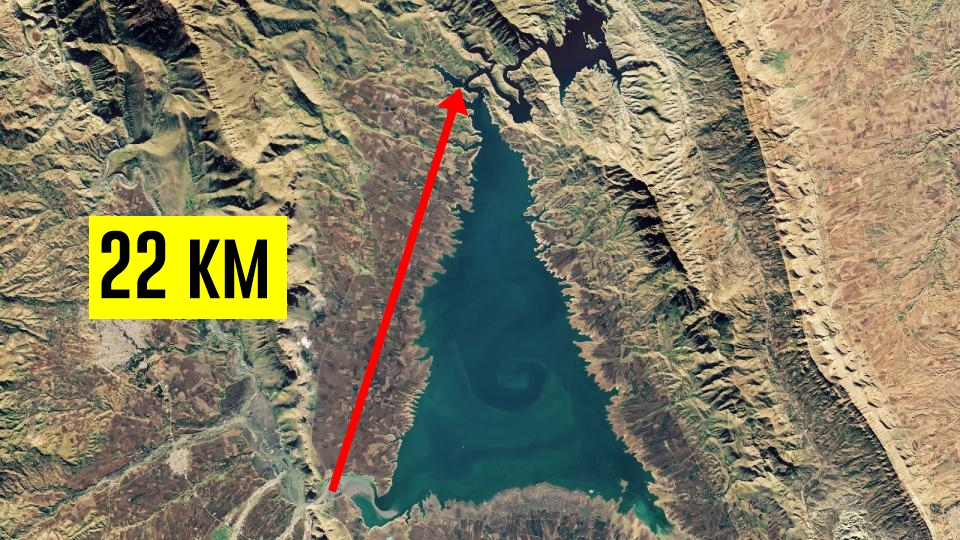

A colossal triangle-shaped tree, which extends 13 km in height and 22 km at its base, is considered the world’s largest “Christmas tree.”
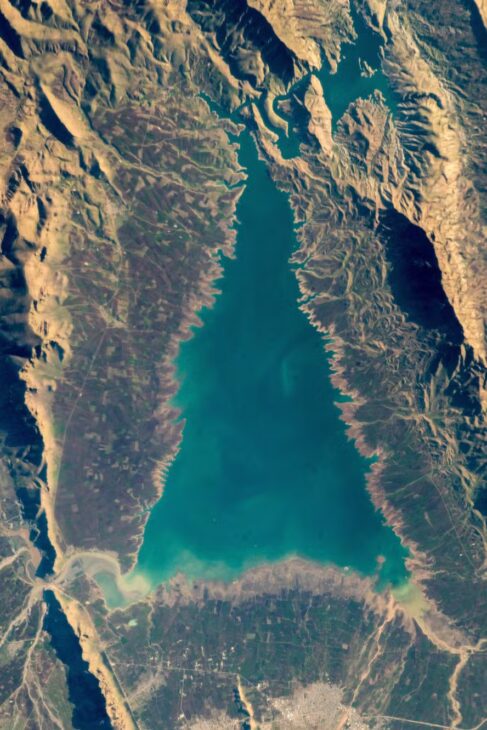
Astronauts on a space mission will not spend Christmas with their families this year, but to ease their longing, they can observe a peculiarity on Earth: Lake Dukan in Iraq, whose shape resembles a Christmas tree when viewed from space.
This curious “tourist spot” in the sky gained notoriety in 2018 when astronaut Alexander Gerst published an image of the lake on platform X (formerly Twitter). Since then, the sight of the lake has delighted professionals in space.
Origin and Formation of Lake Dukan
Lake Dukan is an artificial reservoir, created in 1959 with the construction of a large hydroelectric dam near the city of Ranya in the Iraqi Kurdistan region.
-
Father Sells 10-Year-Old Daughter to Feed Family Amid Crisis; Mother Tries to Undo Marriage in Camp Where Hunger Pushes Families to the Brink

-
6-Year-Old Finds Ancient Neanderthal Axe on English Beach, Discovers Its Significance Three Years Later
-
Over 500,000 Wild Boars Culled in Eight Months, but Industry Estimates 1.25 Million, Raising Concerns About Crop Damage, Threatened Livestock, and Health Risks in Rural Brazil

-
Chinese Spacecraft Releases Mysterious Object in Orbit, Sparking Global Debate on Space Technology and Earth Monitoring



The triangular structure resembling a tree has a base of 13 km and extends about 22 km in its length. At the top, a small narrow branch looks like a star. This area corresponds to the location where the dam releases water into the Little Zab River, according to information from NASA’s Earth Observatory.
“From space, the shapes of Earth often resemble familiar figures – and Lake Dukan looks like a Christmas tree,” commented NASA representatives in a statement in 2018 when the image went viral.
Curious Details in the Image
In the photo captured by Gerst, it is possible to identify elements that enhance the festive appearance of the lake. First, a layer of algae covers the surface, creating a visual effect similar to green garlands. This phenomenon occurs due to the warm climate and runoff from agricultural activities in the area. Second, there are black spots scattered across the “tree,” resembling Christmas ornaments.
However, these points are photographic artifacts caused by reflections in the camera lens used by the astronaut, according to the Earth Observatory.
Tourist Interest and Environmental Impact
It is not only astronauts who find beauty in Lake Dukan.
In recent decades, the site has become a popular destination for tourists on Earth, thanks to its artificial beaches and excellent fishing.
However, experts warn of the risks of these activities on the local ecosystem, which is home to about 180 species of birds and fish, as well as rare animals such as Eurasian otters (Lutra lutra) and striped hyenas (Hyaena hyaena), both of which are endangered species.
Representatives of BirdLife International point out that the lake is under pressure due to tourism and has never been properly assessed for conservation. This raises concerns about the sustainability of the local biodiversity.
Historical and Archaeological Heritage
In addition to its ecological significance, the area around Lake Dukan is rich in history. Nearby, there are the Hazar Merd paleolithic cave, dated at 50,000 years, and ancient citadels located in the Zagros Mountains.
Another highlight is the set of 4,000-year-old sculptures known as the Ga’war Strait Sculptures, all overseen by the Kurdistan Tourism Council.
Thus, Lake Dukan goes beyond its space fame: it is a testament to the interaction between nature, history, and humanity, preserving archaeological memories and enchanting those who observe it, whether from Earth or the stars.