Portuguese
  Spanish


The object left Shoreham Beach, was forgotten in a child’s room in West Sussex, and only gained another meaning when Ben Witten recognized the piece in a Stone Age exhibition. The analysis by the Worthing Museum indicated that the “stone” was a bifacial flint tool, probably made by Neanderthals between 40,000 and 60,000 years ago.
Ben Witten was 6 years old when he found a shiny stone while playing on Shoreham Beach, in West Sussex county, southern England. The object looked different from the other pebbles on the beach, so the boy took the piece home and kept it in his room.
For three years, the supposed stone remained among the family’s belongings. The case changed when Ben, now 9 years old, visited the Worthing Museum and noticed that small axes displayed in the area dedicated to the Stone Age had a shape similar to the object he had found.
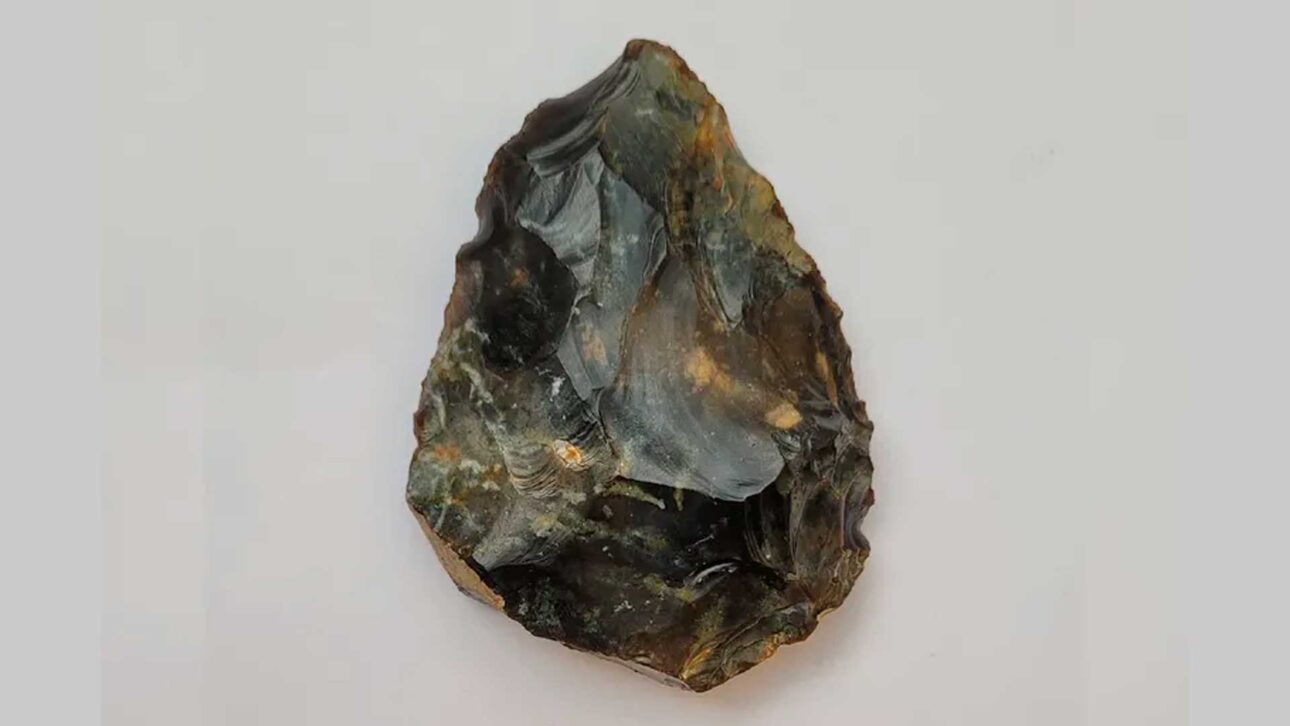
The family sent photos to the museum, and the response was surprising. According to the Smithsonian Magazine, experts identified the artifact as a Neanderthal hand axe, carved in flint and probably dated to the late Middle Paleolithic.
-
Over 500,000 Wild Boars Culled in Eight Months, but Industry Estimates 1.25 Million, Raising Concerns About Crop Damage, Threatened Livestock, and Health Risks in Rural Brazil

-
Chinese Spacecraft Releases Mysterious Object in Orbit, Sparking Global Debate on Space Technology and Earth Monitoring

-
Retired Builder Constructs House Using Over 4,000 Milk Cartons in Brazil, Engineer Estimates Structure Could Last 100 Years

-
Brazilian Well Taps Guarani Aquifer, Sparking Debate on Water Supply and Security




The discovery drew attention because it did not come from a professional excavation, but from an ordinary walk on the beach. For archaeologists, the value lies not only in the age of the piece but also in the record of where it appeared and the care taken to submit the find for evaluation.
The shiny stone that seemed just a pebble drew attention for its shape and worked surface
Ben told the BBC that he saw a shiny flint rock and thought it looked different from the other stones on the beach. He didn’t know what he had in his hands, but the pointed shape and carved appearance made sure the object wasn’t discarded.
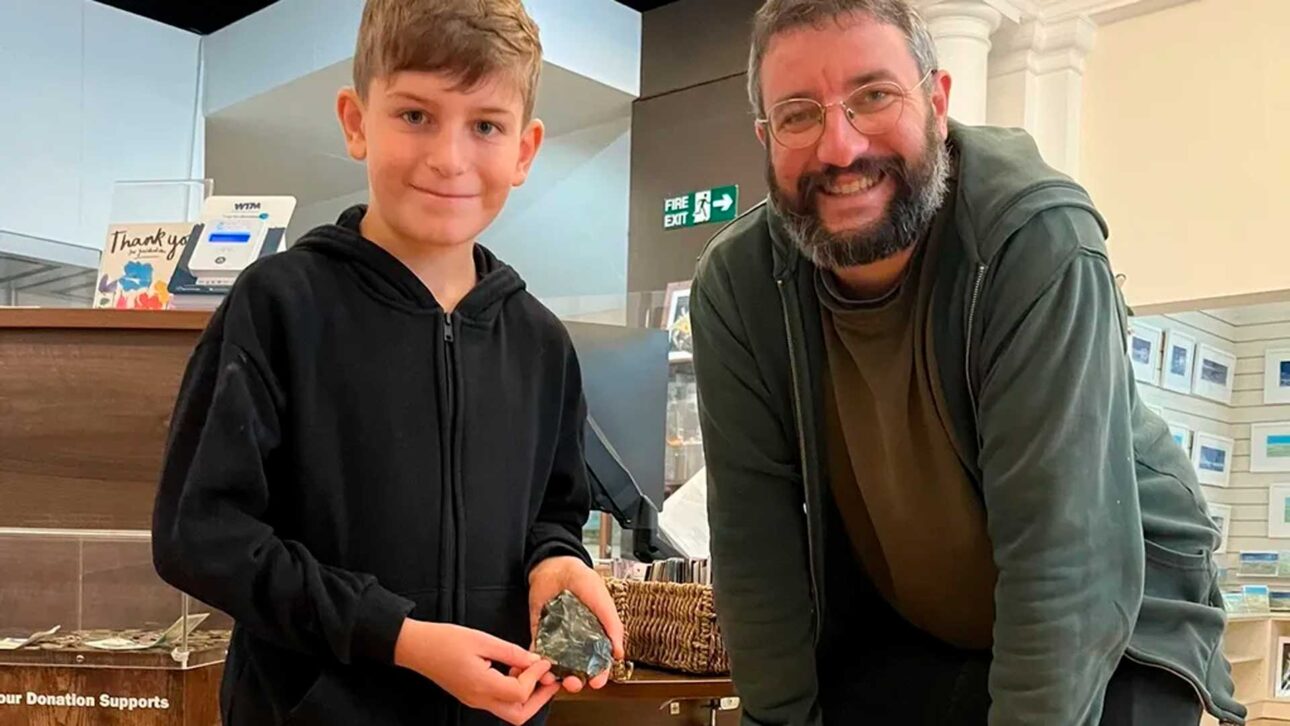
The axe is small enough to fit in the palm of a hand. Even so, it has characteristics that catch the attention of those familiar with prehistoric tools, such as the work on both sides of the piece, known as a bifacial form.
According to information from James Sainsbury, curator of archaeology at the Worthing Museum, the object shows little wear. This detail helps explain why the piece has raised hypotheses about its origin and how it reached the beach without suffering major damage.
Museum confirmed that the axe may have been made by Neanderthals between 40 thousand and 60 thousand years ago
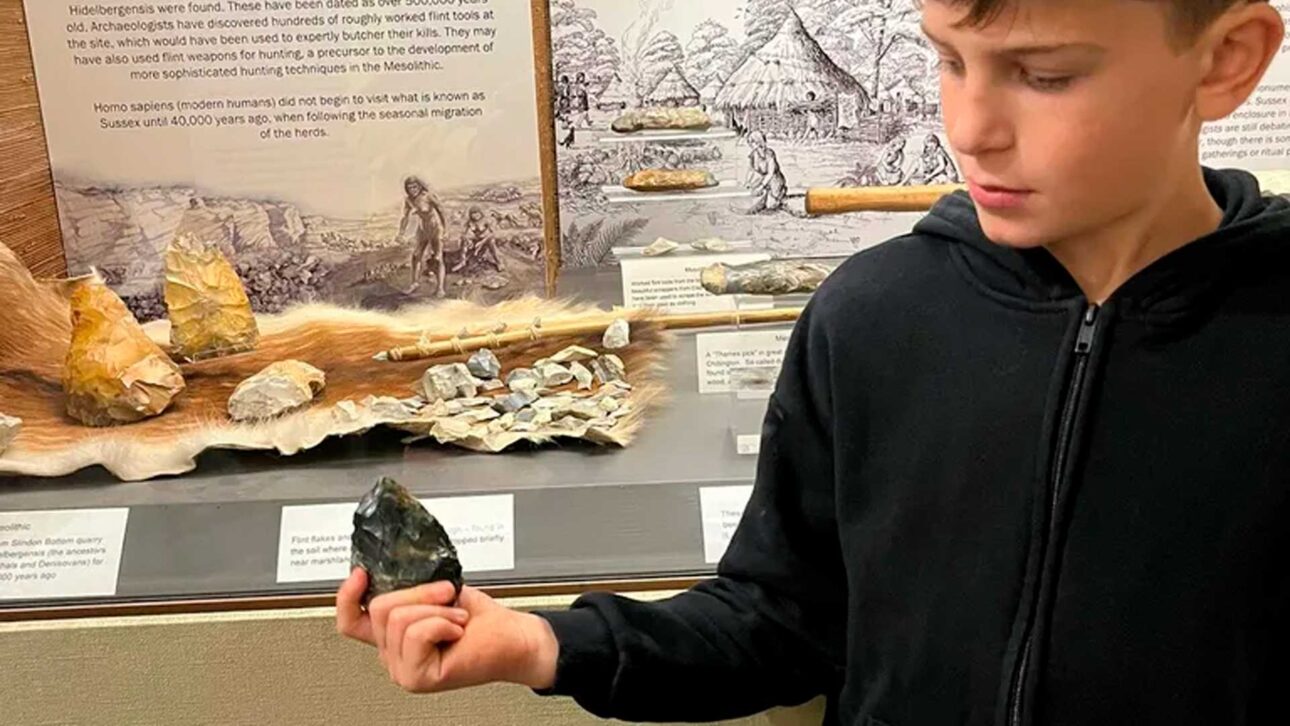
The artifact was identified as a tool from the Late Middle Paleolithic, a period associated with the presence of Neanderthals in Europe. These human groups, extinct about 40 thousand years ago, produced stone tools used in practical daily tasks.
Hand axes like this one could be used for cutting, scraping, digging, woodworking, opening animal carcasses, or breaking bones. The piece found by Ben was made of flint, a hard rock that allows controlled chipping and sharp edges.
As reported by Live Science, Sainsbury classified the object as a Mousterian axe, linked to the final phase of Neanderthal presence in Europe and Britain. The curator stated that this type of piece is rare in Sussex and that the museum had only one similar specimen.
The rarity increases the significance of the discovery. In regions where the Neanderthal population may have been small, each tool found helps to build a more precise picture of movements, landscape use, and survival in ancient environments.
The beach where Ben played was different when Neanderthals roamed the region
The exact origin point of the axe has not yet been defined. One hypothesis is that it came from materials used in coastal defense works against erosion, when tons of stones and pebbles are moved to reinforce beaches.
Another possibility is that the tool was left by a Neanderthal in an area close to the current location. The problem is that the Sussex coast has changed a lot since the period when the object would have been produced.
At the time of the Neanderthals, the sea level was different, and areas now submerged could have been part of dry landscapes. Therefore, researchers consider the possibility that the axe was removed from ancient riverbeds or coastal regions that are now underwater.
This context explains why the play not only tells a story about a child and a curious stone. It also raises questions about the ancient geography of the English Channel, sediment movement, and the human presence before the formation of the current coastal landscape.
The find was loaned to the Worthing Museum and reinforced the importance of communicating archaeological discoveries
The family loaned the axe to the Worthing Museum for public display. At the time of the announcement, in December 2024, the expectation was that the piece would remain in the museum until February 2025 and then be returned to Ben and his family.
According to Fox News Digital, curator James Sainsbury stated that the find would be recorded in the Portable Antiquities Scheme, a system linked to the British Museum and Amgueddfa Cymru in Wales. The aim is to document archaeological objects found by the public in England and Wales.
This record is crucial because an object without location, date of discovery, and description loses part of its historical value. The tool remains ancient, but it becomes much more difficult to understand where it came from, how it arrived at the location, and what it can reveal about the past.
Ben’s case shows that archaeological finds do not only appear in large excavations. Sometimes, they emerge on beaches, gardens, rural areas, or common grounds. The difference lies in what happens afterward: keeping it without informing can erase a part of history; seeking experts allows turning a curiosity into scientific data.
A rare discovery that began with a child’s curiosity
Ben did not find the axe with a metal detector, nor was he participating in an excavation. He simply noticed that the stone did not match the rest of the beach.
The museum’s confirmation showed that a child’s keen eye can preserve a piece tens of thousands of years old. It also reinforced a basic recommendation from archaeologists: upon finding a suspicious object, it is ideal to photograph, note the approximate location, and seek a museum, university, or responsible authority.
In the case of Shoreham Beach, a stone kept in a room for three years ended up revealing a tool made by an extinct human group. Between the flint’s shine and the museum’s showcase, the object ceased to be a beach souvenir and became part of Sussex’s archaeological record.
Would you have realized that this “shiny stone” could be something prehistoric or would you have left the object in the sand? Leave your opinion in the comments and tell us if you have ever found any strange item on a beach, river, land, or yard.