






 Portuguese
  Spanish
  4 min of reading
  0 comments


On World Animal Day, Rare And Little-Known Species Reveal How The Planet’s Biodiversity Still Holds Surprising Creatures, Some Recently Discovered And Others On The Brink Of Extinction
The planet Earth is home to an impressive diversity of life forms. However, even after centuries of scientific studies, new species continue to be discovered. Moreover, many of them possess such unusual characteristics that they seem to belong to fictional worlds. In this context, World Animal Day, celebrated on October 4th, becomes a perfect opportunity to highlight rare creatures that play fundamental roles in environmental preservation.
At the same time, some of these species draw attention not only for their exotic appearance, but also for their unique abilities, intriguing behaviors, and surprising survival stories. This information was released by specialized websites in biodiversity and environmental science, based on surveys from international scientific institutions and records from field researchers around the world.
Next, meet ten rare animals that help to understand why the world’s fauna still holds so many mysteries.
-
The SP government considers demolishing a 40-meter bridge after a 21-year-old was launched without a rope in a radical jump; the federal structure has been abandoned for 30 years and had already been the subject of warnings.

-
Found after demolition, a 1916 capsule contained steel, cast iron, ore, an old newspaper, and clues about how factories avoided industrial measurement errors.

-
Tugboats look like toys next to giant ships, but they are the ones that push, pull, and brake freighters of up to 400,000 tons in narrow ports, where wind, current, and a few meters of error can turn a maneuver into a million-dollar disaster.

-
Singer Roberto Carlos lives between two luxury retreats in Brazil and the USA: the King maintains a penthouse bought in 1980 in Urca, with 4 suites, a pool, and a view of Guanabara Bay, and also has an apartment in Miami, where he has already spent New Year’s Eve with his family.




Rare Species That Challenge The Logic Of Nature
Among thousands of cataloged species, some stand out for having been discovered less than two decades ago. Others, on the other hand, almost disappeared before they could be studied in depth. In this sense, the first animal on the list symbolizes this scientific surprise well.
The Yoda Bat, found in the forest of Papua New Guinea, earned this nickname due to its impressive resemblance to the character from the Star Wars saga. Feeding exclusively on fruits, it plays a crucial role in seed dispersal. Consequently, it directly contributes to the regeneration of tropical forests.
Additionally, the pink-eyed grasshopper, discovered in the same region, intrigues scientists with its unusual eye color. Although its body is similar to that of other grasshoppers, this unique visual characteristic reinforces the idea that nature still harbors little-explored surprises.
Another curious example is the Mangalica pig, originating from Hungary. With an appearance reminiscent of a sheep, this swine was nearly extinct after World War II. However, thanks to preservation efforts initiated in the 1970s, the species has rebounded. Its meat, rich in omega-3 and natural antioxidants, has also sparked international culinary interest.
Small, Strange, And Incredibly Fascinating Creatures

On the other hand, size does not always define a species’ impact. The pink fairy armadillo, considered the smallest armadillo in the world, measures between 84 and 117 millimeters, with a tail of up to 35 millimeters. Its pink shell, combined with a soft white fur coat, makes it look like a fantasy animal.
Meanwhile, the axolotl, known as the Mexican salamander, has become a true object of scientific study. This is because it possesses the extraordinary ability to regenerate body parts, including complex tissues like those of the brain. Still, despite its friendly appearance, it is an amphibian threatened with extinction.
The dumbo octopus lives at extreme depths, between three and four thousand meters below sea level. Its fins resemble the ears of Dumbo, the Disney elephant. Discovered during a scientific expedition in the North Atlantic Ocean, it is rarely observed, which reinforces the mystery surrounding deep marine life.
Dances, Horns, And Behaviors That Seem Unreal
At the same time, some species stand out for behaviors so elaborate that they seem choreographed. The blue-footed boobies, native to the Galápagos Islands, use the vibrant color of their feet as a criterion for sexual selection. During courtship, the males perform rhythmic movements resembling a tango, showcasing their blue feet to attract females.
Meanwhile, the Pakistani wild goat, known as markhor, draws attention for its spiral horns that can reach up to 1.20 meters in length. A national symbol of Pakistan, the species is at risk of extinction due to illegal hunting. According to local folklore, these goats are believed to have antidotal properties against poisons.
Another intriguing animal is the colugo, often referred to as the “flying lemur.” Despite the name, it does not fly but glides long distances between trees thanks to a membrane that stretches between its limbs. This tree-dwelling mammal measures between 35 and 45 centimeters and lives in the tropical forests of Southeast Asia.
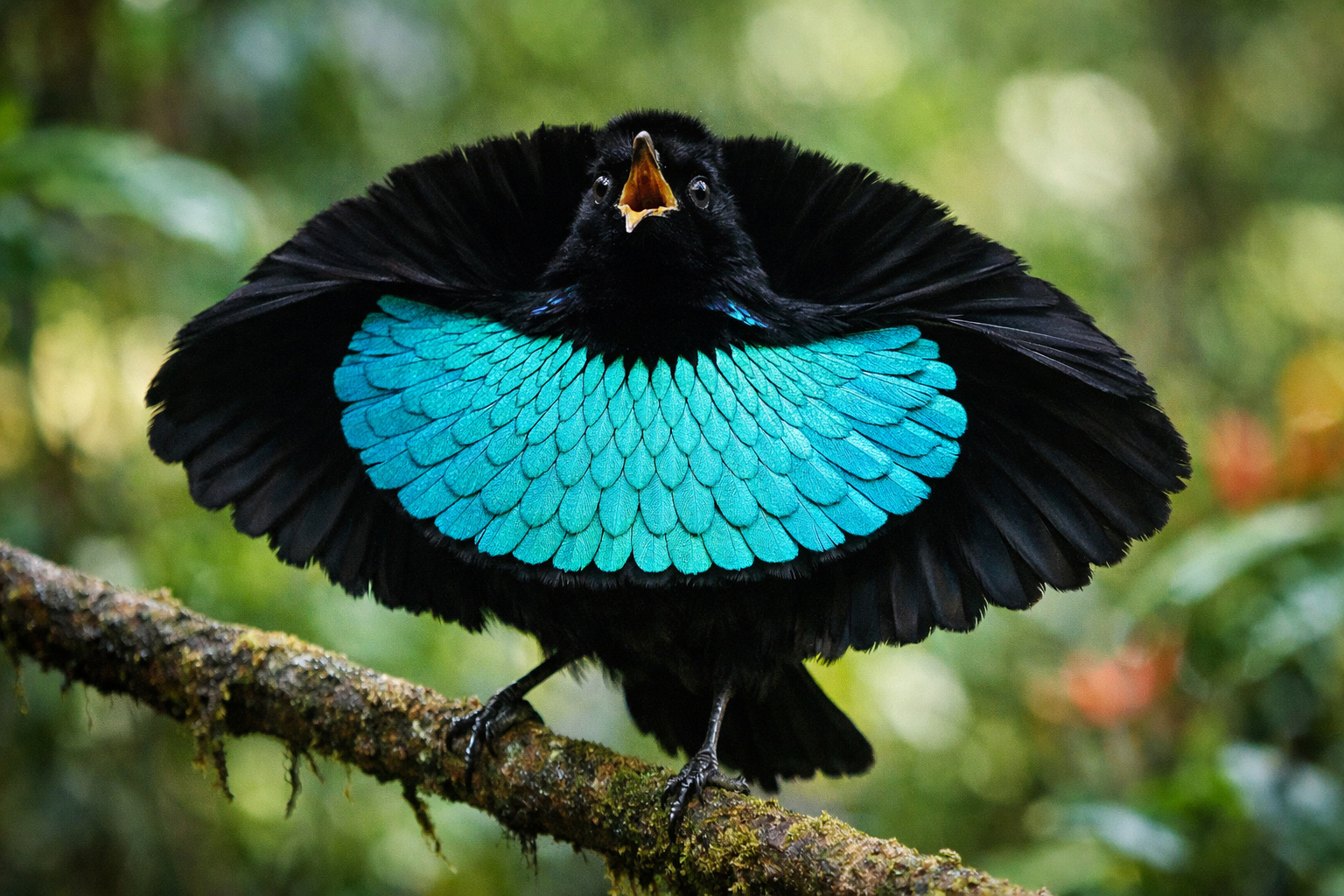
Finally, the Lophorina superba, also known as the bird of paradise, impressively concludes the list. During the courtship ritual, the male performs a hypnotizing dance. In addition, he fully opens his dark plumage, revealing neon blue patterns that resemble shining eyes. The visual transformation is so intense that many describe the animal as a “living disco.”
Why These Animals Matter For The Future Of The Planet
Finally, all these species reinforce the importance of environmental conservation. Each animal plays a specific role in the balance of ecosystems. Consequently, the loss of any one of these species can generate difficult-to-reverse chain impacts.
Moreover, the ongoing discovery of new species shows that we still know little about the planet’s biodiversity. Therefore, preserving natural habitats is not just an ethical issue, but also a scientific and economic one.
Which of these rare animals surprised you the most, and do you believe there are even more extraordinary species waiting to be discovered?






Be the first to react!