






 Portuguese
  Spanish


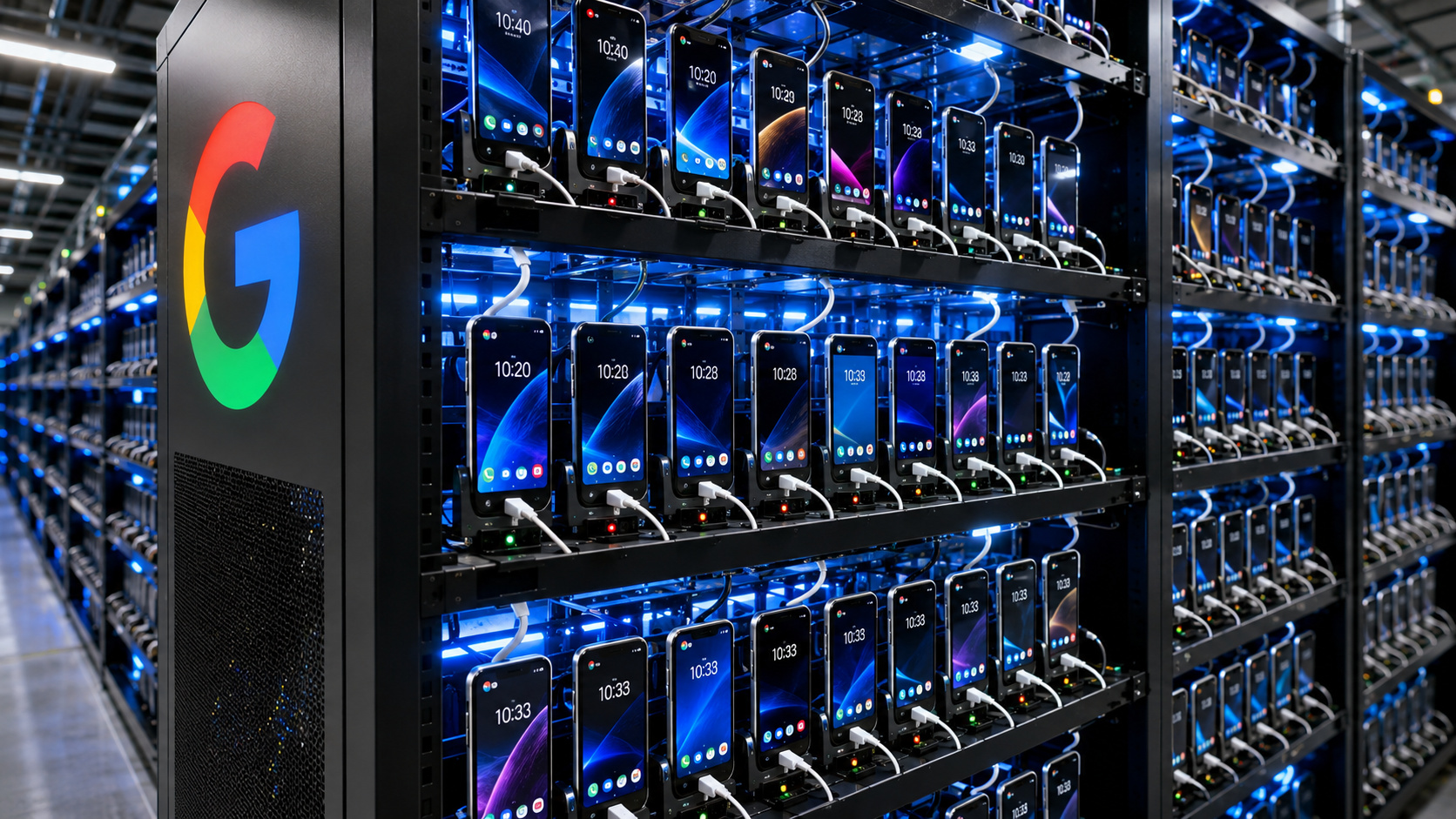

Project supported by Google reuses discarded Pixel smartphones to create low-carbon infrastructure aimed at artificial intelligence.
Google is supporting a project that could change the way cloud computing is built. In partnership with researchers from the University of California, San Diego, the company is reusing old phones to create an infrastructure capable of running artificial intelligence applications, which may include services related to Gemini.
The project was presented by Google and the University of California, San Diego in a document released on June 12, 2026. The initiative is still in the implementation phase and plans to create a platform with 2,000 repurposed Pixel smartphones.
The goal is to reduce the need to manufacture new servers, decrease carbon emissions, and offer a low-cost alternative for researchers and students. Initial tests show that groups of just 25 to 50 devices can already deliver performance similar to that of a traditional server.
-
A fossil kept for years in a small museum in Montreal concealed 450-million-year-old soft tissue, a discovery that has only happened once before in history.

-
Three teenagers transform cut cardboard into Japanese origami-style packaging that promises to retire styrofoam and bubble wrap, win a $12,500 prize, and target giants like Amazon, FedEx, and Home Depot after a robot motor arrived broken.

-
The large jar blender has a rival: Oster Ultra Power bets on 1,000 W, six stainless steel blades, and two portable cups with leak-proof lids.

-
Tesla injected an additional $250 million into the German factory, doubled the battery cell target, and opened its own production line for startups.



Google bets on old phones to expand cloud computing
The proposal presented by Google starts from a simple observation: millions of devices are replaced every year even while remaining fully functional.
According to researchers, smartphone replacement occurs on average every four years. Despite this, many of these devices still have sufficient processing capacity to perform various advanced tasks.
Instead of becoming electronic waste, these devices can gain a new function within cloud computing platforms.
The initiative seeks to reduce two important problems at the same time:
- The premature disposal of electronic equipment;
- The need to manufacture new servers to expand digital infrastructure.
Why modern smartphones still have high computational value
The advances in mobile processors in recent years have transformed smartphones into extremely powerful computers.
According to the study supported by Google, the single-core performance found in modern devices can be equivalent to or even superior to that observed in processors used in modern corporate servers.
The difference is mainly in scale. While servers have dozens of processing cores and large amounts of memory, cell phones work with more limited resources.
Even so, when several devices work together, the result can be surprising.
This approach allows leveraging the potential of thousands of devices that would normally be discarded after purchasing newer models.
How data centers are built from repurposed cell phones
Transforming smartphones into data center components requires various adaptations.
Researchers remove elements considered unnecessary for a continuous computing environment, keeping only the essential components for processing and storage.
Among the items removed are:
- Screen;
- Camera;
- Battery;
- Casing;
- Other everyday peripherals.
The motherboard remains installed, as it houses the main computational resources of the device.
According to internal assessments mentioned by the researchers, this component represents approximately 50% of the carbon footprint embedded in the manufacturing of a smartphone. Therefore, its reuse generates significant environmental gains.
Gemini and artificial intelligence increase the need for infrastructure
The growth of artificial intelligence is rapidly increasing the demand for computational capacity.
Advanced models like Gemini rely on large volumes of processing for training, inference, and testing new functionalities.
This scenario has led technology companies to invest billions of dollars in expanding data centers around the world.
At the same time, there is growing concern about the environmental impacts associated with the manufacturing of these devices.
The project supported by Google emerges precisely as an alternative to reduce part of this problem, leveraging existing hardware instead of producing new servers.
Besides resource savings, the initiative helps to extend the useful life of equipment that still has high computational potential.
From Android to Linux: the necessary adaptation of smartphones
Another important aspect of the project involves modifying the operating system.
Although Android is based on Linux, it was developed for mobile use and not to act as cloud computing infrastructure.
Therefore, researchers replace the traditional environment of the devices with general-purpose Linux distributions.
This change allows:
- Greater control over system resources;
- Execution of more complex applications;
- Better management of processing and memory;
- Compatibility with professional cloud computing tools.
This adaptation also removes limitations present in devices intended for the end consumer.
Tests indicate performance close to that of conventional servers
The preliminary results presented by the team caught the attention of the academic community.
According to tests using the SPEC benchmark, groups formed by 25 to 50 Pixel Fold devices launched in 2023 can achieve performance similar to that of a modern server.
To coordinate the simultaneous operation of the devices, researchers use Kubernetes, one of the most popular platforms for managing containerized applications.
The devices are organized into self-managing clusters, allowing tasks to be distributed automatically.
Initial experiments showed that a set with only 20 phones was able to serve a university class with more than 75 students, presenting response times lower than those observed in certain traditional cloud configurations.
University of California project plans 2,000 smartphones in operation
The University of California in San Diego intends to take the initiative to a much larger scale.
The plan involves building a platform composed of approximately 2,000 reused Pixel smartphones.
According to the researchers, the infrastructure will be used to support courses in computer science, systems programming, and parallel computing.
The expectation is that the deployment will be able to simultaneously serve hundreds of researchers and students.
The project leaders state that the total capacity should correspond to approximately 50 conventional servers, but with reduced cost and lower environmental impact.
Additionally, the structure will function as a testing environment to evaluate the reliability of hardware originally developed for home use in continuous operations.
The full launch is scheduled for the second half of 2026.
What this technology could mean for the future of data centers
The initiative supported by Google shows that the future of computing may not rely solely on manufacturing increasingly powerful equipment.
In some cases, the solution may lie in the intelligent reuse of existing resources.
By transforming old cell phones into platforms for artificial intelligence and cloud computing, researchers create an alternative capable of reducing costs, decreasing carbon emissions, and expanding access to technological infrastructure.
If the results continue to be positive, similar projects could be adopted by universities, research centers, and companies interested in expanding their computational capacity in a more sustainable way.
At a time when the advancement of artificial intelligence demands more and more processing, the reuse of smartphones could pave the way for a new generation of more efficient, economical, and environmentally responsible data centers.


