






 Portuguese
  Spanish


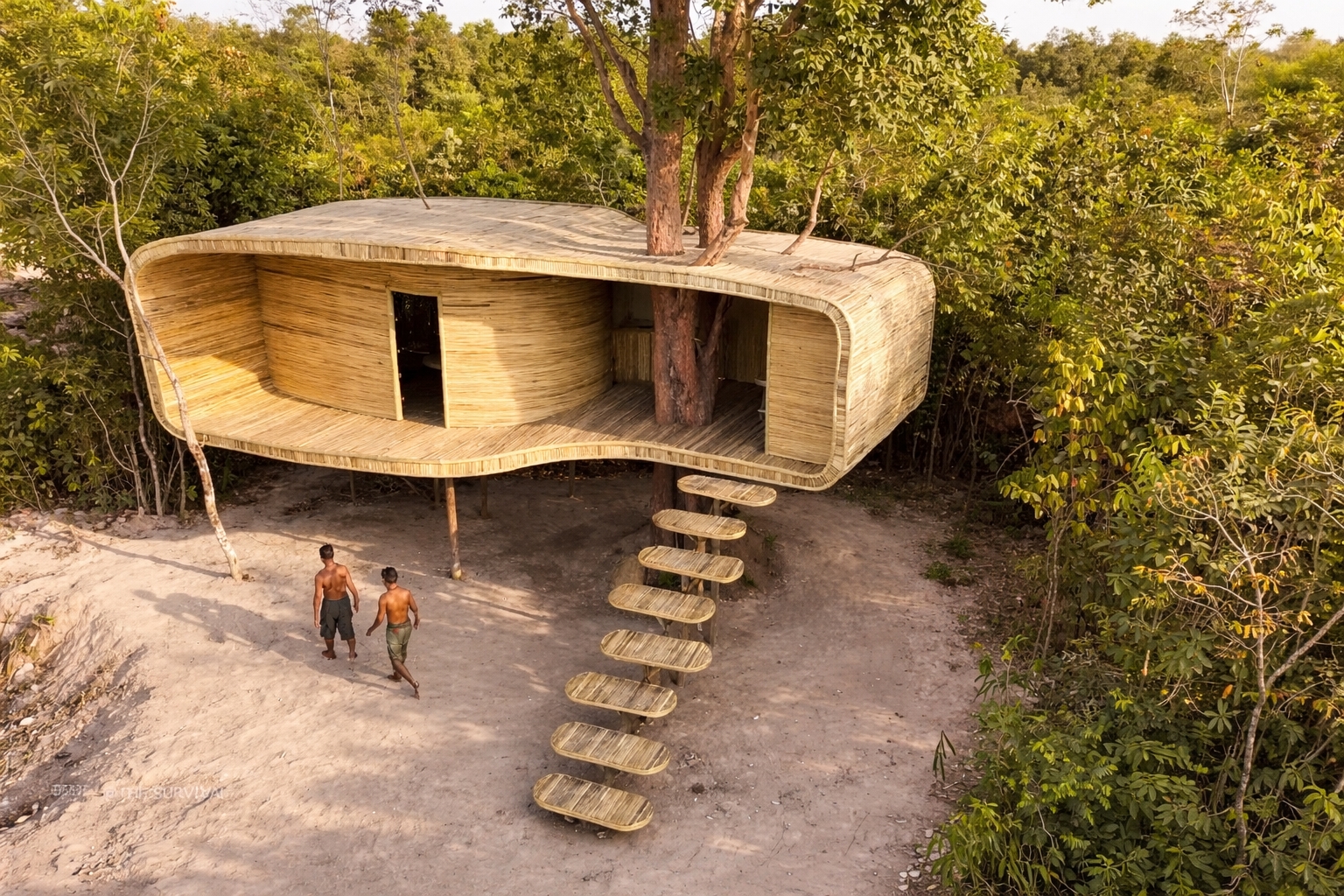


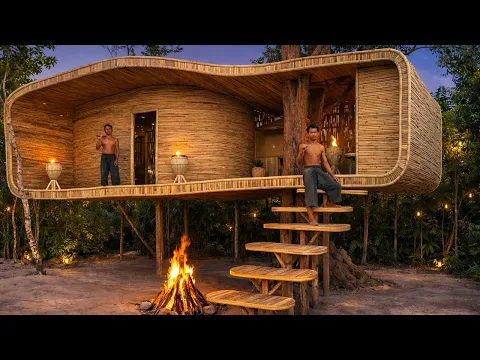
Two Men, In Survival in the Jungle, Build Elevated Bamboo House In a Giant Tree With Suspended Platform, Closed Floor, Guard Rail, Curved Walls and Ladder, Using Only Simple Tools in a 100% Manual and Surprising Job
Two men build an elevated bamboo house in a giant living tree and do it in the most straightforward way possible. No machines, no metal structure, no industrial support. Just bamboo, manual cuts, and a lot of precision. The trunk remains at the center and becomes an essential part of the construction.
It all begins with the area already cleared around the tree. From there, the men build the base that supports the entire elevated house. First come the bamboo columns, then the horizontal beams, the slatted floor, the roof, and the woven walls. Each stage fits into the other.
The result is not only visually striking. What impresses is how the bamboo is organized to support real weight, allow circulation, and transform an open space into a functional shelter.
-
15-Year-Old Entrepreneur Malu Lira Publishes 20 Children’s Books on Financial Education, Earns $500,000, and Expands Her Project to the Amazon Rainforest

-
Entrepreneur Turns Rio Cemetery Canteen into a Successful Snack Chain Generating $4.9 Million Annually and Expanding to Metro Stations

-
Rare fox feared “extinct” found alive on Caribbean island after over two decades without official sightings

-
21-Year-Old Brazilian Student Turns Homemade Popsicle Hobby into $100,000-a-Month Business






Construction of the Base of the Elevated Bamboo House In a Tree With Firm Columns On the Ground
The structure starts with bamboo columns positioned around the trunk. Each one is anchored directly into the ground, with visible marks of superficial digging around the base.
Next come the horizontal bamboo beams. They connect the columns and form a rigid structural grid. The ties hold the meeting points and prevent lateral movement. Nothing seems improvised. Each piece is adjusted until aligned.
When this step ends, the elevated house already supports the weight of the men themselves. They walk on the beams while positioning new pieces. The structure rises from ground level and begins to stand out around the tree.
The manual adjustment of the columns shows repetition and strength. They are pressed, aligned, and secured until they become stable.
Slatted Floor Circles the Trunk
With the base ready, the floor begins to be closed. Bamboo slats are laid side by side over the horizontal beams, creating a continuous surface.
At the point where the floor meets the trunk, each slat needs to be cut to follow the irregular shape of the bark. The fitting is done by trial, adjustment, and new cuts until it fits correctly.
Once the floor is finished, the space completely changes. It is now possible to circulate around the tree. The elevated house stops being just a structure and becomes a usable environment.
During the process, fragments of bamboo and dust are scattered across the surface. A clear sign of constant cutting and adaptation piece by piece.
Upper Structure Creates Covering Mesh Over the House
After the floor, the columns receive vertical extensions. On them, bamboo poles are positioned horizontally forming a covering mesh.
This mesh defines the final height of the elevated house and creates partial shade inside. The trunk continues to pass through the center of the construction, now surrounded by the upper pieces as well.
Raising these poles requires balance. The men climb onto the platform, hold the long pieces, align them, and secure them before installing the next one.
With the covering mounted, the volume of the house becomes clear. Floor, columns, and roof form an organized set around the living tree.
Woven Panels Close the Sides of the Elevated Bamboo House In the Giant Tree
The sides receive panels made with woven bamboo strips. Each panel is fitted between vertical columns and horizontal beams.
The weave leaves small gaps that allow light to pass through and air circulation. It is not a solid closure, but it efficiently delimits the internal space.
With the panels installed, the elevated house gains a sense of shelter. The interior becomes more protected without losing connection with the external environment.
The difference in brightness between inside and outside clearly shows this transformation.
Bamboo Ladder Guarantees Easy Access to the Elevated House

To access the platform, the men build a simple and functional bamboo ladder.
Two parallel vertical elements support aligned cross steps. The incline allows safe access to the edge of the elevated house.
The steps withstand repeated ascent and descent. The constant use begins to mark the bamboo, showing that circulation is frequent.
Now the flow between ground and structure is direct. This facilitates both construction and daily use of the space.
Internal Space Is Prepared for Real Use
With the structure ready, the interior begins to be utilized. A bamboo table occupies part of the space. A wood block serves as a cutting base.
On the table appear clay containers, vegetables, and a whole fish resting on a tray. A machete is used on the wood block, demonstrating immediate practical use.
This proves that the base formed by columns, horizontal beams, and slatted floor supports concentrated weight and constant movement.
The elevated house ceases to be just a visual construction. It really works.

Central Trunk Transforms the Final Design and Surprises
The most striking point is at the center. The trunk of the tree is neither removed nor isolated. It transforms into the structural axis of the elevated house.
Floor, roof, and walls are adjusted around it. Each slat, each pole, and each panel respects its central position.
The final design surprises because it integrates the living tree and the constructed structure into one set. These men build something that seems simple at first, but reveals technical control in every fitting.
And you, would you have the courage to build or live in an elevated bamboo house in a tree of this size? Leave your comment and share with those who enjoy creative construction done in practice.







A really good blog and me back again.