






 Portuguese
  Spanish


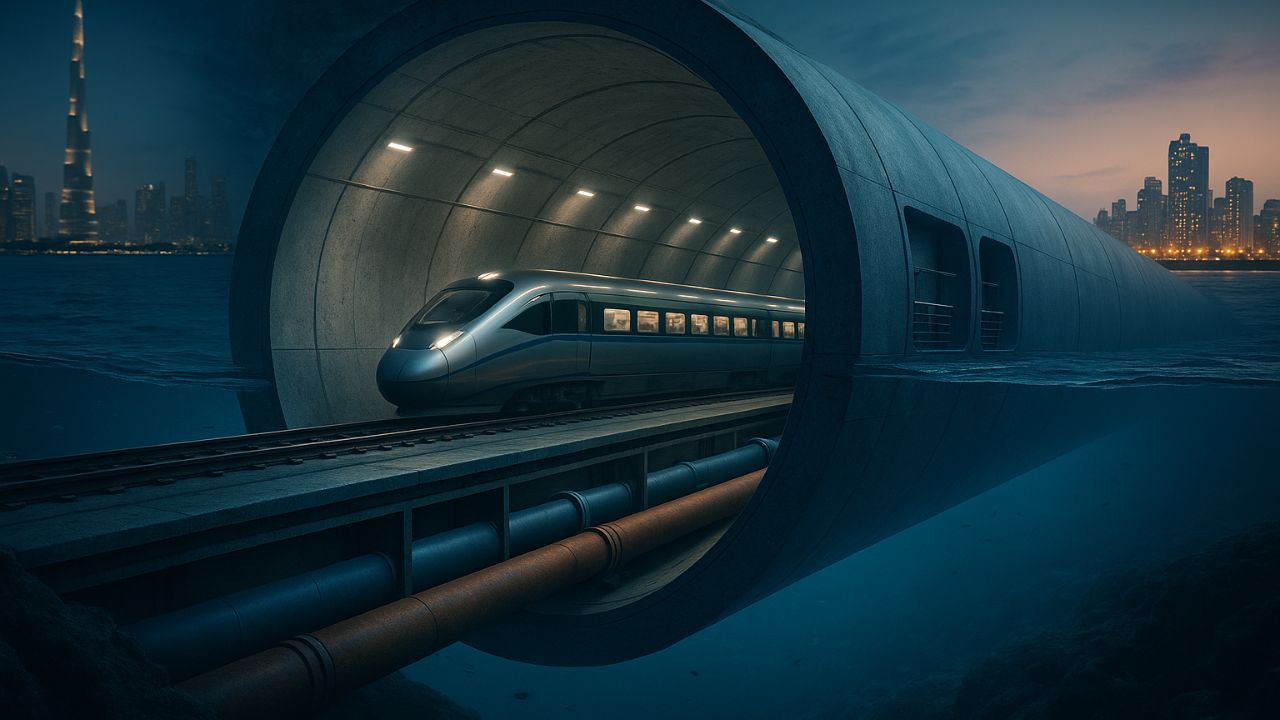
Project Proposes Bullet Train, Cargo Transport, Oil, and Fresh Water Under the Arabian Sea
This project is an ambitious proposal led by National Advisor Bureau Limited to connect the United Arab Emirates to India through the construction of an underwater tunnel of 1,800 kilometers. The plan includes a bullet train of up to 1,000 km/h and corridors for goods and natural resources.
Construction Project Could Redefine Logistics Between Asia and the Middle East
According to the Spanish portal Xataka, the idea is to create a double structure of submerged concrete under the Arabian Sea, linking the port of Fujairah (UAE) to Mumbai (India). The submerged tunnel would operate with parallel tubes, supported by floating platforms or anchored to the seabed.
Each tube would house different functions: one exclusively for high-speed bullet trains, and another dedicated to cargo movement, along with specific channels for transporting oil and fresh water. This complexity reinforces the multifunctional nature of the project.
-
Bolivian Female Construction Workers Form Association to Combat Discrimination and 38% Pay Gap in the Industry

-
Near Amsterdam, residents buy land and discover they must also build streets, manage drainage, handle waste, and grow food on half their plot.
-
Brazil’s WEG to Open New Factory in China by 2027, Expanding Production of Large Rotating Electric Machines and Low to Medium Voltage Motors in Rugao

-
Chinese Shipyard Secures $1 Billion in Orders for Low-Carbon Container Ships Amid Global Fleet Renewal Efforts


The Construction Aims to Unite Innovation and Functionality in One Corridor

The plan is still in the conceptual phase but has already attracted international attention for its uniqueness. The high-speed trains are expected to reach speeds between 600 km/h and 1,000 km/h, promising to shorten the current journey of days or hours of flight to a trip of up to four hours.
The submerged tunnel would also serve as a new route for energy and water supply between the countries, proposing a structure that goes beyond passenger transport, something highlighted by portals such as Interesting Engineering, which analyzed the potential logistical and geopolitical impacts of the project.
Technical Challenges and High Costs Accompany the Grandeur of the Project


The construction of an underwater tunnel of 1,800 km represents an unprecedented challenge in civil and maritime engineering. It would require materials resistant to ocean pressure, continuous monitoring technology, and strict safety protocols, as well as scheduled maintenance in hostile environments.
Experts cite that the cost would exceed hundreds of billions of dollars, requiring joint financing between governments and private consortia. Still, the planners see the initiative as strategic for the future of intercontinental infrastructure.
Underwater Tunnel Could Boost Trade Relations and Strengthen Regional Diplomacy
The project would not only promote advances in mobility but also open new business opportunities, commodity flow, and technological cooperation. United Arab Emirates and India already have established trade relations, and the underwater tunnel would be a permanent and efficient route to expand this connection.
Additionally, the construction could serve as a model for future megaprojects around the world, positioning the involved countries as pioneers in large-scale engineering aimed at economic integration.


Be the first to react!