






 Portuguese
  Spanish
  5 min of reading
  0 comments


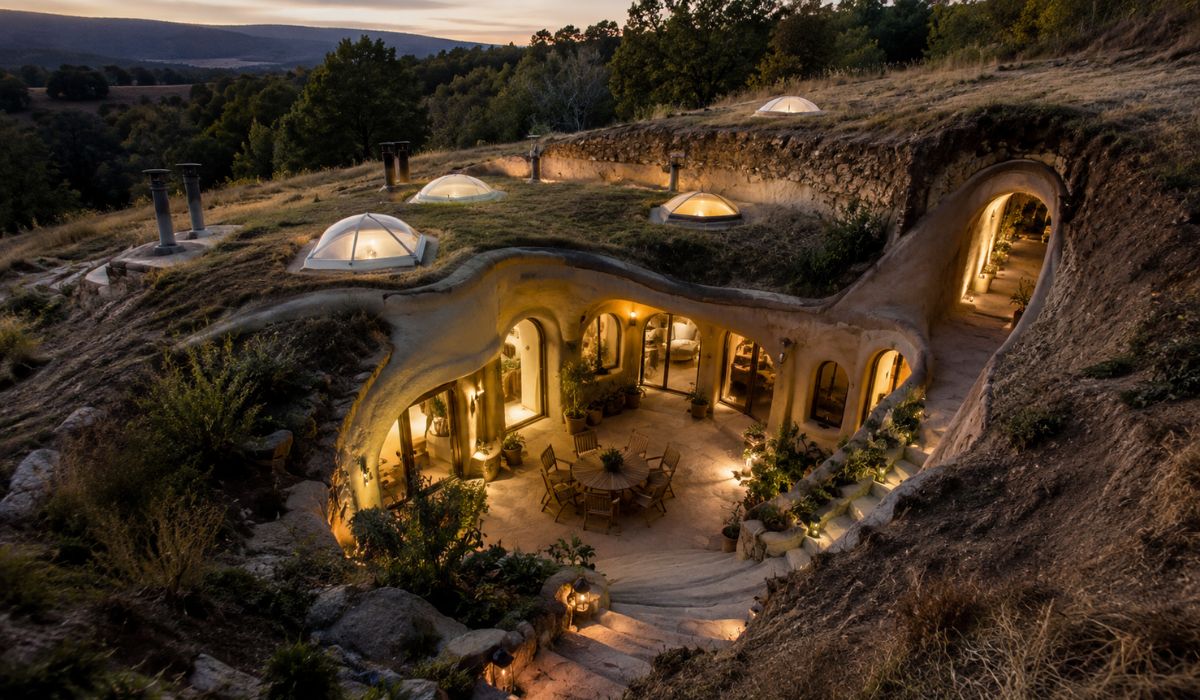
In Grass Valley, California, a couple transformed an excavated hillside over two decades into an underground complex with tunnels, domes, and illuminated patios, in an artisanal living experience connected to the climate and terrain.
Zach and Allison Anderson spent about two decades excavating a hillside on a property in Grass Valley, California, to build an underground dwelling aimed at reducing exposure to heat, cold, and wildfire risk.
The project was featured in a report by Kirsten Dirksen, published on November 9, 2025, on faircompanies, and includes tunnels, domes, open patios, and natural light entries.
Underground house in California
The construction began as a domestic experiment and, over the years, evolved into a set of buried and interconnected environments.
-
How much does it cost to build a pool in 2026? See the average construction costs, licensing fees, and the most common extra expenses that may arise throughout the project.

-
Fort Atacadista uses World Cup fever to raffle off 58-inch TVs, promises one winner per day, multiplies chances with Vuon Card, and targets customers with purchases over R$ 100 as Grupo Pereira reaches 190 stores in the Brazilian retail market.
-
Son of a market vendor who saw his father wake up at 2 a.m. to set up the stall partners with OpenAI to offer ChatGPT Business licenses in Latin America and projects revenue above R$ 200 million in 2026.
-
A Maasai boy noticed the lions’ fear of human light and created an inexpensive system that protects enclosures without driving away or eliminating the predators.


According to the report, the property houses vaulted rooms, corridors, living areas, and small residential spaces protected by the hillside, in a configuration described by the publication as akin to an ecovillage sheltered by the ground.
The house is not presented as a closed and isolated shelter from the outside.
The model adopted by the couple combines partially buried areas with openings for ventilation, lighting, and circulation, a feature used to reduce the feeling of confinement usually associated with underground constructions.
The report also attributes to the project the intention of taking advantage of the more stable temperature of the terrain surrounding the environments.
Ferrocement shapes tunnels and domes
The system used by Zach Anderson is based on ferrocement, a technique consisting of cement mortar applied over layers of metal mesh.
According to the American Concrete Institute, ferrocement is a structural material composed of thin sections of mortar reinforced by closely spaced layers of steel mesh or continuous mesh, allowing the frame to be shaped as desired before applying the mortar.
On the Anderson property, this technique appears in curved surfaces, narrow passages, rounded rooms, and domes.
The use of ferrocement helps explain the presence of less rigid forms than those found in conventional constructions, as the material can be molded into arched structures and thin-walled shells, according to the institute’s technical definition.
The starting point of the project, according to faircompanies, was the attempt to escape the most extreme surface conditions.
The region of Grass Valley, in northern California, is cited in the original text as the place where the couple decided to dig into the hillside to deal with heat, cold, and fire risk above ground.
Buried Housing and Thermal Comfort
The internal organization of the dwelling follows a logic of a reduced core and transition areas around it.
According to the report’s description, Zach kept the insulated part of the house smaller and surrounded this core with environments that function between the interior and exterior, taking advantage of the terrain’s protection and natural ventilation.
This distribution is also related to the construction cost, according to the original source.
The report states that the choice of a smaller core and naturally tempered spaces around it was used to keep construction costs and property taxes lower, although it does not present detailed values or tax documents on the case.
Among the described environments are a nursery or underground pond with fish and a room with a cave-like appearance under a dome illuminated by a skylight.
Parakeets flying freely in the space, shelves that hide pantries and stairs, and a system called by Zach as “living well,” presented as an adaptation of a living wall to conduct fresh and fragrant air through plants into the house.
The construction was gradually expanded over the 20 years mentioned in the report.
With the new excavations, the complex came to include passages, patios, and connected environments, without the publication providing a total measurement or a complete plan of the property.


Casa Di Terra and Artisanal Construction
Zach Anderson is also associated with Casa Di Terra.
The Professional TrailBuilders Association states that the company is primarily located in Grass Valley, California, and lists Zachi Anderson and Alison Anderson among the members related to the business.
The entity’s page describes Casa Di Terra as a trail and landscaping company, offering construction, design, planning, stonework, bridges, and trails services.
The same page states that Casa Di Terra has used ferrocement in underground passages, grottos, atriums, cisterns, towers, and faux bois structures.
The registration also mentions more than 25 years of operation with excavators and construction of trails, a fact that contextualizes Anderson’s experience with excavation, terrain modeling, and handcrafted structures.
This history helps situate the project within a broader set of alternative constructions in Nevada County, where Grass Valley is located.
In January 2025, the Nevada County Arts & Culture published a report on creative and sustainable housing projects in the region, including an underground house developed with the participation of Zachi Anderson.
In the local publication, Anderson stated that the goal of that project was to develop housing better insulated against heat and fire, using thin-walled ferrocement structures to allow natural lighting and ventilation around a partially buried house.
The report also heard from Nick McBurney, project analysis supervisor at the Nevada County Building Department, who said that such constructions can be analyzed within applicable codes and standards.
Compact Prototype of Accessory House
The most recent part of the Andersons’ set, according to faircompanies, is a compact ferrocement unit presented as an accessory house.
The internal space was planned to accommodate a built-in Murphy bed and a small kitchen, while the external areas extend the use of the unit through patios and open environments.
The report describes this smaller construction as a prototype of a reduced-scale buried dwelling.
Zach presents it as an example that underground houses do not need, in his view, to be large or expensive to receive natural light and function as habitable spaces; however, this interpretation is attributed to the project’s own responsible party.
There are still no independent data from the consulted sources on thermal performance, fire resistance, total cost, complete footage, or specific licensing of the Anderson property.
Thus, the experience should be treated as a case of handcrafted construction documented by a report and by professional records associated with Zach Anderson, without automatic generalization to other lands, cities, or construction standards.
Underground Architecture and Local Rules
The case also shows how underground housing projects depend on technical factors that go beyond excavation.
Soil, drainage, ventilation, structural stability, building code, fire safety, and local authorization are elements that need to be considered in any attempt to replicate such a construction, even if these details were not detailed in the original material about the couple’s house.
In practice, the set created by Zach and Allison Anderson brings together a sequence of solutions developed over two decades: illuminated domes, tunnels, courtyards, curved walls, hidden passages, and buried spaces with access to natural light.
The experience was presented as a response to the region’s climatic conditions and fire risk, but remains limited to the specific context of the property in Grass Valley and the information available in the consulted sources.




Be the first to react!