Portuguese
  Spanish


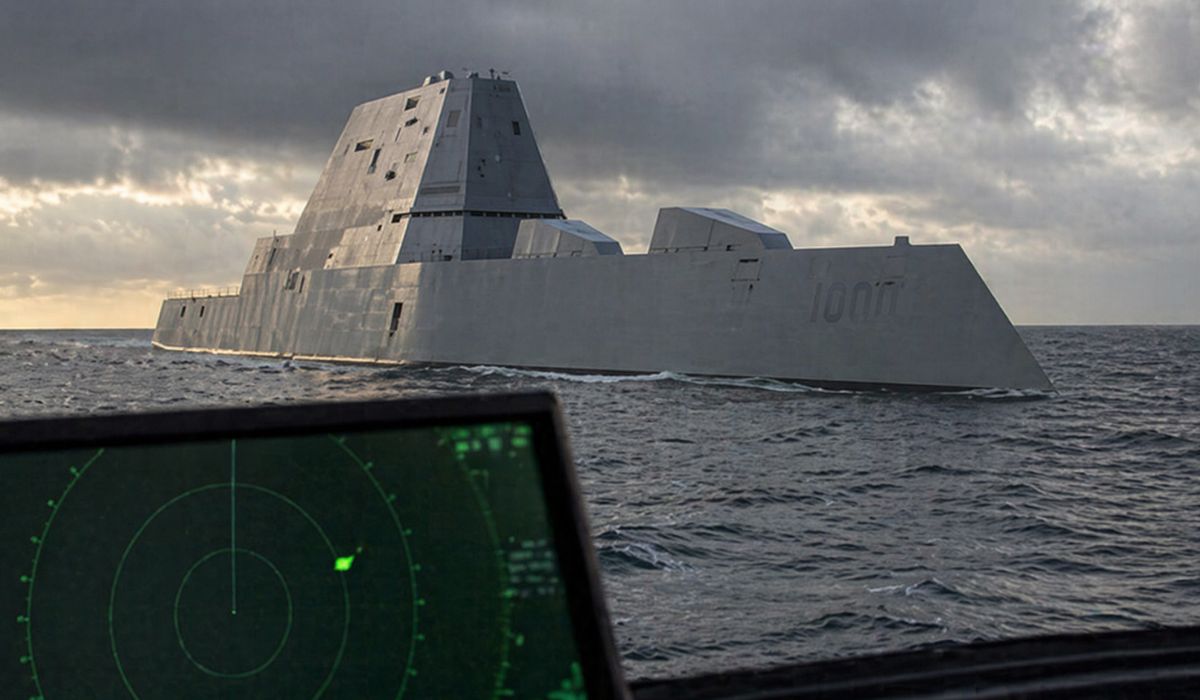

A large destroyer draws attention for its stealth engineering, unusual hull, and the ability to combine sensors, electric propulsion, and long-range weapons on a single naval platform.
The USS Zumwalt (DDG 1000), a stealth destroyer of the United States Navy, was designed to reduce its radar signature despite having the dimensions of a large military vessel.
According to the Naval Sea Systems Command, the U.S. Navy agency responsible for naval systems, the vessel measures 186 meters in length, displaces 15,995 metric tons, and uses a tumblehome hull type, with inwardly sloping sides.
This shape helps direct radar waves away from the emitting source, reducing the ship’s radar signature.
-
China Tests Giant 582-Ton Magnets to Contain Plasma Hotter Than the Sun’s Core, Aiming to Cut Superconductor Costs and Generate First Electricity from “Artificial Sun” by 2030

-
Seventh Grader Builds Nuclear Fusion Machine at Home, Aiming for Guinness World Record

-
Ancient Ritual Circle, Hidden for 5,000 Years, Discovered in Scotland’s Machrie Moor Using Sensors, Revealing a “Phantom Stonehenge”

-
Engineers Develop Fridge-Sized Machine to Produce 95-Octane Synthetic Fuel from Air and Water, Aiming to Sustain Combustion Engines Without Oil




The smaller this return, the more difficult it can be for adversary sensors to identify and track the target, depending on operating conditions and the type of radar used.
As a result, a large destroyer can be perceived by certain detection systems as a much smaller vessel.
How the USS Zumwalt’s hull reduces its radar signature
The most noticeable difference in the Zumwalt is its hull design.
The wave-piercing tumblehome model has inwardly sloping sides and a bow designed to cut through waves, a solution that departs from the more common shape of many surface military ships.
According to the U.S. Navy, this design, combined with the superstructure and antenna arrangement, was adopted to reduce the radar signature.
Instead of multiple exposed surfaces, visible masts, and protruding equipment, the ship concentrates much of its components into continuous, angled lines.
In practice, the design attempts to control how electromagnetic waves strike the ship and return to the radar.
This principle also appears in stealth aircraft, although its application in vessels involves limitations inherent to the maritime environment, such as waves, corrosion, stability, autonomy, and the need for large internal capacity.
Why a ship of this size aims to appear smaller on radar
In naval operations, early detection can influence decision-making, force positioning, and the use of long-range weapons.
Therefore, ships designed with a smaller signature can gain operational time before being precisely identified.
In the case of the Zumwalt, stealth is just one layer of the design.
The vessel also brings together sensors, communication systems, integrated electric propulsion, and vertical launchers.
The U.S. Navy classifies the class as a multi-mission platform, with capabilities for deterrence, sea control, power projection, and command and control.
This concept helps explain why the external shape received so much attention.
The hull and superstructure do not only serve a hydrodynamic or structural function; they are also part of the effort to reduce the ship’s exposure to detection systems.
Integrated electric propulsion sustains sensors and combat systems
Another relevant technical element of the Zumwalt is the Integrated Electric Propulsion System.
According to the Naval Sea Systems Command, the class features 78 megawatts of installed power, distributed among generators, advanced induction motors, sensors, shipboard systems, and combat loads.
The Navy states that the DDG 1000 was the first U.S. surface combatant to employ this type of integrated system, capable of allocating power for propulsion, ship’s internal services, and combat systems as operational needs dictate.
This arrangement differentiates the Zumwalt from ships that rely more directly on conventional mechanical systems.
In addition to propelling the vessel, the internal electrical grid was designed to sustain high-energy-consumption equipment, which opened the way for future technological adaptations.
Change from 155 mm guns to long-range weapons
The original Zumwalt design included two 155 mm Advanced Gun Systems.
Public Navy documents indicate that these guns were planned to fire long-range land attack projectiles and support operations in coastal areas.
This plan was changed.
In December 2024, Huntington Ingalls Industries reported that the USS Zumwalt underwent modernization in Pascagoula, Mississippi, to receive the Conventional Prompt Strike system.
During the work, the two original 155 mm guns were replaced by new missile tubes.
With this update, the ship was prepared for a different role than initially envisioned in part of its original design.
Manufacturer Bath Iron Works states that the Zumwalt class is to receive the Large Missile Vertical Launch System, intended to enable the deployment of the Conventional Prompt Strike missile, described by the company as a hypersonic variant.
Sensors, missiles, and network operation on DDG 1000
The Naval Sea Systems Command technical sheet states that the Zumwalt class has 80 vertical launch cells for Tomahawk missiles, Evolved Sea Sparrow Missile, Standard Missiles, and ASROC anti-submarine rockets.
The same documentation also lists SPY-3 multifunction radar, high and medium frequency bow sonars, a multifunction towed array, and an electro-optical and infrared system.
These systems indicate that the vessel was designed to operate connected to other platforms.
Instead of acting solely as an isolated ship, the Zumwalt can share data and integrate information in missions involving other naval units, aircraft, and command structures.
The U.S. Navy also pointed out, upon accepting delivery of the ship in 2020, that the DDG 1000 would serve to accelerate new combat capabilities and validate operational tactics, techniques, and procedures.
This developmental role helps explain why the class remained relevant even without being produced in large numbers.
Zumwalt Class brings together three ships and technologies under test
The Zumwalt class was limited to three ships.
The USS Zumwalt is the first in the series; the USS Michael Monsoor is the second; and the Lyndon B. Johnson is the third.
The Naval Sea Systems Command lists all three units on the official DDG 1000 program page.
Even with a reduced fleet, the class brings together solutions that can be applied or studied in other naval programs.
Bath Iron Works cites, among the advances demonstrated on the DDG 1000, the integrated power system, ship control automation, damage control features, integrated command and control architecture, and low-observability external design.
Automation also appears as an important part of the project.
The Naval Sea Systems Command sheet reports accommodations for 186 people, a number lower than observed in many surface ships of similar size, although crew composition may vary according to mission, air detachment, and operational phase.

Naval engineering and low observability at sea
The scientific interest surrounding the Zumwalt lies in the combination of scale and electromagnetic discretion.
The ship has the mass, length, and armament capacity of a large surface combatant, but its geometry seeks to reduce how it appears on certain detection systems.
This characteristic does not eliminate vulnerabilities or guarantee invisibility.
The technical vocabulary used by the Navy itself speaks of reducing radar cross-section and lower visibility to enemy radars, not complete disappearance.
The trajectory of the DDG 1000 also shows how military projects can change function over time.
The 155 mm cannons were part of the original concept, but recent modernization has shifted the focus to long-range missiles and the integration of new weapons.
In this scenario, the platform has come to serve as a base for capabilities different from those planned at the beginning of the program.