Portuguese
  Spanish


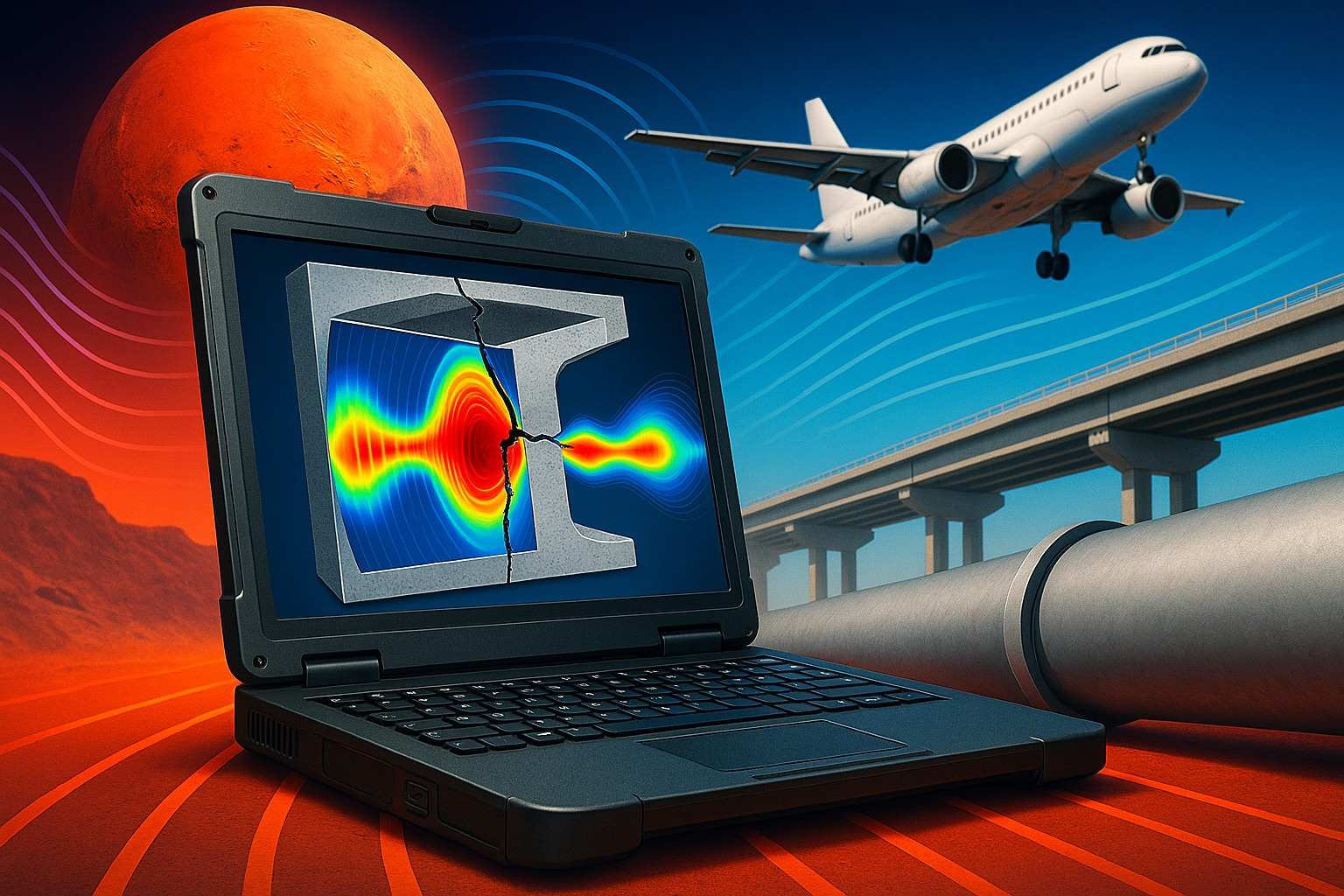

Swiss Startup Mondaic Adapts NASA Technology Used on Mars and Creates Software That Identifies Hidden Flaws in Bridges, Pipelines, and Aircraft.
A technology developed to explore Mars now protects essential structures on Earth. The wave physics software created by scientists associated with the NASA InSight mission evolved into a flaw detection tool for bridges, pipelines, and aircraft.
The driving force behind this transformation is the Swiss startup Mondaic, founded in 2018 by Christian Boehm, Michael Afanasiev, and Lion Krischer.
From Space Seismology to Earth Bridges
The trio was part of the Seismology and Wave Physics group at ETH Zurich. At the time, they used models and simulators to interpret seismic data from the red planet, revealing details of the Martian crust and core.
-
Spain Launches World’s Largest Floating Dry Dock: 56-Meter Giant Produces Massive Concrete Structures in A Coruña Using Technology Proven in Brazil

-
AI-powered toys that talk, recognize faces, and collect data face scrutiny from Brazilian government over children’s privacy concerns

-
4,000-Year-Old Child’s Skull Unveils Ancient Burial in 7,500-Year-Old Norwegian Rock Shelter, Impressing Archaeologists

-
Norway Defeats Brazil in World Cup but Invests Billions to Preserve the Amazon, Strengthens Amazon Fund, and Joins Brazil in Leading Global Effort Against Tropical Deforestation


Shortly after, came the insight: the same tools could be used to evaluate man-made structures. Thus, the idea to apply the technique to bridges, airplanes, and pipelines emerged, creating a non-invasive way to detect cracks, leaks, and other issues.
Boehm explains that the software sends ultrasonic waves through a solid object. Sensors record how the movement of the waves changes in the presence of internal irregularities. This data is compared with a perfect “digital twin” of the structure. If there is a difference, it indicates a flaw.
<p“For example, we use our software to simulate how a wave should traverse an intact pipeline. When the actual result differs, we find the problem,” says Boehm.
From the Laboratory to Practice
Turning research into a product was a challenge. The team needed to rethink the program to ensure stability, practicality, and total automation—from data collection to the final image revealing flaws.
Today, the platform runs in the cloud. This allows calculations that were once restricted to supercomputers to be done in minutes by common servers. As a result, the technology gained competitiveness and became suitable for everyday use outside of the academic environment.
Currently, Mondaic offers not only software. It provides sensors, specialized consulting, and cloud support, creating a complete package for infrastructure teams that lack knowledge in wave physics.
Applications Beyond Civil Engineering
The possibilities for use are diverse. The team recalls that the tools even helped discover a hidden corridor in the Great Pyramid of Egypt. The software has also been applied in seismic risk studies and even in monitoring nuclear tests.
In Switzerland, the startup maintains a partnership with the Federal Roads Office (FEDRO) to inspect bridges. The ultrasonic waves penetrate the concrete and reveal problems such as air pockets, water infiltrations, and defective joints, allowing repairs before damage escalates.
The aerospace sector has also entered the radar. Tests conducted with ETH Zurich and FHNW showed that the technology can identify manufacturing flaws in carbon fiber components used in aircraft.
Looking Ahead
Mondaic’s path shows how a tool created to probe another planet can gain importance on Earth. Christian Boehm summarizes with a phrase that mixes ambition and reality: “Perhaps one day, a component inspected by Mondaic will fly to Mars. Until then, we have much to do here on Earth.”
With this spirit, the startup continues to push the boundaries of wave technology, bringing an extra layer of safety to civil engineering and aviation—all inspired by the challenge of looking inside Mars.