






 Portuguese
  Spanish
  3 min of reading
  0 comments


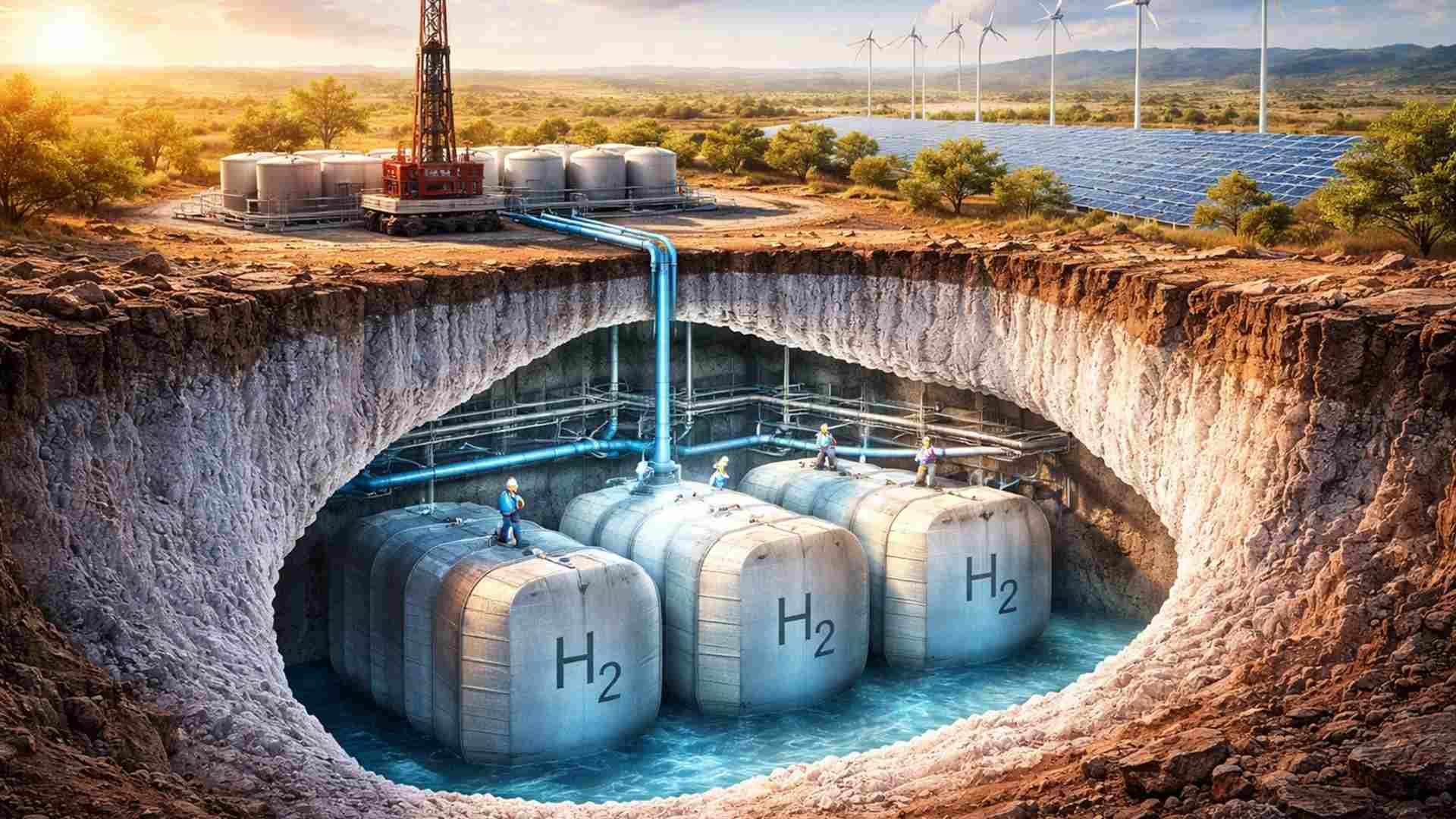
Oldest Salt Deposit Older Than Dinosaurs, Located in the Adavale Basin About Three Kilometers Deep, Can Store Up to 6,000 Tons of Hydrogen per Cave, Reaching 100 Gigawatt-Hours and Offering Large-Scale Alternative to Stabilize Renewable Energy in Australia
Under the dusty plains of inland Queensland, the oldest salt deposit older than dinosaurs, in the Adavale Basin, can store up to 6,000 tons of hydrogen per cave, equivalent to 100 gigawatt-hours, providing a massive-scale energy reserve alternative for Australia.
Buried beneath other basins and invisible on the surface, the rock formation predates dinosaurs. For decades, it remained practically ignored. Now, scientists point out that this geology could help address the challenge of storing renewable energy at scale in the country.
According to a government report, the Adavale Basin is underexplored but contains resources that could contribute to reducing emissions and meeting Australia’s modern energy needs.
-
At 22 years old, a young person from Recife creates an artificial intelligence startup with a team barely over 25, serves giants like Bayer and Ipiranga, earns millions without taking a cent from investors, and transforms a young company into a national AI phenomenon.

-
The invisible danger inside the house: plugging too many devices into the same outlet and spreading extensions throughout the rooms can overload the electrical network, silently heat wires, and turn a common habit into one of the leading causes of house fires.

-
Goodbye traditional laundry: Roborock launches washer and dryer with super hydrolysis, microbubbles, 99.99% sterilization, low-temperature drying, automatic detergent, app control, and cycles to remove stains, odors, mites, and bacteria from clothes.

-
It is now possible to generate energy without batteries: new flexible material transforms body heat into electricity and paves the way for more efficient, autonomous, and comfortable wearable devices, with the potential to revolutionize personal electronics in the coming years.



Australia is producing more electricity from solar and wind energy than ever before. However, sunlight and wind are unpredictable. When supply is high, excess can be wasted. When it falls, the grid needs backup energy.
Lithium-ion batteries help, but they are expensive and have limited capacity. Storing energy for hours is possible. Storing it for days, or at the scale of millions of houses, is more complex. The alternative may lie two or three kilometers deep.
Oldest Salt Deposit Older Than Dinosaurs in the Adavale Basin
The Adavale Basin was first identified in 1958. Geologists still describe it as underexplored. It is buried beneath the Eromanga Basin and the Galilee Basin, part of the Great Artesian Basin, one of the largest underground freshwater systems on Earth.
Unlike many geological formations, there are no evident markings on the surface indicating its presence. There are no dramatic cliffs or exposed layers. To understand what lies below, scientists need to drill.
Recently, Geoscience Australia completed a $31 million drilling campaign to investigate the basin’s potential. In November, the team drilled a well about three kilometers deep, setting a depth record for the agency.
From the bore, a continuous rock core was extracted measuring 976 meters, along with more than 500 rock fragment samples and several samples of groundwater. At the center of interest is a thick layer of rock salt known as the Boree Salt Deposit.
How the Salt Deposit Can Store Hydrogen
The Boree Salt Deposit is currently the only known salt layer in eastern Australia that appears to have sufficient thickness to store hydrogen at depth. The technique involves dissolving the salt with water to create underground caverns.
Engineers inject water to dissolve part of the salt and pump out the resulting brine. The process leaves an empty chamber underground. This cavity can then be used to store gases, such as hydrogen or compressed air.
Mitchell Bouma, director of Geoscience Australia, told ABC News that the salt can be dissolved and the resulting cavern used to store hydrogen. Although the concept may seem unusual, it is a well-established practice abroad.
Energy Scale and Comparison with Batteries
Hydrogen produced with renewable electricity can be injected into the caverns when supply is abundant. Later, when demand increases, the gas can return to the surface to generate energy.
Each cavern in the Adavale Basin could store about 6,000 tons of hydrogen. This amounts to approximately 100 gigawatt-hours of energy, a figure comparable to the sum of 50 of Australia’s largest grid-scale batteries.
Experts estimate that just a few of these caverns could provide enough electricity to power around 20 million homes for a day, based on average household demand in Brisbane.
International Experiences and Recent Findings
Hydrogen storage facilities in salt caverns have been operating abroad for decades. In the United States, a project in Utah is building two salt caverns designed to store 5,500 metric tons of hydrogen each.
The oldest salt deposit in the Adavale Basin remains under investigation. The recent drilling campaign and sample extraction deepened knowledge of its structure.
For Australia, the possibility of using underground caverns as energy reserves represents a geologically scalable alternative to conventional batteries, given the challenge of balancing renewable production and electrical demand.





-

-

2 people reacted to this.