





 Portuguese
  English
  Spanish
  2 min of reading
  0 comments



Brazilian Currency Achieves Historical Strength Against Argentina and Exposes Economic Fragility
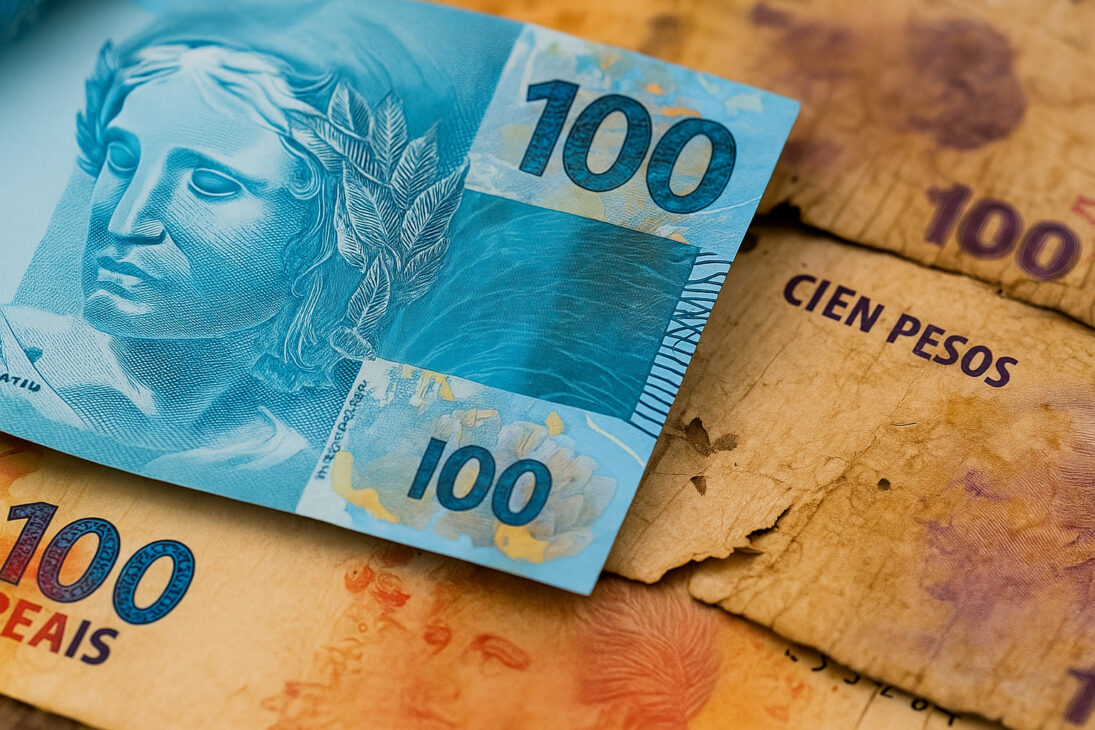
The real reached a record exchange rate against the Argentine peso this Monday (8). This occurred shortly after the defeat of Javier Milei’s party in the provincial elections in Buenos Aires.
Just in 2025, the Argentine currency has already accumulated a decline of 37% against the Brazilian one, according to official data released by the Central Bank of Argentina.
Argentine Peso Loses Value Quickly
Throughout the year, the Argentine peso has been experiencing successive devaluations. At the beginning of January 2025, one real bought 163 Argentine pesos.
-
While banks see the risk of default and difficulty in recovering financed motorcycles, the Lula government is considering using a guarantee fund to unlock credit for delivery workers; the measure could reach up to 1.2 million workers linked to digital platforms.

-
SpaceX sets share price at $135 and targets a historic $75 billion IPO to debut on Nasdaq with a trillion-dollar market value

-
While the world rushes to mine lithium from Congo and Chile, Brazil sits on one of the largest reserves and has barely begun to explore.

-
Heir worked at thirteen in an ice cream factory without revealing he was the owner’s son; today, at twenty-five, he leads the best-selling ice cream brand for home consumption in the Northeast, grosses almost R$ 300 million, has 145 stores, and competes with multinationals with regional flavors.


Now, after the election on Sunday (7), the same amount in reals became worth 262 pesos, according to figures from the foreign exchange market in Buenos Aires.
This exchange rate was recorded around 4:22 PM on Monday. Therefore, the Argentine currency continues on a path of significant loss, increasing internal pressures.
Electoral Defeat Pressures Milei Government
With almost 100% of the votes counted, the Peronist-Kirchnerist coalition National Force obtained 41.75% of the votes in the province of Buenos Aires.
Milei’s party, La Libertad Avanza (LLA), received only 34.15% of the electorate. Thus, the election on Sunday (7) was interpreted as a thermometer for the federal legislature.
The election is scheduled for October 26, 2025. As the province accounts for 40% of the Argentine electorate, the defeat represented a severe political blow to Milei.
The president is trying to maintain support for his reform agenda. However, the results increased uncertainty regarding his governability and the future of his economic project.
Declining Electoral Participation
The voter turnout rate was 63%, seven points below the rate recorded in 2021, according to Argentina’s Electoral Justice.
This data reinforced the perception of popular discontent and signaled weaknesses in Milei’s support base.
Moreover, experts emphasize that the election in Buenos Aires is strategic. It sets scenarios that can directly influence the national outcome in October.
Economic Crisis and Political Instability
The electoral defeat of Milei adds to structural problems in the Argentine economy, such as high inflation and scarcity of international reserves.
Additionally, corruption allegations involving his sister, Karina Milei, have increased the perception of instability and fueled currency devaluation.
Therefore, the Argentine peso has once again lost value against the real and also against the Chilean peso. These currencies are seen as safer in the region.
As a result, pressure on the Argentine economy is growing. The country has already been suffering from market distrust and political instability.
In light of this, analysts foresee greater difficulties in implementing economic reforms in the coming months.




-

-

7 people reacted to this.