






 Portuguese
  Spanish
  3 min of reading
  0 comments


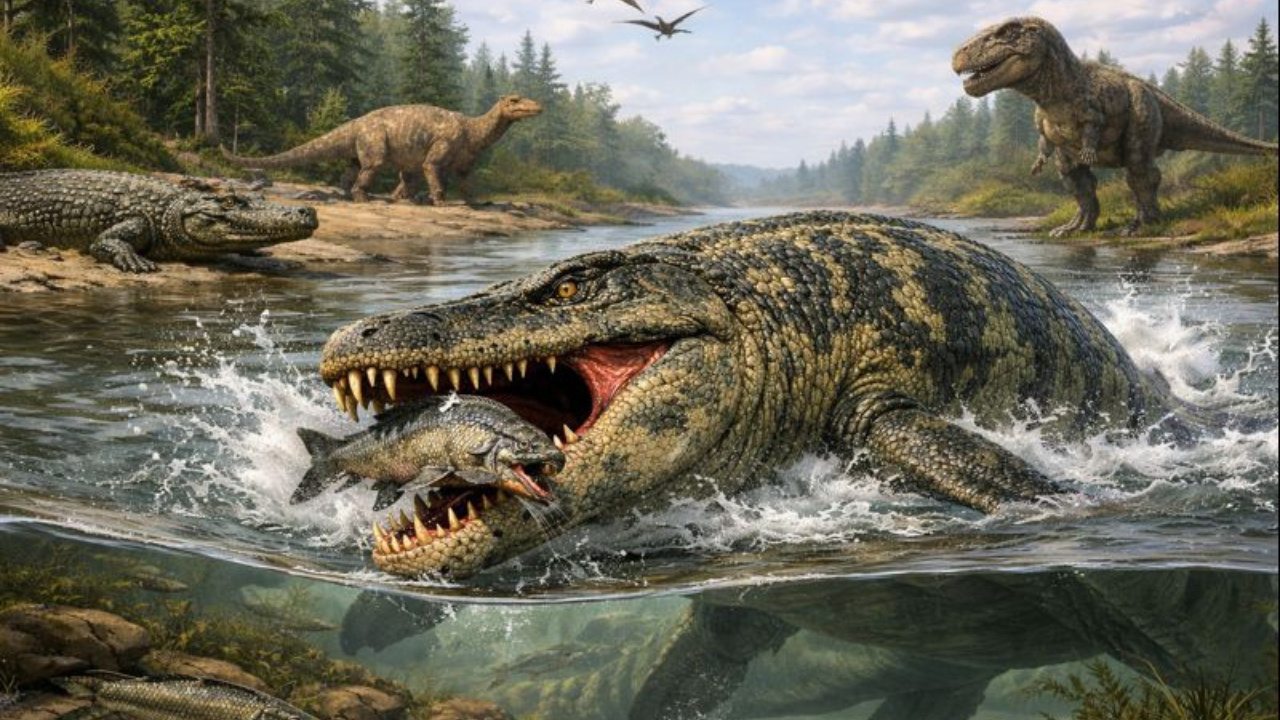
Mosasaurs Lived in Freshwater During the Cretaceous Period, According to Oxygen Isotope Analysis of Fossil Found in the USA.
A scientific discovery made in North America revealed that the mosasaurs, giant marine reptiles from the Cretaceous Period, did not only live in oceans, as was previously believed.
Researchers identified evidence that these superpredators spent their last years exploring freshwater rivers, coexisting with crocodilians and large terrestrial dinosaurs.
The finding was made from a fossil found in North Dakota, in the United States, and confirmed through oxygen isotope analysis, a chemical technique capable of indicating the environment in which the animal lived.
-
Invisible Induction Technology Enables Wireless Power for Blenders, Coffee Makers, and Air Fryers, Reducing Countertop Cables

-
Smart Outdoor Lighting Transforms Gardens into Living Spaces with Weather Resistance and App-Controlled Scenes

-
Green dot on top of smartphone intrigues users, signals privacy alert in Android 12 that experts say shouldn’t be ignored.
-
Humanoid Robot Climbs 6,263-Meter Volcano in Ecuador, Sets Sights on Everest Challenge





The discovery helps explain how these species reacted to rapid environmental changes before the mass extinction, about 66 million years ago.
Scientific Discovery Challenges What Was Known About Mosasaurs
For decades, mosasaurs were considered exclusively marine. These reptiles dominated the seas at the end of the Cretaceous Period, occupying the top of the food chain.
However, the new scientific discovery suggests a much more flexible behavior.
According to researchers, some of these animals began to explore riverine environments, demonstrating a greater capacity for adaptation than previously imagined.
This change in habitat indicates that mosasaurs not only survived in different environments but also actively hunted in freshwater.
Fossil Found in Area Dominated by Terrestrial Dinosaurs
The main evidence came from a large tooth found in river sediments in North Dakota.
The region is famous for dinosaur fossils such as the Edmontosaurus, known as the duck-billed dinosaur, and even the Tyrannosaurus rex.
The presence of a mosasaur fossil in this environment caught scientists’ attention. This is because it is not a coastal area, but an ancient river system.
The estimated size of the animal, possibly comparable to that of a bus, emphasizes the impact of the discovery on the understanding of these predators.
Oxygen Isotopes Confirm Freshwater Life
To rule out the hypothesis that the tooth was transported by marine currents, researchers resorted to oxygen isotope analysis.
This technique allows identification of whether an animal lived in salty or fresh water throughout its life.
The international team from Uppsala University compared the enamel of the mosasaur tooth with teeth from T. rex and a crocodilian jaw found at the same place and time.
Chemical Signature Indicates Adaptation Outside of Marine Environment
According to the study, the tooth showed elevated levels of the lighter oxygen isotope, O-16. This chemical composition is typical of organisms that lived in freshwater, not in marine environments.
“Oxygen isotopes (O-16): the mosasaur tooth contained exceptionally high levels of the lighter oxygen isotope, a chemical signature typical of freshwater environments, not marine.”
This evidence reinforces that the animal was alive and hunting in rivers, not just passing through the area after death.
What the Scientific Discovery Reveals About the Cretaceous Period
The presence of mosasaurs in freshwater indicates that deep environmental transformations marked the end of the Cretaceous Period.
Changes in sea level and climate forced highly specialized species to seek new ecological niches.
This adaptation may have been an attempt at survival in the face of an unstable world.
By sharing space with crocodilians and large dinosaurs, mosasaurs demonstrated a rare ecological plasticity among large predators.
Furthermore, the discovery expands the understanding of interactions between aquatic and terrestrial species before the mass extinction.
Impact of the Scientific Discovery on Paleontology
For science, the finding represents a significant advancement.
It not only changes what was known about mosasaurs, but also reinforces the importance of chemical methods, such as oxygen isotopes, in reconstructing the past.
The research paves the way for new investigations in other regions of the world, where similar fossils may be awaiting reinterpretation.
Thus, the scientific discovery in North Dakota redefines the role of these giants in the ecosystem of the Cretaceous Period and shows that, even at the end of the age of dinosaurs, life continued to find unexpected ways to adapt.






-

-

-

-

-

7 people reacted to this.